ICFs Convert
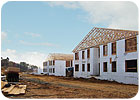
Two decades after he built his first apartment building and only two months into his first ICFs project, Richard Colasuonno has no intention of ever building another stick-frame building again.
Colasuonno serves as general contractor for the building side of Connolly and Colasuonno LLC, of which he is also partner. The firm owns 3,200 apartments in and around its Plainfield, N.J., headquarters.
And in a few months, that figure will grow by 200 when Colasuonno finishes Hillside Valley Apartments in Allentown, Pa. It is a sprawling 10-building complex that his 18-man crew began building in August.
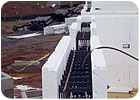
Concrete will be poured into the 10-inch space in these ICF forms. The 2.5-inch sheets of foam provide insulation against heat and cold as well as sound.
FITS LIKE A GLOVE
“This system fits us like a glove,” Colasuonno told Walls & Ceilings. “We believe that the ICFs system allows for a profit that is superior to conventional wood-framed structures. There is also a savings from the energy standpoint for the tenant.”When asked why he started using ICFs only a few months ago, Colasuonno laughed as he recalled his former skepticism. “I remember 20 years ago when we went to builders shows and walked past booths where ICFs were being displayed. I’d look, walk right past and say, ‘yeah right.’”
He acknowledged that like so many of his peers in the construction industry, change takes time: “We builders and developers don’t like to fall outside of convention and tradition.”
Quite aside from the major money he expects to save in energy costs once the buildings are finished, Colasuonno said a main reason he began investigating the possibility of using ICFs was that he didn’t much like having to subcontract out the concrete work for the foundations and basements.
“I like to use my own people for everything when I can. We have our own excavators, dozers, handling equipment, everything is ours,” Colasuonno explained. “On this project we are doing everything; site improvement, framing, roofing, siding, interior drywall, insulation, flooring. The only thing we are farming out is electric and plumbing. These licensed trades are always very independent, and I like to have everything under my roof.”
As he was scouting around trying to see if he could get his own crew to pour the foundations and basements, Colasuonno remembered that a contractor friend of his had used ICFs and was quite satisfied with the experience.
His friend’s referral led to a meeting earlier this year with Tom Reilly, regional sales manager of the Mid-Atlantic region for Reward Wall, a manufacturer of ICFs, held at Construction Supply Center in New Holland, Pa. Colasuonno brought a consultant and one of his lead supervisors.
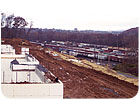
The sound-deadening properties of ICFs were a good solution to the prospect of continual noise from the railroad depot that is adjacent to one third of the buildings.
THE FIRST MEETING
Reilly recalls that first meeting and the fierce determination of Colasuonno to have his own crew do the masonry work in the Hillside project.“Richard was researching how to put in his own foundations,” Reilly said. “The initial concept was for Richard’s people to pour the basement so they would not have to bring in a mason to do the block. So we got to talking about how to self-perform, giving ideas of people who had done it before, and showed him sample product.”
The more Reilly talked, the more Colasuonno liked what he heard, and the next thing he knew, Colasuonno was sold not only on the idea of using ICFs for the basements, but taking the system all the way to the roofline.
“As we talked about maybe doing the entire structure and about the energy savings and sound abatement, we could see his eyes light up. A light bulb went off,” Reilly said.
As Colasuonno tells the story, “the rest is history.” He provided architectural drawings of the project to Reward Wall, which came back with its own take-offs, estimated quantities of product to do the job and an informal proposal.
“It doesn’t make sense for us not to do the buildings complete,” Colasuonno told Reilly when he committed.
The basement walls are 15-inches thick; 10 inches of concrete sandwiched between 2.5-inch sheets of foam. The walls from the basement to the roofline are all 11 inches thick; six inches of concrete between sheets of 2.5-inch foam.
Those massive walls, Colasuonno said, insulate well against heat and cold as well as sound. They have an R-32 value. “Conventional 2x4s have an R-value of 13 or 19,” he said.
The sound-deadening characteristics of the ICFs is very important, he said. “One-third of the project is adjacent to a railroad depot and there is a relatively constant in-and-out of trains, with all the squeaking and squealing. We’ve gotten used to it working here daily, but once you are inside the building, you don’t hear a thing,” he explained.
Each building is 22,500 square feet and contains ten 820-square foot 1-bedroom units and ten 1,130 square foot 2-bed, 2-bathroom units. Each building also has an interior 15-inch wall cutting it in half. “This wall gives us double what the fire requirements are,” Colasuonno said. “They wanted a two-hour rating and this is a four-hour rating.”
The exterior of the various buildings may vary, Colasuonno said, but plans at this point call for the fronts to have a cultured stone facade while the sides will be vinyl, possibly with some stone.
A ROUGH START
Construction began in August, after Colasuonno and three of his leads took a day of training from the manufacturer. Even so, the project got off to what Colasuonno called a “rough start.”“We were kind of taken aback by how long it was taking us. It took us three solid weeks to do the first foundation,” Colasuonno explained. “There were several ‘blowouts,’” when the foam walls of the system breaks from the pressure of the poured concrete.
But soon, they got the hang of it, and a crew of four men was delegated to work just with the ICFs.
Reilly said he’s been amazed at how smoothly things have been going. “They have turned this into an assembly line that is kind of neat to watch. In the first building they made some mistakes, but you can see they are getting faster and better with each building. Down the line you can see how it gets better and better.”
Colasuonno couldn’t have been happier: “We started about two and a half months ago and now we’re placing footings for the seventh foundation. The first and second buildings have roofs, the third is ready for roof trusses. Now, it’s clear sailing.”
Colasuonno said things have gone so well that, “a local developer came and asked us to do 54 units downtown for him. He heard about us, came over and is personally trying to purchase the property. We haven’t worked out the details, but he definitely wants to go with ICFs.
He had just inked an agreement that very week to build two other townhouse buildings, each 57,000-square-feet, in Franklin, N.J.
Looking for a reprint of this article?
From high-res PDFs to custom plaques, order your copy today!