Cinematic Soul
USC School of Cinematic Arts gets Old World charm from Southern California’s finest union plasterers.
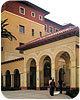
The USC School of Cinematic Arts is a state-of-the-art facility that instructs all levels of filmmaking techniques. Inside the 137,000-square-foot building are many lecture style halls, and theaters for film screening, numerous classrooms, editing rooms and sound mixing studios. The offices of the Dean of the School will also be housed in the new building. Building on skills for cinema, television and new media, the school also has undertaken an initiative that includes a mastery of moving image, sound and data-based resources, as well as text.
Second-generation plasterers Berger Bros. Inc., of Azusa, Calif., was awarded the subcontract to install metal stud framing, drywall (hanging and finishing), exterior Venetian plaster, lath and fireproofing. Berger was also awarded the contract to furnish and install all the pre-cast stone throughout the building, which was manufactured by Moonlight Molds Inc. Calply was the dealer that supplied the ClarkWestern Building Systems metal studs and lath, USG wallboard, and Westpac joint compounds, while Westside Building Materials supplied the Monokote and Variance plaster.
 The
original idea was to have the exterior walls constructed of 14 inch thick,
poured-in-place concrete in order to satisfy the extremely high sound-rating
requirements. The walls had to be soundproof and needed 14 inches of solid
concrete. However, general contractors Hathaway Dinwiddie had a different plan;
one that would save time and money-Shotcrete. Shotcrete is also known as
“Gunite” and similar to a swimming pool shell, the structure is strong and
provides superior sound attenuation.
The
original idea was to have the exterior walls constructed of 14 inch thick,
poured-in-place concrete in order to satisfy the extremely high sound-rating
requirements. The walls had to be soundproof and needed 14 inches of solid
concrete. However, general contractors Hathaway Dinwiddie had a different plan;
one that would save time and money-Shotcrete. Shotcrete is also known as
“Gunite” and similar to a swimming pool shell, the structure is strong and
provides superior sound attenuation.
“The entire exterior was hand-troweled to complete that old world look,” says Juan Morales, Berger Bros. plaster foreman.
“The reason the high sound ratings is that they have theaters inside the building that are pretty large,” says Berger Bros. President Michael Berger. “So, the acoustics were very primary on this project and that’s what drove the whole exterior having such thick walls.”
Berger went on further about how a general contractor can make or break a job for subcontractors and how Hathaway Dinwiddie is one of the best at supervision and managing coordination between subcontractors.
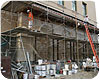
“I think originally they wanted all the architectural detail pieces to be real stone accents but for cost reasons, the compromise was to use pre-cast,” says Berger.
Moonlight Molds was called upon to cast the stone features that made the project have that “Old World” feeling. These are not the lightweight foam shapes many of us are accustomed to, but full cement, making them heavy and not that easy to install.
Another fascinating aspect to the 8,500 pieces of pre-cast stone was how to attach them to the Shotcrete exterior. The method was a combination of adhesive and steel pins attached on site. Holes were drilled into the Shotcrete and filled with an extremely strong epoxy adhesive, which held the steel pins. Moonlight Molds has vast experience at this type of work as they create similar molds for Hollywood and Las Vegas on a daily basis.
Morales commented that his crew of plasterers used approximately 17 different hand trowels, many of which he made himself to create new textures or to work in certain confined spaces. Variance Acrylic Finishes was used on the exterior and its team worked with Berger Bros. to achieve the desired look.
“A product called Anciano was used as the primary finish. It was used on the walls and upper tile pattern that surrounds the structure,” says Garrnett Baca, of Variance. “Another plaster product called Alto was used to create the appearance of ‘colored grout’ in the tile pattern. A color-wash product called VariStain was used on both the main walls and the upper tile band during the final part of the application process to create a mottled, aged appearance.”

Micah Carrol, of Variance, says that during the process of creating samples the companies were having a difficult time producing the exact look that UDG wanted for the upper band of “simulated stone tile” that surrounds the building. Real stone tile was not an option, due to the fact that the campus is in a high seismic zone and tiles falling on students were unacceptable. The process was to coat the upper bands with a skim of Alto and let them dry. Grout lines were created by applying masking tape in a diagonal grid pattern. Another skim coat of plaster was applied over the grout plaster and the masking tape. After the plaster set sufficiently, an additional spray coat was added for texture. The completely covered tape, which was custom ordered, was carefully exposed using precise measurements taken prior to applying plaster. The exposed underline grey coat, gave the visual effect of grout lines. The end result was an upper band of a tile-looking wall, which was not tile at all; another Hollywood illusion perfected. Berger Bros., working with Variance, ended up switching from a trowel-applied technique to a spray-applied technique on the tile areas. This increased productivity while maintaining the look they were trying to achieve.
“Once the samples and full-size mock-ups were approved, the application went pretty smoothly. This is due largely to the efforts of one of the most talented plasterers we have ever dealt with, namely Juan Morales and his crew,” says Carroll. “He and his team of craftsmen required virtually no technical support after they started, which is not typical when working with the relatively complex finish system that was developed specifically for this project.” The talent of these journeymen was is in large part due to the Apprenticeship programs by Local 200, the Operative Plasterers and Cement Masons and their commitment to training in a variety of plastering techniques.
As the School of Cinematic Arts is now opening its doors, the next project, Phase 2, will begin. This will expound on USC’s campus and have four separate buildings that connect to this first new building.
In a related note: This project has won the Western Wall and Ceiling Contractors Association Award for Exterior Institutional by a Wall and Ceiling Contractor. It is fitting that Berger Bros. receives this award in 2009, as the company started in 1959 and is celebrating its 50th anniversary. With offices in Los Angeles and San Francisco, and an average of 400 employees on the payroll, the company is sure to be a driving force in the California wall and ceiling industry for many years to come. W&C
The USC School of Cinematic Arts is a state-of-the-art facility that instructs all levels of filmmaking techniques. Inside the 137,000-square-foot building are many lecture style halls, and theaters for film screening, numerous classrooms, editing rooms and sound mixing studios. The offices of the Dean of the School will also be housed in the new building. Building on skills for cinema, television and new media, the school also has undertaken an initiative that includes a mastery of moving image, sound and data-based resources, as well as text.
Second-generation plasterers Berger Bros. Inc., of Azusa, Calif., was awarded the subcontract to install metal stud framing, drywall (hanging and finishing), exterior Venetian plaster, lath and fireproofing. Berger was also awarded the contract to furnish and install all the pre-cast stone throughout the building, which was manufactured by Moonlight Molds Inc. Calply was the dealer that supplied the ClarkWestern Building Systems metal studs and lath, USG wallboard, and Westpac joint compounds, while Westside Building Materials supplied the Monokote and Variance plaster.
“The entire exterior was hand-troweled to complete that old world look,” says Juan Morales, Berger Bros. plaster foreman.
“The reason the high sound ratings is that they have theaters inside the building that are pretty large,” says Berger Bros. President Michael Berger. “So, the acoustics were very primary on this project and that’s what drove the whole exterior having such thick walls.”
Berger went on further about how a general contractor can make or break a job for subcontractors and how Hathaway Dinwiddie is one of the best at supervision and managing coordination between subcontractors.
TO THE MOON AND BACK
What makes this building very unique is its Old World exterior finish. Mike Armas, general foreman and Sean Cooney, general superintendent for Berger Bros. noted that with the 8,500 pieces from Moonlight Molds, “It was like putting together a giant jigsaw puzzle.” The project would not have been possible without the help of Moonlight Molds.“I think originally they wanted all the architectural detail pieces to be real stone accents but for cost reasons, the compromise was to use pre-cast,” says Berger.
Moonlight Molds was called upon to cast the stone features that made the project have that “Old World” feeling. These are not the lightweight foam shapes many of us are accustomed to, but full cement, making them heavy and not that easy to install.
Another fascinating aspect to the 8,500 pieces of pre-cast stone was how to attach them to the Shotcrete exterior. The method was a combination of adhesive and steel pins attached on site. Holes were drilled into the Shotcrete and filled with an extremely strong epoxy adhesive, which held the steel pins. Moonlight Molds has vast experience at this type of work as they create similar molds for Hollywood and Las Vegas on a daily basis.
Morales commented that his crew of plasterers used approximately 17 different hand trowels, many of which he made himself to create new textures or to work in certain confined spaces. Variance Acrylic Finishes was used on the exterior and its team worked with Berger Bros. to achieve the desired look.
“A product called Anciano was used as the primary finish. It was used on the walls and upper tile pattern that surrounds the structure,” says Garrnett Baca, of Variance. “Another plaster product called Alto was used to create the appearance of ‘colored grout’ in the tile pattern. A color-wash product called VariStain was used on both the main walls and the upper tile band during the final part of the application process to create a mottled, aged appearance.”
STAR DOME
When the small samples were approved by the architects Urban Design Group and university representatives, Berger Bros. then made larger, more representative samples to allow the design team to fully realize their vision.Micah Carrol, of Variance, says that during the process of creating samples the companies were having a difficult time producing the exact look that UDG wanted for the upper band of “simulated stone tile” that surrounds the building. Real stone tile was not an option, due to the fact that the campus is in a high seismic zone and tiles falling on students were unacceptable. The process was to coat the upper bands with a skim of Alto and let them dry. Grout lines were created by applying masking tape in a diagonal grid pattern. Another skim coat of plaster was applied over the grout plaster and the masking tape. After the plaster set sufficiently, an additional spray coat was added for texture. The completely covered tape, which was custom ordered, was carefully exposed using precise measurements taken prior to applying plaster. The exposed underline grey coat, gave the visual effect of grout lines. The end result was an upper band of a tile-looking wall, which was not tile at all; another Hollywood illusion perfected. Berger Bros., working with Variance, ended up switching from a trowel-applied technique to a spray-applied technique on the tile areas. This increased productivity while maintaining the look they were trying to achieve.
“Once the samples and full-size mock-ups were approved, the application went pretty smoothly. This is due largely to the efforts of one of the most talented plasterers we have ever dealt with, namely Juan Morales and his crew,” says Carroll. “He and his team of craftsmen required virtually no technical support after they started, which is not typical when working with the relatively complex finish system that was developed specifically for this project.” The talent of these journeymen was is in large part due to the Apprenticeship programs by Local 200, the Operative Plasterers and Cement Masons and their commitment to training in a variety of plastering techniques.
As the School of Cinematic Arts is now opening its doors, the next project, Phase 2, will begin. This will expound on USC’s campus and have four separate buildings that connect to this first new building.
In a related note: This project has won the Western Wall and Ceiling Contractors Association Award for Exterior Institutional by a Wall and Ceiling Contractor. It is fitting that Berger Bros. receives this award in 2009, as the company started in 1959 and is celebrating its 50th anniversary. With offices in Los Angeles and San Francisco, and an average of 400 employees on the payroll, the company is sure to be a driving force in the California wall and ceiling industry for many years to come. W&C
Looking for a reprint of this article?
From high-res PDFs to custom plaques, order your copy today!