Cracking the Code: The Thickness of Plaster
What is the correct thickness of cement plaster (stucco)?

That is a complicated question and looking at the code and referring to thickness tables provides even more confusion. In addition, many consultants and experts in the litigation field try to make it simple and absolute in an attempt to crucify the plastering contractor. This is not to say all plastering contractors apply plaster at the correct intended thickness. Some plastering contractors cheat and should be brought to the carpet. However, many plastering contractors are good people doing what is intended by the code and then are held to an impossibly unrealistic and misunderstood standard. I have often seen samples removed from a wall, then measured by forensic experts with calipers to see if the thickness violates the code. Not surprising to me, it almost always is in non-conformance. I can promise you if you take enough samples of stucco from a wall-no matterhow good the application-it can be proven to violate the code. Why? I will explain and I will also provide a more fair and honest method to measure true plaster thickness.
The code seems confusing, as it calls for all Portland cement plaster to be anywhere from 3/8-inch to 7/8-inch finished thickness per IBC, ASTM C 926 and IRC Table R702.1. And then, from where do you measure the thickness? The code is all over the place, the back plane of the lath, the face of the support or backing. Here are the basic simple rules to follow to be code and industry compliant.
That is a complicated question and looking at the code and referring to thickness tables provides even more confusion. In addition, many consultants and experts in the litigation field try to make it simple and absolute in an attempt to crucify the plastering contractor. This is not to say all plastering contractors apply plaster at the correct intended thickness. Some plastering contractors cheat and should be brought to the carpet. However, many plastering contractors are good people doing what is intended by the code and then are held to an impossibly unrealistic and misunderstood standard. I have often seen samples removed from a wall, then measured by forensic experts with calipers to see if the thickness violates the code. Not surprising to me, it almost always is in non-conformance. I can promise you if you take enough samples of stucco from a wall-no matterhow good the application-it can be proven to violate the code. Why? I will explain and I will also provide a more fair and honest method to measure true plaster thickness.
The code seems confusing, as it calls for all Portland cement plaster to be anywhere from 3/8-inch to 7/8-inch finished thickness per IBC, ASTM C 926 and IRC Table R702.1. And then, from where do you measure the thickness? The code is all over the place, the back plane of the lath, the face of the support or backing. Here are the basic simple rules to follow to be code and industry compliant.
CONCRETE OR MASONRY
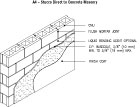
First and foremost, the substrate is recommended to be at a tolerance of 1/4-inch in 10 feet. Anything that exceeds that tolerance will force the plastering contractor to apply plaster to a thickness that may violate code. Wall and ceiling contractors should be aware of this and supply letters to protect themselves prior to proceeding with the application of plaster. Plaster over concrete or masonry is referred to as a maximum thickness. Without lath, the maximum is 5/8-inch for walls and 1/8-inch for ceilings. Plaster may be applied thicker, if lath is used.FRAMED CONSTRUCTION
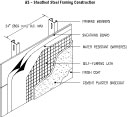
The minimum thickness over framed walls is 3/4-inch. Most all fire-rated assemblies require 7/8-inch and some require a full 1-inch thick cement plaster. Always refer to the fire-rated assembly test before making an assumption. One-coat systems may be applied as thin as 3/8-inch. However, the material used must be the proprietary product and it must be installed per manufacturer’s code evaluation report.INTENDED THICKNESS
Many experts have measured the thickness of the plaster and claimed it to be non-code compliant. This is particularly true for plaster on framed walls with building paper. The building paper will wrinkle when wet. This causes shallow waves in the back of the plaster. A uniform thickness is impossible and the undulations in the plaster make the membrane vary in actual thickness. The best way to determine the thickness is to measure the thickness of the plaster grounds. This is the “intended” thickness of material the plasterer was trying to achieve. Wall undulations, imperfections and paper wrinkles are beyond his control.Looking for a reprint of this article?
From high-res PDFs to custom plaques, order your copy today!