Walls & Ceilings logo
search
cart
facebook twitter linkedin youtube youtube Spotify Podcasts Apple Podcasts Spotify Podcasts Apple Podcasts
  • Sign In
  • Create Account
  • Sign Out
  • My Account
Walls & Ceilings logo
  • NEWS
  • TOPICS
    • Drywall
    • Stucco/EIFS
    • Ceilings
    • Steel Framing
    • Fireproofing
    • Interior Plaster
    • Building Envelope
    • Insulation
    • Technology
    • Interior
    • Exterior
    • Women In Construction
  • COLUMNS
    • Up Front
    • All Things Gypsum
    • Art & Craft of Plastering
    • Stucco Stop
    • Steel Deal
    • Industry Voices
  • PRODUCTS
    • Buzz Guide
  • EVENTS
    • Industry Events
    • Webinars
    • BUILD Expo
  • MEDIA
    • Videos
    • Podcasts
    • Photo Galleries
    • BUILD26 Videos
    • Take our Quiz!
    • Infographics
  • EXCLUSIVE
    • Newsletters
    • Top 50 Contractors
    • Contractor of the Year
    • State of the Industry
    • W&C Store
    • Market Research
    • CEUs
    • Sponsor Insights
    • Custom Content & Marketing Services
  • DIRECTORY
  • EMAGAZINE
    • eMagazine
    • Advertise
    • Archive Issues
  • SIGN UP!
ColumnsAll Things Gypsum

All Things Gypsum

The "Corridor Lid" Rule
By Michael Gardner
All Things Gypsum
Walls & Ceilings
November 1, 2008
Detail from Gypsum Association

One of the most basic principles of fire-rated assembly application is addressed in the Fire Resistance Design Manual (GA-600) with a simple phrase: “systems tested vertically shall not be permitted to be arbitrarily used in horizontal orientation.”

Since heat rises and a wall system and ceiling system are on different planes, the rule makes sense. Reviewing the ASTM E119 test method further reinforces the logic of the rule, since the furnace orientation for fire testing a wall and a ceiling is different.

Enforcement of the concept precludes the use of a wall system as a substitute for a ceiling system when fire-resistant construction is required. And in nearly every situation, that concept is iron-clad. The text of GA-600 contains no exceptions to the rule.

The only real relief from the rule is found in Section 708.4 of the International Building Code and is commonly known as the “corridor lid” rule. The specific language in the IBC allows for a wall to be used as a corridor ceiling when the ceiling is constructed “as required for the corridor walls.”

KEEP A LID ON IT
Detail from Gypsum Association

The lid rule originated in the Uniform Building Code and was carried into the first version of the IBC in 2000 when the three predecessor regional codes were melded into the International family of codes. It has always been codified as an exception to the basic rule that requires full vertical continuity of a fire partition.

The rule appears to have been placed into the UBC to facilitate the installation of corridors in the instance where equipment and wiring would necessitate the creation of numerous penetrations in the corridor walls above a ceiling line. Rather than creating walls that are so riddled with penetrations so as to be almost unsealable, code language took the approach that terminating the corridor walls at a rated ceiling and creating a safe, U-shaped egress envelope would not compromise life safety. Thus, the lid rule was born.

The 1988 Handbook to the Uniform Building Code describes the concept: “In all probability, typical wall construction, when tested in a horizontal position, might not pass the one-hour test. However, this arrangement is considered to be adequate protection for the corridor separating it from the spaces above.” Notice that the handbook clearly states that the horizontal wall might not pass a fire test, but does not consider that to be an abridgement of life safety.

And, to repeat a notion stated earlier, that concept makes sense for it can be difficult to construct a floor- or roof-ceiling system the width of a corridor using a conventional tested ceiling system. Since they are more commonly used as structural elements of a building, floor-ceiling systems generally incorporate large structural members, an attribute that would make them unwieldy to construct in a limited or narrow area.

The lid rule is contained in the Section of the IBC that defines requirements for fire partitions; walls that are generally used to create corridors and separate dwelling units in the same building. Fire partitions are required to have a rating of not less than one hour.

In the 2007 IBC Supplement, the lid rule is defined by Exception 3 to Section 708.4 of Chapter 7. As noted previously, Section 708.4 defines continuity requirements for a fire partition and mandates that a fire partition “extend from the top of the foundation or floor/ceiling assembly below to the underside of the floor or roof sheathing, slab, or deck above or to the fire-resistance-rated floor/ceiling or roof/ceiling assembly above …”

ILLUSTRATIONS

Exception 3 modifies this rule when it allows for a circumstance where “… the corridor ceiling is constructed as required for the corridor walls, the walls shall be permitted to terminate at the upper membrane of such ceiling assembly.” While the grammar may be a bit odd, the concept is pretty clear: build a wall over the corridor with a rating the same as the corridor walls, and the walls can terminate at the corridor ceiling.

Figure 1 shows the concept graphically. Note how the walls extend to the underside of the ceiling and the area above the corridor is open to the underside of the structure above.

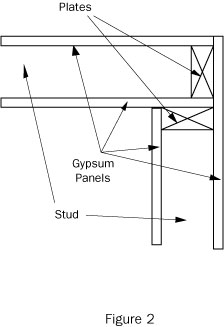
One issue with the lid rule is the language that requires the wall to “terminate at the underside of … the ceiling assembly.” Neither the code nor the IBC commentary provides any interpretation or explanation of how that is to be accomplished, so it can be a cause of dispute at times. In general, what is typically required, at a minimum, is that the gypsum panels on the outside face of the corridor walls-the room side of the tunnel-extend up to a corner where they meet to form an outside angle with the layer of board that is installed on the top of the corridor ceiling. In addition, the ceiling is constructed as if it was a separate wall that is placed entirely on the top of the corridor walls so that the bottom panel on the ceiling extends over and above the top plates of the walls.

In essence, the junction point where the outside panel on the wall and the panel on the top of the ceiling meet looks like an outside corner where two rated one-hour walls meet, except that the entire detail has been rotated 90 degrees to the vertical. Figure 2 provides a graphic representation of the concept. Note the positioning of the bottom panel on the ceiling as it rests on the top plate of the wall and that the outside panel on the wall extends completely through to the panel that has been installed on the top face of the ceiling. All joints in the system are sealed with at least one coat of joint treatment material.

Since creating the head and corner details can be the source of some interpretation, it is advised that a local code official be consulted prior to construction of the corridor.

Constructing a rated corridor wall that contains a myriad of penetrations can be a difficult task. Suggesting an option to incorporate the lid rule concept as outlined in Section 708 of the IBC might be a viable option on a future non-residential project. W&C

KEYWORDS: fire resistance gypsum Gypsum Association manuals and handbooks

Share This Story

Looking for a reprint of this article?
From high-res PDFs to custom plaques, order your copy today!

Michael Gardner is the president of M Gardner Services LLC, a consulting firm that assists organizations with issues involving industry standards and building codes, meeting management, and external collaboration and outreach. Prior to establishing MGS, he was the executive vice president of Compliance Programs for the International Code Council. He is also the former CEO of the Gypsum Association, currently serves as a special technical advisor to the Wall & Ceiling Alliance and can be reached at michael@mgardnerservices.com.

Recommended Content

JOIN TODAY
To unlock your recommendations.

Already have an account? Sign In

  • Abercrombie & Fitch

    EIFS in 2026: How Specialty Finishes Are Redefining Exterior Wall Systems

    As building codes, owner expectations, and design demands...
    Stucco/EIFS
    By: Regi Mendoza
  • proper air and vapor control

    From Energy Efficiency to Moisture Management: Why Air and Vapor Control Matter

    How proper air and vapor control within building...
    Building Envelope
    By: Benjamin Meyer AIA, LEED AP
  • Linear Metal Ceiling Beam Baffles

    Top 25 Ceiling Contractors of 2026

    Suspended ceilings demand precision, code compliance and...
    Ceilings
    By: John Wyatt and Tanja Kern
You must login or register in order to post a comment.

Report Abusive Comment

Manage My Account
  • eMagazine Subscription
  • Newsletters
  • Online Registration
  • Manage My Preferences
  • Subscription Customer Service

More Videos

Sponsored Content

Sponsored Content is a special paid section where industry companies provide high quality, objective, non-commercial content around topics of interest to the Walls & Ceilings audience. All Sponsored Content is supplied by the advertising company and any opinions expressed in this article are those of the author and not necessarily reflect the views of Walls & Ceilings or its parent company, BNP Media. Interested in participating in our Sponsored Content section? Contact your local rep!

close
  • medical professionals moving a patient on a stretcher through the halls of a medical building
    Sponsored byNational Gypsum Company

    What Does High Performance Mean When It Comes To Gypsum Boards?

Popular Stories

Linear Metal Ceiling Beam Baffles

Top 25 Ceiling Contractors of 2026

Wichita Biomedical Campus

Wichita Drywall Worker Dies After Scaffolding Fall

Construction workers in safety vests install drywall

Gypsum Sales Hold Amid Market Shifts in the U.S.

QXO Just Changed the Game-Here's What Contractors Are Asking

QXO Just Changed the Game-Here's What Contractors Are Asking

Events

June 24, 2026

The Bright Side & Benefits of Designing with Integrated Lighting

Credits 1 AIA LU/HSW; 0.1 ICC CEU

This course will explore the pivotal role architects and lighting design play in creating safer, more sustainable spaces. Learn how to avoid common lighting mistakes and make informed decisions that create the best visual environment for occupants. 

January 1, 2030

Webinar Sponsorship Information

For webinar sponsorship information, visit www.bnpevents.com/webinars or email webinars@bnpmedia.com.

See our full library of webinars

View All Submit An Event

Products

2026 National Painting Cost Estimator

2026 National Painting Cost Estimator

See More Products

Related Articles

  • All Things Gypsum: Where is it in the Code?

    See More
  • The Wall is Bent

    See More
  • The Past is History

    See More

Related Products

See More Products
  • building codes illustated.jpg

    Building Codes Illustrated: A Guide to Understanding the 2021 International Building Code, 7th Edition

  • Lean Builder book cover - front.jpg

    The Lean Builder

See More Products

Related Directories

  • The QUIKRETE Companies

    Concrete and mortar mixes, cements; concrete repair products, stucco, waterproofing, tile setting and blacktop products, floor underlayments and overlayments, sand and aggregates, concrete coatings, shotcrete products, bulk products, and other seasonal items.
×

Connect with the industry’s leading resource for unparalleled insights and education.

Join thousands of industry professionals today. Shouldn’t you know what they know?

JOIN NOW
  • RESOURCES
    • Advertise
    • Contact Us
    • Directories
    • Store
    • Want More
  • SIGN UP TODAY
    • Create Account
    • eMagazine
    • Newsletters
    • Customer Service
    • Manage Preferences
  • SERVICES
    • Marketing Services
    • Reprints
    • Market Research
    • List Rental
    • Survey/Respondent Access
  • STAY CONNECTED
    • LinkedIn
    • Facebook
    • Instagram
    • YouTube
    • X
  • PRIVACY
    • PRIVACY POLICY
    • TERMS & CONDITIONS
    • DO NOT SELL MY PERSONAL INFORMATION
    • PRIVACY REQUEST
    • ACCESSIBILITY

Copyright ©2026. All Rights Reserved BNP Media, Inc. and BNP Media II, LLC.

Design, CMS, Hosting & Web Development :: ePublishing