All Things Gypsum: Gypsum Roof Underlayment Redux
We first ran this column in the November 2004 issue of Walls & Ceilings. Since then, the Gypsum Association has conducted an ongoing public relations campaign designed to broaden awareness of gypsum area separation walls and gypsum roof underlayment. During this period several other events have transpired. First, the model codes have moved away from the term “Area Separation Wall” and have moved toward the more encompassing term “Firewall.” Second, the Gypsum Association has recently extended its awareness campaign into Canada, where the term “Firewall” is also preferred.
As these terms change, we want to reinforce the idea that no matter what one calls the building system designed to prevent fire from moving on to an adjacent unit, the use of gypsum roof underlayment should be considered as an alternative to the construction of a parapet as part of that system. Finally, the association recently released a revised and award-wining version of its Miracle Mineral video (GA-540V) on DVD, which features one of the three systems described in the following article. Since the release of the DVD, we have fielded several questions about that system and the other two systems, so we’re taking this opportunity to revisit the topic.
An area separation wall used to separate townhouse units is almost always required by model building codes to withstand exposure to fire for two hours. It must also be designed so that in the event of a fire, it will permit the collapse of the burning building while leaving the adjacent building protected and intact. To further prevent the spread of fire from one building to the next, model codes typically require that an area separation wall rests on the foundation and extends 30 inches beyond the roof as a parapet.
There are several exceptions to this parapet requirement all of which allow the parapet to be eliminated, and one of which involves the use of 5/8-inch type-X gypsum board as roof underlayment. When using this exception, the area separation wall extends continuously from the foundation to the underside of the roof sheathing and gypsum board underlayment is installed between the combustible roof sheathing (usually plywood or oriented strand board) and the building below. When using this exception, the gypsum board underlayment must extend at least 4 feet in either direction from the intersection of the wall and the roof; there must be no penetrations through the roof in that area; and the roofing material must carry either a B or a C rating (depending upon the applicable code).
Using the gypsum board underlayment exception offers a key advantage to building a parapet: a parapet must be meticulously installed and properly flashed and sealed so as not to create opportunities for moisture intrusion and the resultant water damage and mold infestation. Using the gypsum board underlayment approach keeps the plane of the roof intact, thus eliminating the opportunity for moisture intrusion that the use of a parapet provides.
THREE METHODS
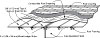
The gypsum industry has developed three code-compliant methods for installing gypsum roof underlayment: the Ledger Strip Method, The Partial Roof Underlayment Method, and the Full Roof Underlayment Method.The Ledger Strip Method (see Figure 1) uses 5/8-inch-thick pieces of type X gypsum board that fit snuggly between the roof rafters or trusses, and sit directly under the roof sheathing. The gypsum board is supported on its underside by 2-inch-by-2-inch ledger strips that are attached to the sides of the roof framing members. The ledger strips are attached to the framing leaving sufficient space from its top edge to allow the upper face of the gypsum board to sit flush with the top of the trusses or rafters. Once positioned tightly between the framing and so that end joints that span between framing members fit together snugly, the gypsum board is attached to the ledger strips with minimum 1¼-inch long fasteners spaced a maximum of 48 inches on center.
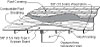
The Partial Roof Underlayment Method (see Figure 2) places 5/8-inch type-X gypsum board panels a width of 4 feet (more or less depending on the applicable code requirement) on either side of the wall/roof intersection under the combustible roof sheathing.
Prior to the application of the roof sheathing, each 5/8-inch type-X gypsum panel is applied to the roof framing with the long edges oriented parallel with and placed over the framing members. Each panel must be nailed to each framing member with no fewer than two nails. The nails used to attach the panels to the framing must be at a minimum 1⅜-inch long gypsum board nails or 4d common nails. Panel edges and end joints must butt tightly. Roof framing not covered with gypsum panels must be shimmed to bring the framing surface level with the surface of the gypsum panels so that the sheathing material remains flat once installed. Alternately, instead of shimming, different sizes of framing may be used to produce a uniform sheathed surface. Joints in the sheathing must be offset from the joints in the gypsum underlayment; fasteners used to attach sheathing over the gypsum underlayment or shimmed areas must be an additional 5/8 inch longer to ensure proper penetration into the framing.
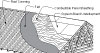
The Full Roof Underlayment Method (see Figure 3) is achieved by applying a layer of 5/8-inch-thick type X gypsum board over the entire roof area. The gypsum panels are applied perpendicularly over the roof framing before the roof sheathing is installed. The end joints of the gypsum panels must be positioned over and supported by the framing members. As with the partial roof underlayment method, nails used to attach the gypsum panels to the roof framing must be at a minimum 1⅜-inch long gypsum board nails or 4d common nails. Also as in the previously described method, the fasteners used to attach the roof sheathing must be increased by 5/8-inch in length to include the thickness of the gypsum board. Joints between the roof sheathing panels must be staggered to avoid coinciding with the joints between the gypsum panels.
The full roof underlayment method provides several benefits over the two previously described methods: it offers the highest degree of fire protection of the three designs; it is the simplest of the three methods to install; and it is generally more cost effective than the other two methods once the labor outlays are included.
Unlike fire-resistance rated systems for walls and ceilings using gypsum board, the joints in all three gypsum board roof underlayment systems do not require taping and finishing to provide the code recognized fire protection. Similarly, it is not necessary to treat the fasteners used to attach the gypsum pieces or panels to the roof framing. Additionally, screws may be used in lieu of the prescribed nails when the screw length and head diameter equal or exceed the length and head diameter of the nails specified, provided that the screw spacing does not exceed the required nail spacing.
Modifications to recent editions of the International Building Code allow for the elimination of parapets in many different types of construction occupancies other than townhouses and multi-family residential dwellings. The judicious use of the parapet exception rules can provide many alternatives for a knowledgeable contractor or builder. Not only is using one of the gypsum board roof underlayment methods a very cost effective way to provide substantial additional fire protection for townhouse construction, doing so also eliminates a potential entry point for moisture intrusion, something most builders wishing to reduce their liability for mold infestation should welcome. W&C
Looking for a reprint of this article?
From high-res PDFs to custom plaques, order your copy today!