Sound Proof
Gypsum floor underlayments provide noise control and much more.
Today, when constructing multi-level buildings, poured floor underlayments are selected for four major reasons: 1) to provide a level surface for the finished floor, 2) to add fire resistance to the floor construction, 3) to add sound control between floors of the building, and 4) to add thermal mass to the floor (e.g. when used with a radiant floor heating system).
According to the International Building Code, ceiling/floor assemblies in multi-level residential units must be built to achieve sound ratings of STC50 and IIC50. Sound Transmission Class tells how well the assembly blocks airborne sound from passing through it. Impact Isolation Class tells how well the assembly prevents impacts on the floor above (such as from the patter of little feet) from causing noise in the room below. Designers can meet this requirement by either using an assembly that a manufacturer has already tested in a lab or by testing the actual assembly in the building after it has been constructed.
To achieve a high IIC rating, a floor/ceiling assembly must be heavy enough to resist acting like a trampoline when someone jumps up and down on it. Typically, this is a concern with subfloor-on-joist construction. In addition, the upper layer of the floor/ceiling assembly must be cushioned enough to prevent vibrations from traveling through the structure when someone tap dances on it. This is typically a concern for concrete slab construction.
The easiest way to deaden tap dancing noise is to install carpet on the floor. In fact, be careful when comparing IIC test data to make sure that a big jump in IIC rating is not due mainly to the use of carpet. A concrete slab floor with a carpet finish is an easy way to achieve high IIC ratings.
Trampoline noise in subfloor-on-joist construction is reduced by adding a thick layer of poured underlayment onto the prepared subfloor. This adds the weight needed to reduce the trampoline noise but makes the floor surface hard so that we now have tap dancing noise problems. Just as with the concrete slab construction, the easiest way to solve this is with a carpet finish.
Since designers, architects and residents of multi-story buildings prefer a variety of hard floor finishes, the necessary cushion layer can no longer be placed on top, and we must achieve the same effect with the cushion located between the subfloor and the underlayment.
Hacker Industries’ gypsum concrete floor underlayments, acoustical control products, and self-leveling underlayments are widely used across North America for sound resistance and fire ratings. These underlayments are a lightweight, high-strength, non-structural cementious underlayment for use in a variety of applications, from the historic Book Cadillac building in Detroit where its Firm-Fill 3310 was used to renovate and restore existing concrete floors to the Bard’s Crossing Retirement Home where Hacker Sound Mat II were utilized to create a quieter environment.
The improved flowability and quick installation time make them an ideal choice to level existing concrete subfloors in commercial and renovation projects.
Additionally, they are widely used for capping hydronic heat tubes to provide a thermal mass for even heat distribution in the fast-growing radiant heating market.
 JM:
How is the system installed?
JM:
How is the system installed?
Hacker: Floor underlayments are installed by licensed applicators that are trained to adhere to Quality Assurance Standards, which include compressive strength testing, field quality audits, technical updates and continuing education seminars.
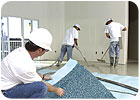
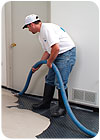
Underlayments are delivered to the job site in bags and mixed with washed masonry or plaster sand, tested in accordance with ASTM E11, and water in approved mixing and pumping equipment with a water meter. Licensed Applicators then pump the slurry into place over a structurally sound, L/360, subfloor and screeded to create a flat, durable surface ready for the installation of finished floor coverings.
As part of Hacker’s Quality Assurance Standards, applicators conduct “slump” or patty-size tests to measure the design mix and product flow. Patty-size results should be as recommended by product specifications. Additionally, field cube samples of underlayments are taken using split brass molds and tested in accordance with ASTM C 472 to test for compressive strengths. Patty-sized tests are recommended to be performed every 10,000 square feet and cube samples taken on each project.
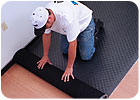
For applications utilizing Hacker Sound Mat II, a perimeter isolation strip is installed throughout the perimeter of the rooms to reduce the flanking paths then the product is rolled onto a smooth surface. The seams are then sealed with an approved tape. The applicator then pours a minimum of 1 inch of an underlayment on top of the mat.
JM: What added value does your company bring to projects?
Hacker: The company supplies consistent tested products to trained and licensed applicators. We train licensed applicators on job sites and in classroom sessions. To educate the building community, several programs are offered, as well as a CEU approved program that we supply to architects, builders and general contractors through AIA approved lunch-and-learn programs.
The company supplies Quality Control Kits to general contractors enabling them to conduct their own on-site patty test to ensure an accurate design mix.
Floor underlayments undergo third party testing to ensure that they meet building standards for fire resistance, sound resistance and durability.
Hacker’s technical department is available to help contractors, architects and builders choose the right underlayment.
Vice President Kerry Hacker is the technical contact for ASTM Standard F2419; Standard Practice for the Installation of Thick Poured Gypsum Concrete Floor Underlayments and the Preparation of the Surface to Receive Resilient Floor Coverings. She is available to answer questions.
 JM:
Do you have a published listing of floor/ceiling constructions that have been
tested?
JM:
Do you have a published listing of floor/ceiling constructions that have been
tested?
Hacker: Hacker floor underlayments are listed in 85 UL floor/ceiling assemblies. These 85 UL listings detail floor/ceiling assemblies utilizing a Hacker Floor Underlayment as an integral component to achieve a 1, 2, 3, or 4-hour fire rating. By including our products in more listings, the architectural and construction communities are provided the ability to specify floor underlayments on a wider array of floor/ceiling assemblies.
JM: Do you have recommended construction requirements for fire ratings, sound control or LEED ratings?
Hacker: While architects and acoustical engineers specify project requirements, there are a range of floor underlayments designed to meet project specifications. The company’s floor underlayments have been comprehensively tested for fire resistance and are listed in UL for applications requiring 1 to 4 hour fire ratings.
Regarding sound control, floor underlayments play an integral role in reducing sound transmission. Again, the end user makes the decision as to the extent of sound control desired. For optimum sound performance, the use of an acoustical control mat is recommended in conjunction with a gypsum concrete floor underlayment. Since minimizing sound control consists of many variables, the goal is to provide components of a cost-effective system, which create a quieter living environment.
To assist projects in obtaining LEED credits, the company’s gypsum concrete floor underlayments and sound mat now contribute to sustainable, green building sites. They contain recycled material and are available from most plants throughout the U.S. to help impact LEED credit areas.
As building codes have changed regarding noise control, the need for fire-rated, green building products, which contribute to “soundproofing” the buildings we live and work in, continues to grow. Gypsum concrete floor underlayments and sound control mats are increasingly recognized by architects, specifiers and builders as the solution to these flooring requirements. W&C
Today, when constructing multi-level buildings, poured floor underlayments are selected for four major reasons: 1) to provide a level surface for the finished floor, 2) to add fire resistance to the floor construction, 3) to add sound control between floors of the building, and 4) to add thermal mass to the floor (e.g. when used with a radiant floor heating system).
According to the International Building Code, ceiling/floor assemblies in multi-level residential units must be built to achieve sound ratings of STC50 and IIC50. Sound Transmission Class tells how well the assembly blocks airborne sound from passing through it. Impact Isolation Class tells how well the assembly prevents impacts on the floor above (such as from the patter of little feet) from causing noise in the room below. Designers can meet this requirement by either using an assembly that a manufacturer has already tested in a lab or by testing the actual assembly in the building after it has been constructed.
To achieve a high IIC rating, a floor/ceiling assembly must be heavy enough to resist acting like a trampoline when someone jumps up and down on it. Typically, this is a concern with subfloor-on-joist construction. In addition, the upper layer of the floor/ceiling assembly must be cushioned enough to prevent vibrations from traveling through the structure when someone tap dances on it. This is typically a concern for concrete slab construction.
The easiest way to deaden tap dancing noise is to install carpet on the floor. In fact, be careful when comparing IIC test data to make sure that a big jump in IIC rating is not due mainly to the use of carpet. A concrete slab floor with a carpet finish is an easy way to achieve high IIC ratings.
Trampoline noise in subfloor-on-joist construction is reduced by adding a thick layer of poured underlayment onto the prepared subfloor. This adds the weight needed to reduce the trampoline noise but makes the floor surface hard so that we now have tap dancing noise problems. Just as with the concrete slab construction, the easiest way to solve this is with a carpet finish.
Since designers, architects and residents of multi-story buildings prefer a variety of hard floor finishes, the necessary cushion layer can no longer be placed on top, and we must achieve the same effect with the cushion located between the subfloor and the underlayment.
Hacker Industries’ gypsum concrete floor underlayments, acoustical control products, and self-leveling underlayments are widely used across North America for sound resistance and fire ratings. These underlayments are a lightweight, high-strength, non-structural cementious underlayment for use in a variety of applications, from the historic Book Cadillac building in Detroit where its Firm-Fill 3310 was used to renovate and restore existing concrete floors to the Bard’s Crossing Retirement Home where Hacker Sound Mat II were utilized to create a quieter environment.
The improved flowability and quick installation time make them an ideal choice to level existing concrete subfloors in commercial and renovation projects.
Additionally, they are widely used for capping hydronic heat tubes to provide a thermal mass for even heat distribution in the fast-growing radiant heating market.
Hacker: Floor underlayments are installed by licensed applicators that are trained to adhere to Quality Assurance Standards, which include compressive strength testing, field quality audits, technical updates and continuing education seminars.
Underlayments are delivered to the job site in bags and mixed with washed masonry or plaster sand, tested in accordance with ASTM E11, and water in approved mixing and pumping equipment with a water meter. Licensed Applicators then pump the slurry into place over a structurally sound, L/360, subfloor and screeded to create a flat, durable surface ready for the installation of finished floor coverings.
As part of Hacker’s Quality Assurance Standards, applicators conduct “slump” or patty-size tests to measure the design mix and product flow. Patty-size results should be as recommended by product specifications. Additionally, field cube samples of underlayments are taken using split brass molds and tested in accordance with ASTM C 472 to test for compressive strengths. Patty-sized tests are recommended to be performed every 10,000 square feet and cube samples taken on each project.
For applications utilizing Hacker Sound Mat II, a perimeter isolation strip is installed throughout the perimeter of the rooms to reduce the flanking paths then the product is rolled onto a smooth surface. The seams are then sealed with an approved tape. The applicator then pours a minimum of 1 inch of an underlayment on top of the mat.
JM: What added value does your company bring to projects?
Hacker: The company supplies consistent tested products to trained and licensed applicators. We train licensed applicators on job sites and in classroom sessions. To educate the building community, several programs are offered, as well as a CEU approved program that we supply to architects, builders and general contractors through AIA approved lunch-and-learn programs.
The company supplies Quality Control Kits to general contractors enabling them to conduct their own on-site patty test to ensure an accurate design mix.
Floor underlayments undergo third party testing to ensure that they meet building standards for fire resistance, sound resistance and durability.
Hacker’s technical department is available to help contractors, architects and builders choose the right underlayment.
Vice President Kerry Hacker is the technical contact for ASTM Standard F2419; Standard Practice for the Installation of Thick Poured Gypsum Concrete Floor Underlayments and the Preparation of the Surface to Receive Resilient Floor Coverings. She is available to answer questions.
Hacker: Hacker floor underlayments are listed in 85 UL floor/ceiling assemblies. These 85 UL listings detail floor/ceiling assemblies utilizing a Hacker Floor Underlayment as an integral component to achieve a 1, 2, 3, or 4-hour fire rating. By including our products in more listings, the architectural and construction communities are provided the ability to specify floor underlayments on a wider array of floor/ceiling assemblies.
JM: Do you have recommended construction requirements for fire ratings, sound control or LEED ratings?
Hacker: While architects and acoustical engineers specify project requirements, there are a range of floor underlayments designed to meet project specifications. The company’s floor underlayments have been comprehensively tested for fire resistance and are listed in UL for applications requiring 1 to 4 hour fire ratings.
Regarding sound control, floor underlayments play an integral role in reducing sound transmission. Again, the end user makes the decision as to the extent of sound control desired. For optimum sound performance, the use of an acoustical control mat is recommended in conjunction with a gypsum concrete floor underlayment. Since minimizing sound control consists of many variables, the goal is to provide components of a cost-effective system, which create a quieter living environment.
To assist projects in obtaining LEED credits, the company’s gypsum concrete floor underlayments and sound mat now contribute to sustainable, green building sites. They contain recycled material and are available from most plants throughout the U.S. to help impact LEED credit areas.
As building codes have changed regarding noise control, the need for fire-rated, green building products, which contribute to “soundproofing” the buildings we live and work in, continues to grow. Gypsum concrete floor underlayments and sound control mats are increasingly recognized by architects, specifiers and builders as the solution to these flooring requirements. W&C
Looking for a reprint of this article?
From high-res PDFs to custom plaques, order your copy today!