Fire, Smoke and Air Barriers: What's the connection?
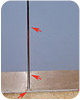
The gap between these double doors allows air to flow unchecked between two places.
The connection between fire, smoke and air migration is simple: where there’s a fire, there is smoke. And where there are gaps, cracks and holes in the building envelope (and other key junctions) air can travel freely, especially if there is a strong pressure difference between two areas. Combine those two forces together and you have a situation where a fire starts and its most deadly force, smoke, travels upwards through a building in just minutes.
Studies have shown that smoke and carbon monoxide inhalation are more responsible for fire-related deaths than fire itself. In the report, “Fire Safety in High Rise Apartment Buildings,” Ken Richardson of Ken Richardson Fire Technologies Inc. writes that the dangers posed by smoke are magnified by the size of the building and the number of occupants:
“Unsuppressed fires in high-rise buildings generate large quantities of smoke that can spread vertically or horizontally through the building, even if the fire is contained to only one room or apartment… A contained, but not extinguished, fire can also generate significant smoke… despite the type of structure (steel or reinforced concrete), most damage, deaths and injuries result from the spread of smoke.”
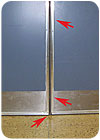
Now
repaired, the gap has been closed and the two separate zones are
compartmentalized from one another (when the doors are closed).
For high-rise buildings in the northern states, the threat of spreading smoke is significantly exacerbated by stack effect. A largely wintertime (cold-climate) phenomenon, stack effect occurs when colder air enters the structure at the bottom of the building, forcing the warmer interior air to rise. Suction is created as the cold air continuously forces the warm air upwards, leading to negative corridor pressure on the lower floors and over-pressurization on the upper floors.
If there are gaps, cracks or holes in the roof-wall assembly at the top of the building, the warm air escapes, leading to a continuous cycle of uncontrolled air exchange.
When fire and stack-effect join forces, smoke is sucked upwards. People on upper floors have less time to escape the building, as their attempts to descend in emergency stairwells meet the smoke’s attempts to rise. The result is a much greater chance of injury or death via smoke inhalation.
The tragic consequences of this phenomenon were sadly illustrated in the 1995 fire at 2 Forest Laneway, an apartment complex in Toronto. A fire on the fifth floor of the building (which was contained to the unit) caused smoke to spread rapidly up the egress routes.
Six people trapped in the upper stairwells of the building died from smoke inhalation.
Control by construction seeks to reduce the opportunities for smoke to spread upwards. Commonly referred to as “compartmentalization,” this strategy seals each floor off from the others via air sealing, weatherization and fire-stop materials. A comprehensive compartmentalization strategy helps to control stack effect. When it is done properly, it also reduces air migration between units, special-purpose rooms, egress routes and vertical penetrations.
A common indication that the building may have a failure in its interior compartmentalization is occupant complaints about odor transfer between units, says Don Sawyer, property manager with Toronto-based company Canlight Hall Management. Because he’s found that odor complaints (commonly linked to cigarette smoke) are so often linked to a failure in air seal and fire-stop materials, he’s adopted a policy of dealing with such complaints immediately, and with professional help.
“It’s a life-safety issue,” Sawyer says. “It’s not a question of whether or not you can stop someone from smoking in their unit. Management can’t infringe upon the human rights of the smoker downstairs. But it’s a sign of a failure in firestop materials. It’s a Fire Code requirement. When you consider that’s maybe $900 or $1,000 to have someone come out and seal it up, it’s a small price to pay.”
Let’s take a look at how air moves through a structure and how building scientists can retrofit existing buildings with the goal of control by construction.
Building
diagnostic testing helps reveal pathways through which air can travel. This
tool (above) works by emitting smoke, which is then drawn, via pressure
difference, through existing pathways.
In a high-rise residential building, the science of air migration is simple: for air to travel, there must be a path for it to travel through and a driving force to push it. This driving force is an air pressure difference between two areas.
Air migration pathways are usually found in the joints of assemblies such as roof/wall junctions, parapets, low-level soffits, the intersections of cladding systems and through internal vertical and horizontal pathways such as those for plumbing or electrical.
The pathways most often responsible for odor and vapor (smoke) travel include:
- The gap under the main door to the unit
- Electrical outlets
- Plumbing penetrations
- Ducts
- The joints between walls, ceilings and floors
In precast-concrete-clad buildings there is always a gap between the concrete cladding and the floor slabs. This gap is filled with appropriate fire stopping materials, which consist frequently of a mineral fiber with the appropriate rating. The mineral fiber is porous and allows smoke and odors to travel up the outside wall. Often the fire stopping is not properly fitted around the concrete anchors, and this makes the problem even worse.
Air has to have a reason to travel, and this is usually provided by stack effect and wind. In a fire, these forces can be deadly. Richardson writes:
“Stack effect and winds have a major impact on smoke movement in high buildings. Stack effect increases with increasing height of building. Wind velocity and direction also affect the course of a fire. They are significantly less of a problem in lower buildings.”
INVESTIGATION
As Don Sawyer indicates, occupant complaints about odor can be indications there has been a failure in the compartmentalization of a building, whether it’s from damaged fire-stop materials or uncontrolled stack effect. Other indications that there are gaps, cracks and holes in a building are occupant complaints about temperature control problems and comfort issues, air quality concerns, high energy bills, pest control problems, and premature decay of materials. If any of these are a concern, it may be time to call in the pros.
Air-leakage building diagnostics most often start with a smoke-generating pencil or theatrical smoke machine and a blower door fan to pressurize or depressurize a room. The smoke will travel where the opportunity exists, revealing hidden pathways of air migration. If the whole building is to be tested, large-scale pressurization fans can be used instead of single-unit blower door fans.
Another useful diagnostic tool is an infrared camera, which can show areas of air leakage by identifying differing temperatures within the structure as air passes through.
Once the pathways are identified, they should be professionally sealed and repaired, especially if there is a breach of firestop materials (as per Fire Code). An air sealing and compartmentalization strategy should address five critical areas of the building in this order: the top, the bottom, the vertical shafts and the outside walls, as well as horizontal openings that create permanent connections to the outside from rooms and other areas.
The materials needed to air seal and compartmentalize buildings include:
- One- and two-component polyurethane foam-insulating air sealants (air barrier materials)
- Door and window weather stripping
- Air-seal/firestop system
Weatherization is a particularly effective compartmentalization tool and is the one most often overlooked. Professional weather stripping materials on doors for units, boiler rooms, garage rooms and chutes, shipping areas, electrical rooms, stairwells and fire-hose cabinets make a huge difference in properly controlling air flow in a building. In the author’s experience, these are the areas with the most haphazard attention paid to air sealing and they are critical to a compartmentalization program.
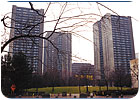
Smoke
from a fire at this building, 2 Forest Laneway in Toronto, spread upwards
through the building at a rapid rate. Building diagnostic testing after the
fire revealed “extreme” stack effect.
Controlling air movement has many benefits that can help pay for the cost of the investment, both financially and in quality of life for occupants. Improving comfort for people who live or work in a building not only makes them happier, it reduces stress for property managers and administrators who deal with complaints about drafts, odors, noise, and pests.
Lower energy bills can be another significant benefit. After the fire at 2 Forest Laneway, property managers hired the author’s company to air seal and compartmentalize the building to achieve dual objectives of smoke control and improved occupant comfort (the HVAC system was also upgraded). In the first year following the retrofit, the savings goal of $195,348 ($200,000 CAD today) in energy costs was surpassed and the payback time on the project reduced from original projections.
There are several other ways that an air sealing retrofit can generate financial savings. As in the Forest Laneway example, HVAC systems run more efficiently and can often be downsized if the building has been properly air sealed, as the system stops having to compensate for the loss of conditioned air. This saves money in operating costs over the long term. And in the short term, make-up air fans can be turned off completely, as stack effect is controlled and they are no longer needed. Additionally, this type of retrofit often qualifies for incentives from utilities and/or government programs that can help reduce the simple payback time on the project.
Add these together, and you have the real prospect of improving life safety, energy efficiency, and occupant comfort in your building while getting a solid financial return on your investment. Compared to the cost of other retrofits or renovations, it’s a strategy worth considering. W&C
Looking for a reprint of this article?
From high-res PDFs to custom plaques, order your copy today!