Capitol Gains

A new entry has been put on the ballot and Dura-Tape International is hoping for the drywallers’ vote. Its Wet n Stick tape has been recently used on several D.C. area projects and its value and efficiency is gaining tapers’ confidence.
Precision Drywall is a medium-sized commercial contractor that focuses its services on apartment buildings, hotels, and occasionally shopping centers. Based in Manassas, Va., just southwest of Washington, this drywall and steel stud contractor works throughout the metro region (Virginia, Maryland, and D.C.), traveling as far north as New Jersey and during the wintertime as far south as the panhandle in Florida. The company has grown drastically since it was founded in 1998.
Only a decade old, Precision has found its niche within multi-unit complexes. As its Vice President of Operations, Turner Williams oversees projects and decides what products are used on his watch. No doubt, this contributes to the company’s success and has helped it flourish in only 10 years. While reading a trade magazine to see what’s new, Williams saw an ad for Dura-Tape’s Wet n Stick line in Walls & Ceilings. He rang its President Lee Goldman to inquire about the product. Williams told Goldman about a project he was working on in northwest D.C., the Allegro Condominium Project which had begun in April and was scheduled to wrap in October. Goldman initially thought he was only going to be supplying a couple rolls of Wet n Stick. When he heard Precision was working on a 297-unit complex with approximately 907,200 square feet (18,900 units of drywall), he decided to drive down from New Jersey to demonstrate the product himself.
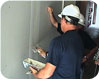
The Wet n Stick product is a water-activated, adhesive drywall joint tape. The paper profile integrates with the company’s water-activated adhesive, and when combined, its properties provide a rapid airtight bond that once dry will neither delaminate nor reactivate, with a topcoat of applied compound.
“We were having problems with our finishing whenever we used standard tape,” Williams says. “When the sun came out, it would cast a shadow across the wall. You could see the joints from the indirect light that came in [through the windows].
“I had to figure out how to overcome that,” he continues. “Lee’s tape looked like it might fit that role. When he came down, he demonstrated how to apply the tape, what to anticipate for any problems we might have from small bumps in the drywall and after we saw how it worked, we purchased a skid of his tape. Once we started using it we liked it so much we switched the whole company over to that product. We no longer use paper tape unless it’s on a limited application.”
The company found that by using the product, the compound that was used in each unit was cut down 10 to 15 percent. The company also noticed that using the tape helped make those bumps and shadows on the walls all but disappear.
“We have some applications where we use eggshell and semi gloss paint and in those areas we had no issues with those joints showing up,” Williams says. “It almost eliminated any touch up or massive amount of skimming of the walls to bring those walls back to what would be a perfect Level 5 finish.”
Williams says that even the painter thinks that using the product has sped up the job, enough so that his schedule has been moved up. The company also found that by changing to the tape it almost eliminated both the indirect and direct lighting problems it was having with high sunlight-prone areas.
A TAPE RUNS THROUGH IT
Application of the product seems quite straightforward: The tape itself comes in a roll with a dry adhesive on one side. There is a small water dispenser that the tape runs through. The tape is applied to the wall and then the product is pressed into the seam using your hand. The product takes roughly an hour to dry. From there, the first application of mud is applied over the product. And then, as Williams says, it’s just a standard process: first application of mud, second light skim over it and it’s ready for sanding.
The research that led to the creation of the product was to find a method to simplify and speed up the existing drywall taping process using the best benefits of existing products, says Goldman. The challenge required joining wallboard panels with the confidence of a strong bond, ease of application and the end result requiring no counteractive efforts to remedy the usual bubbling, blistering and cracking.
“Wet n Stick technology … is similar to the idea used in water-activated wallpaper except we had to create an adhesive that set up quickly and began its grip in seconds to allow the taper to string without missing a beat,” says Goldman. “The outcome is a quick-dry adhesive that absorbs into the face paper of wallboard. This allows Wet n Stick to expand and contract as the finished construction settles.”
Although initially concerned with the cost of the tape (Wet n Stick is $5 per roll vs. $1 for regular tape), Williams says the savings are immense on several different levels: First, the amount of mud used on the project is 1.5 less buckets per unit; second, he says his tapers have doubled the number of units taped per day, they now average 15 units vs. six to eight using traditional methods; and third, the company has trimmed two months off the construction schedule by using this product.
Williams says since the first initial trial of the product, Precision Drywall has converted almost entirely to it. While the company enjoyed its success with the product on the Allegro project, two other jobs the company had going on went exclusively with the product line.
It is curious that during reported lows for most drywallers throughout North America, with housing starts down and a very dismal economic condition, Precision is still prospering. The company says it will probably end its year with a range of $8 to $12 million. He adds that by switching over to the Wet n Stick line, he’s crunched the numbers and figures he’s probably saving $100,000 annually in labor and cost.
“This product truly was a good change for us,” says Williams. “Keep in mind I don’t do a lot of changing in here-if the system works, there’s no need to change it.” W&C
If you read this article, please circle number 208
Looking for a reprint of this article?
From high-res PDFs to custom plaques, order your copy today!