Board Away
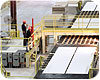
Courtesy of the Gypsum Association
The world market for drywall totaled 25.5 billion square feet (7.8 billion square meters) in 2007, representing consumption of 3.9 square feet (1.2 square meters) per person. However, per capita penetration rates vary greatly by country. At the top end of the spectrum are the United States and Canada with per capita demand of 36.4 and 32.8 square feet (11.1 and 10.0 square meters) per person, respectively. In both of these countries, the historical prevalence of wood framed construction and more recent preference for steel framed construction have allowed for the development of sizable wallboard markets.
Many other developed countries, such as Australia, Denmark, Finland, France, Japan, New Zealand, Norway, South Korea, Sweden and the United Kingdom have per capita demand of between 11 to 19.6 square feet per person. On the other hand, some developed countries such as Italy and Taiwan have per capita demand that is close to the world average of 3.9 square feet (1.2 square meters) per person due to cultural and construction preferences that have precluded the development of any markets of significance for wallboard.
World demand for drywall is forecast to expand 4.5 percent per year through 2012 to almost 32 billion square feet. Gains will vary greatly by region, depending on a host of factors such as building construction spending and economic growth prospects, as well as trends in local construction techniques. In most developed countries, drywall is by far the dominant market for gypsum. In developing countries, however, the dominant use for gypsum is as a cement additive.
The market for drywall is concentrated in North America, which accounted for 48 percent of global sales in 2007. However, through 2012, sales growth in North America will significantly lag all other regions, primarily due to maturation in the large U.S. market. Moreover, construction spending growth in the states will remain well below the global average, although it will improve relative to the 2002-2007 period.
Drywall prospects in the Asia/Pacific region will be particularly robust, especially when excluding Japan. The Japanese drywall market, although registering weak gains through 2012, will recover somewhat from the anemic performance of the past decade. China and India will perform especially favorably, with countries such as Indonesia, Malaysia, Thailand and Vietnam also registering healthy gains in demand. Growth in other developing parts of the world will typically exceed nine percent per year through 2012, with new drywall plants opening in booming markets such as the UAE and Ukraine. Both rapid construction growth and rising popularity of dry construction techniques will bolster demand in developing countries.
Drywall based on synthetic gypsum will account for an increasing share of global demand through 2012. The most popular type of synthetic gypsum used in drywall is produced as a byproduct of flue gas desulfurization systems at coal-fired power plants. Drywall recycling will also become more common, spurred by the efforts of companies, such as New West Gypsum Recycling (Canada) and Gypsum Recycling International (Denmark).
WORLD PLAYERS
The world’s largest drywall producers in 2007 were Saint-Gobain (France), USG (U.S.), Knauf (Germany), Lafarge (France), National Gypsum (U.S.), Koch Industries (U.S.-via Georgia-Pacific), Yoshino Gypsum (Japan), Beijing New Building Material (China) and Eagle Materials (U.S.-via American Gypsum). Together, these nine companies supplied almost 80 percent of the global market in 2007.
The global industry composition changed significantly in December 2005, when BPB (U.K.) was acquired by Saint-Gobain, and Georgia-Pacific (U.S.) was acquired by Koch Industries. Of the market leaders, Saint-Gobain, Lafarge and Knauf conduct a significant portion of their business outside their home region of Western Europe. Of the rest, each company largely operates within its home country.
The global drywall industry has undergone significant consolidation over the past decade, with the 60 or so active producers around the world in the early ’90s declining to around 30 in 2007. The West European drywall industry has essentially consolidated to just three firms: Saint-Gobain, Lafarge and Knauf. Yoshino Gypsum accounts for 80 percent of Japanese drywall production. The U.S. industry is less concentrated with around 10 significant domestic producers, although four companies-USG, National Gypsum, Koch Industries (G-P) and Saint-Gobain-account for three-quarters of domestic drywall output.
Besides the producers mentioned so far, other significant participants (with annual production capacity ranging from 196.8 million to 525 million square feet) include Boral (Australia), Chiyoda Ute (Japan), CSR (Australia), KCC (South Korea), Pacific Coast Building Products Incorporated (U.S.), Panel Rey (Mexico), Temple-Inland (U.S.) and Uralita (Pladur-Spain).
Smaller producers with estimated annual capacity between 32 million and 197 million square feet, such as BGC Plasterboard (Australia), Etex Group (Belgium), Federal Gypsum (Canada), Winstone Wallboards (New Zealand) and a dozen or so state-controlled Chinese producers round out the list. A number of producers with less than 32 million square feet of annual drywall production capacity, such as BK Plaster and Gypsum (Thailand) and Kuwait Gypsum (Kuwait) are also locally important.
Recent trends suggest that the period of consolidation seen in the global drywall industry over the past several decades is now reaching an end, with newer players entering the market as drywall demand significantly rises (especially in the developing world).
In 2007, J.D. Irving (Canada) entered the global wallboard market via a new company called Atlantic Wallboard, which operates a new wallboard facility in Canada with annual production capacity of a bit more than 98.4 million square feet. The company plans to predominantly sell its products in Canada and the northeastern United States.
Cemex (Mexico) entered the global drywall industry in 2007 by opening a new plant in Queretaro, Mexico, in a 60/40 joint venture with Lafarge. In Chile, Sociedad Industrial Romeral and Compania Industrial El Volcan built a new gypsum board plant near Santiago in 2007, representing another new entrant into the global market. In Iran (the world’s fourth largest gypsum producing nation), locally based Sadaf Gypsum recently opened a small plasterboard plant, only the second in the country after Knauf’s much larger existing one. In the UAE, locally based Gypsemna (part of the Jamal Al Ghurair Group) is planning to open a new drywall plant in Abu Dhabi at the end of 2008 with annual production capacity of 164 million square feet, half of which will be exported.
In spite of all the above mentioned projects, the vast majority of new drywall capacity expansion activity in the developing world will continue to be undertaken by Lafarge, Knauf and Saint-Gobain. These three companies benefit from their technology, experience, global presence, respected brand names and financial wherewithal to undertake large projects that provide economies of scale. W&C
Looking for a reprint of this article?
From high-res PDFs to custom plaques, order your copy today!