Walls & Ceilings logo
search
cart
facebook twitter linkedin youtube youtube Spotify Podcasts Apple Podcasts Spotify Podcasts Apple Podcasts
  • Sign In
  • Create Account
  • Sign Out
  • My Account
Walls & Ceilings logo
  • NEWS
  • TOPICS
    • Drywall
    • Stucco/EIFS
    • Ceilings
    • Steel Framing
    • Fireproofing
    • Interior Plaster
    • Building Envelope
    • Insulation
    • Technology
    • Interior
    • Exterior
    • Women In Construction
  • COLUMNS
    • Up Front
    • All Things Gypsum
    • Art & Craft of Plastering
    • Stucco Stop
    • Steel Deal
    • Industry Voices
  • PRODUCTS
    • Buzz Guide
  • EVENTS
    • Industry Events
    • Webinars
    • BUILD Expo
  • MEDIA
    • Videos
    • Podcasts
    • Photo Galleries
    • BUILD26 Videos
    • Take our Quiz!
    • Infographics
  • EXCLUSIVE
    • Newsletters
    • Top 50 Contractors
    • Contractor of the Year
    • State of the Industry
    • W&C Store
    • Market Research
    • CEUs
    • Sponsor Insights
    • Custom Content & Marketing Services
  • DIRECTORY
  • EMAGAZINE
    • eMagazine
    • Advertise
    • Archive Issues
  • SIGN UP!

Rough Stuff

By John Koester
March 1, 2011
The areas where two or more different construction products, details and systems intersect are always places of potential risk.


Leaking windows are one of the most frequent callback issues in the building industry. They leave many contractors feeling like the old sailor in “The Rime of the Ancient Mariner” when he cried, “Water, water everywhere!” When wind and water leaks into the interior living space from the perimeter of a window, it’s all too easy to blame the window for the problem. However, the odds are great that it isn’t a faulty window but rather a faulty window rough opening that’s responsible for those leaks and drafts. We need to focus our attention on the window rough opening and the wall system itself to overcome these air and moisture infiltration issues.
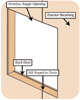
Rough opening moisture management.
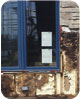
The areas where two or more different construction products, details and systems intersect are always places of potential risk. Incompatibility of products or designs and poor communication between the various people involved (architects, contractors, tradesmen) are some of the more common scenarios that result in failures. In many cases, the solution to the “leaky, drafty window” problem is to focus on the materials and methods used around the window rough opening.

Moisture should also be diverted away from construction details with drainage products as quickly as possible to minimize risk.

Detail Failures

Exterior building envelope construction systems (roofs and walls) often fail in the detailing of openings, projections and transitions. The detailing process is complicated because it involves more than a single individual or discipline. The challenge is uniting the various disciplines using a wide range of materials into a cohesive unit. The need for holistic building is imperative. Each party involved needs to know how their work and materials are used to complete that task and how they impact the final result.


The first and most important task of moisture management, as it relates to construction products and details, is keeping moisture off of them. If water can’t get to the detail, it can’t damage it. The second task is to isolate as many details as possible, identify risk zones and design details, and concentrate on their intrinsic weaknesses. Once these are identified, then create a moisture solution. When a potential problem isn’t addressed in one area, it often leads to failure in another. A poorly prepared rough opening develops leaks that then get blamed on the window. In reality, had the window detail been properly addressed in the first place, a failure in an adjacent detail may not have happened. Many wall failures, both structural and veneer-related, are a result of a moisture management failure on a window installation (specifically, problems with preparation of the rough opening).

A thin veneer with a predictable rain screen drainage plane affords an opportunity to apply moisture diverter technology on the inside of the void of the rainscreen drainage plane rather than by adding architectural details on the outside.

Risk Zones of a Window Rough Opening

Moisture risk at the top of a window detail can come from a number of sources, such as:

Condensation or frost accumulation from warm, moist air coming in contact with dew point temperature in the air or on surfaces of the interior of the window rough opening and on the surfaces of the window unit.

Openings or voids in the waterproofing material at the top of the window (installation flange and flashings).

Moisture that may have entered the wall system above the window and moved from the high point of the entrance down to the top of the window detail in an open waterproofing system.

When there are voids or chases in construction details of the exterior building envelope, the air that is in these voids or that can move into them must be controlled or conditioned. The control mechanism is usually some kind of vapor retarder membrane placed on the warm side of the detail and made as airtight as possible. When warm, moist air can’t meet a dew point temperature, there is no condensation and therefore, no frosting. These voids also need to be filled with some sort of insulation to interrupt temperature transfer-no dew point temperature, no condensation problem.

To a lesser degree, the voids at the sides of the window rough opening have the same condensation concerns as the top and bottom because the surfaces are vertical rather than horizontal. However, they are dependent on the top of the window being properly treated to manage moisture correctly so that it doesn’t allow moisture to move down into the voids at the side.
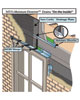
The bottom of the window area is of greater concern. It can be compared to the bottom of a bucket; everything runs downward. Any and all liquid that gets into the window’s rough opening will accumulate at the bottom of the window rough opening. The accumulation of moisture at a low point in a window rough opening leads to absorption and migration into the surrounding details resulting in one of the most common failure scenarios in the construction industry.

Cover the construction details that you don’t want to get wet with moisture-proof or moisture-resistant materials. Moisture should also be diverted away from construction details with drainage products as quickly as possible to minimize risk. The combination of a well-designed drainage system and a moisture-resistant or waterproofing system is the ultimate detail to manage moisture.
Historical Basis for Moisture Diversion

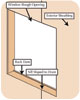
Diverting water away from window details is not a new idea nor is it a new technology. Designing a pattern in the veneer immediately above a window has a long and successful history. What is not commonly known or understood in today’s construction and design industry is that most of the patterns in older historical building veneers were there to manage moisture and to move it off of-and away from-sensitive details such as windows and doors.
This historical idea of diverting moisture away from sensitive details with architectural details can be applied today, but with a twist. A thin veneer with a predictable rain screen drainage plane affords an opportunity to apply this moisture diverter technology on the inside of the void of the rainscreen drainage plane rather than by adding architectural details on the outside. Here are two examples of this moisture diversion practice of creating a detail above the window to move moisture away from the top and out and around the sides, one from the past and MTI’s “inside the envelope” solution.

Rough Opening Moisture Management

The bottoms of chases in framed construction window rough openings should be addressed with the following details and materials:

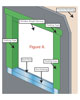
Figure A Detail

The construction materials that make up the bottom of this detail must be covered with a waterproofing material that turns up the sides of the window rough opening a minimum of 8 inches.

The top surface of the bottom of the window rough opening must be sloped to drain to the exterior of the building.

The back edge of the bottom of the window rough opening must have an elevation change that is higher and creates a back dam.

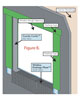
Figure B Detail

A pathway must be provided for moisture to move out of and off this detail. This needs to be done for moisture that may enter at the sides as well as at the bottom.

A pathway must be provided for moisture to exit the wall detail once it has drained out of the window rough opening.
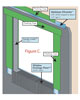
Figure C Detail

The next step involves moving water away from the top. Remember that moisture moves downward. If we follow the examples from history that created external details away from the top of windows and doors, much of the moisture problem can be eliminated from the window rough opening. The only difference is that the moisture diverting mechanism is inside the building envelope.
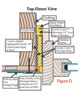
A moisture diverter is placed above the window rough opening. It should slope 1/4 inch per 1 foot and should extend at least 4 inches past the side of the rough opening.

Apply flashing tape to the top edge of the moisture diverter. The layers of construction paper should overlap the top of the moisture diverter and extend down into the trough.
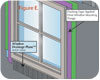

Incorporating these practices into rough opening design gets moisture away from, off of and out of the window construction detail as quickly as possible. These practices constitute a well-designed rough opening. The voids at the top, sides, and bottom need to have predictable pathways to drain moisture that may enter these voids or condense in them. The voids also need to be insulated because they can allow air infiltration with negative results. The idea that moisture can’t get in, or that if the voids are filled with insulation there isn’t enough room for moisture, is just wishful thinking.

The moisture diverter provides drainage at the top of the window (see Figure C). To provide drainage on the side, install cavity strips on the sides of the rough opening (see Figure C) and on the sides of the window frame. It is critical that these strips are centered on the sides of the rough opening and the sides of the window frame, and that the edges of the strips are at least 3/4 inch in from each edge of the rough opening. (see Figure D).

Insulate the top and sides of the rough opening with foam (see photos 1 and 2). The strips will provide the drainage required for the side voids of the rough opening; the diverter will provide drainage for the top. The foam insulation will seal off the sides and top of the detail.

Use a window drainage plane for drainage at the bottom of the rough opening (see Figure E). The plane will also provide a pathway for moisture to enter the rainscreen drainage plane system.

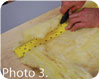
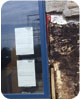
The bottom should be insulated with fiberglass batt insulation cut to size; the addition of the insulation will seal off the bottom of the detail while still allowing drainage (see photos 3 and 4).

Conclusion

Placing blame is always easier than working for perfection. Most of us parrot the words “best construction,” “sustainable design” and “green building,” but do we truly try to attain them? If we honestly want to employ these practices, we need to use what works even though it may seem to infringe on our long-held beliefs about correct building methods.

Share This Story

Looking for a reprint of this article?
From high-res PDFs to custom plaques, order your copy today!

John Koester is CEO of Masonry Technology Inc. He can be reached at (800) 879-3348.

Recommended Content

JOIN TODAY
To unlock your recommendations.

Already have an account? Sign In

  • Abercrombie & Fitch

    EIFS in 2026: How Specialty Finishes Are Redefining Exterior Wall Systems

    As building codes, owner expectations, and design demands...
    Stucco/EIFS
    By: Regi Mendoza
  • proper air and vapor control

    From Energy Efficiency to Moisture Management: Why Air and Vapor Control Matter

    How proper air and vapor control within building...
    Building Envelope
    By: Benjamin Meyer AIA, LEED AP
  • Linear Metal Ceiling Beam Baffles

    Top 25 Ceiling Contractors of 2026

    Suspended ceilings demand precision, code compliance and...
    Ceilings
    By: John Wyatt and Tanja Kern
You must login or register in order to post a comment.

Report Abusive Comment

Manage My Account
  • eMagazine Subscription
  • Newsletters
  • Online Registration
  • Manage My Preferences
  • Subscription Customer Service

More Videos

Sponsored Content

Sponsored Content is a special paid section where industry companies provide high quality, objective, non-commercial content around topics of interest to the Walls & Ceilings audience. All Sponsored Content is supplied by the advertising company and any opinions expressed in this article are those of the author and not necessarily reflect the views of Walls & Ceilings or its parent company, BNP Media. Interested in participating in our Sponsored Content section? Contact your local rep!

close
  • medical professionals moving a patient on a stretcher through the halls of a medical building
    Sponsored byNational Gypsum Company

    What Does High Performance Mean When It Comes To Gypsum Boards?

Popular Stories

Linear Metal Ceiling Beam Baffles

Top 25 Ceiling Contractors of 2026

Wichita Biomedical Campus

Wichita Drywall Worker Dies After Scaffolding Fall

Construction workers in safety vests install drywall

Gypsum Sales Hold Amid Market Shifts in the U.S.

QXO Just Changed the Game-Here's What Contractors Are Asking

QXO Just Changed the Game-Here's What Contractors Are Asking

Events

June 24, 2026

The Bright Side & Benefits of Designing with Integrated Lighting

Credits 1 AIA LU/HSW; 0.1 ICC CEU

This course will explore the pivotal role architects and lighting design play in creating safer, more sustainable spaces. Learn how to avoid common lighting mistakes and make informed decisions that create the best visual environment for occupants. 

January 1, 2030

Webinar Sponsorship Information

For webinar sponsorship information, visit www.bnpevents.com/webinars or email webinars@bnpmedia.com.

See our full library of webinars

View All Submit An Event

Products

2026 National Painting Cost Estimator

2026 National Painting Cost Estimator

See More Products

Related Articles

  • Hot Stuff

    See More
  • Rough Opening System

    See More
  • ALL First to Get New Liebherr Rough-Terrain Crane

    ALL Crane First to Get New Liebherr Rough-Terrain Crane

    See More

Related Directories

  • CEMCO LLC

    Steel framing, metal lathing products, shear/diaphragm panels, rough-opening/header systems, fire rated head-of-wall systems and shaftwall assemblies for commercial, institutional, mid-rise, and residential steel framing and metal lath construction systems.
  • ClarkDietrich

    Metal framing systems for drywall, curtainwall, shaftwall, area separation wall and load-bearing applications, clips and connections, metal lath and accessories, metal, zinc, vinyl and paper-faced beads and trims; floor joist systems, engineering services and BIM services.
×

Connect with the industry’s leading resource for unparalleled insights and education.

Join thousands of industry professionals today. Shouldn’t you know what they know?

JOIN NOW
  • RESOURCES
    • Advertise
    • Contact Us
    • Directories
    • Store
    • Want More
  • SIGN UP TODAY
    • Create Account
    • eMagazine
    • Newsletters
    • Customer Service
    • Manage Preferences
  • SERVICES
    • Marketing Services
    • Reprints
    • Market Research
    • List Rental
    • Survey/Respondent Access
  • STAY CONNECTED
    • LinkedIn
    • Facebook
    • Instagram
    • YouTube
    • X
  • PRIVACY
    • PRIVACY POLICY
    • TERMS & CONDITIONS
    • DO NOT SELL MY PERSONAL INFORMATION
    • PRIVACY REQUEST
    • ACCESSIBILITY

Copyright ©2026. All Rights Reserved BNP Media, Inc. and BNP Media II, LLC.

Design, CMS, Hosting & Web Development :: ePublishing