Progression of tools
"The drywall finishing trade is physically demanding work and poses significant risk for repetitive strain injuries to workers. The tasks are highly repetitive, require significant force and involve many awkward postures."
-Midstate Education and Service Foundation
When I first heard the word "ergonomic," someone had to explain its meaning to me. I just thought, well that's interesting but I have not had too many aches and pains so I am not going to even think about it until I do.
Ergonomics is the study of how a workplace and the equipment used there can best be designed for comfort, safety, efficiency and productivity. Companies are always trying to come up with improvements. Just when I think that something is as good as it can get someone comes up with a new design. Sometimes it is better, sometimes worse, and sometimes the same (just looks different). I am always fascinated by the simple toothbrush. It has been improved so many times that it is ridiculous, and still it needs to be used properly and regularly to be effective.
Tasks at hand
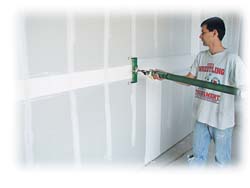
Having productive and efficient tools is great but they must also be comfortable and safe if they are to stand the test of time. I have done a little research on the evolution of drywall taping. Tools and techniques have been developed over the years that have greatly improved productivity and efficiency.Conventional drywall currently holds more than a 90-percent market share of interior finish materials. As drywall was replacing plaster, it was only natural that many of the same tools and methods that were used to finish a plaster job were also used to finish the drywall, save for the front paper of the drywall is made of high-quality face that is ready to accept paint; only the seams and fasteners need to be concealed. It wasn't long before some people in the industry were starting to think of more efficient and inexpensive ways to finish wallboard.
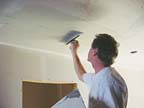
Taping can be summarized as the process of strengthening and concealing joints between panels and where they butt together at inside and outside corners. Joint compound acts as an adhesive that, when combined with paper or fiberglass mesh tape, actually joins the two panels together. The layers of joint compound that cover the tape are used to conceal a joint. Sounds simple but getting the tape embedded tight and smooth in the proper amount of joint compound, and then applying two or three layers of joint compound over the tape (in a smooth manner that blends into the surrounding face paper on the drywall), can be challenging and time consuming.
Excellent results were being achieved in hand taping but it was time consuming and it took a lot of skill. With all this drywall being hung, there became a need to develop an efficient method of finishing joints. In 1939, the Ames brothers started experimenting with new ways of finishing drywall. They were painters and plasterers who came up with the Corner Shoe, which was the first of a long line of drywall tools. The Corner Shoe applied joint compound to seams using air pressure and a long hose.
Ames came up with the pre-curser of today's Bazooka (automatic taper) in 1945. The automatic taper applies compound and tape to seams and corners all in one motion. This first taper was battery powered and weighed more than 100 pounds when fully loaded. In the early '50s, Ames introduced the first boxes. Boxes apply the finish coats of joint compound used to conceal seams.
Over the years, a lot has happened in the development and improvements on existing tools. In the early '60s, many of the patents that were filed by the Ames brothers were starting to expire and competitive tools entered the marketplace. For the first time, Ames tools were not the only tools being used by drywallers.

Easier does it
About five years ago, I attended an Ames one-day class and I returned home with a full set of tools. I was happy that I had finally decided to try the mechanical tools and was looking forward to easier workdays. What I soon found out was that I could finish much faster, had improved quality and less sanding. However, I was also working harder physically than I had been while hand taping. I thought that I was working faster so I should just be happy with increased production and maybe less work hours. But I wasn't going home early and even pushed myself to work my normal nine- to 10-hour days. I was going home very tired but very content with all the work I was getting accomplished.This is why so many tool companies are working harder to make tools less demanding physically. For example, Ames came out with a Power Assist Box a few years ago. It is designed to greatly reduce the amount of pressure used to push the compound out and onto the seam. A change in the spring design pulls the back cover in when the wheels on the box are in contact with the drywall. This pushes the compound out of the mouth of the box. They work very well and those seams that were difficult to coat because of poor leverage can now be coated easily. The Mudrunner is a similar tool used for coating inside corners that also uses a spring to push mud out.
In an ergonomic study of drywall finishing tools and tasks, Greg Shaw, of the Midstate Education and Service Foundation, found many interesting results:
"The most serious problem with using flat and corner boxes is the high force required to use them," he said. Results of tests done with the power assist box show that this tool "can dramatically reduce the force (up to a 75-percent decrease) required to finish joints. The data clearly shows that the Power Assist boxes are safer than traditional boxes because of the reduction in force required to do the job."
Shaw also tested the Mudrunner.
"The spring applies all of the force required to apply the mud. All the user does is guide the tool along the joint. This is a dramatic difference from traditional corner boxes that are considered by some finishers to be the toughest tool to use because of the enormous force required to push mud out."
Apla-Tech, the maker of pneumatic finishing tools, wasn't satisfied with just improvements to automatic tools. The company came up with a whole new design that is different from automatic tools in many ways. The main difference is that Apla-Tech uses air pressure to push the compound out of the tool head instead of springs or physical pressure by the tool user.
According to Shaw's study, "The Apla-Tech system helps reduce worker strain and injuries because it is air driven, light and durable. The system requires as little as 10 percent of the muscle activity of spring-powered boxes and only 2 percent of regular boxes for finishing both seams and inside corners. From an ergonomic standpoint, the Apla-Tech system does a good job at eliminating the risk of finishing with boxes and possibly is safer than hand finishing."
Some changes are subtle. I recently used an angle box made by Wilco Drywall Tools. The box has a simplified design and is made of urethane. It is advertised as being friction resistant and it really does seem easier to push the mud out.
Hand finishing was also studied. I read in Shaw's report that "hand finishing is dangerous work and is likely related to back, neck, shoulder, arm and wrist injury." This is not exactly something you want to read to perspective employees. If I had read this before I started in the business, I may have chosen a different career.
Over the years, I have discovered tools that I prefer to use when hand taping. I prefer a stiffer knife blade with a wider rubber handle. With my wider knives, I like an offset handle and a pan with a round bottom. I have recently started using a magnetic handle that attaches to my metal flat bottom pans that offers a nice change. I prefer the tools that I use because they are more comfortable and easier to hold, and less stressful to use for long periods.
How one uses tools also is important. For example, I usually use two fingers on the backside of my knife instead of one because it is less tiring. I had to make a conscious effort to do this at first but now it is natural.
So, if you're not really comfortable or have aches and pains from using your tools, whether it is a 6-inch knife or a pan or 15-year-old boxes, look around for other options. There are many new tools out there that are much more ergonomically friendly. Better and more efficient tools will continually be brought to the market, because I think it is a natural progression. Don't be afraid of change.
New tools can make work easier, which is a good thing. But you will need to spend some money, which is not always easy to do. Remember, time is money, increased production and less down time spent nursing aches and pains is money in your pocket. In other words, it may be wise to put older tools on the shelf for more ergonomically friendly tools. Tapers want tools that offer fast high quality results and are easy on the body. They want to keep on doing what they do best. I know I do.
Sidebar
A typical set of automatic
taping tools consists of
the following:
· An automatic taper, which simultaneously applies tape and joint compound to any seams and inside corners. After the tape is applied to the seams, it is wiped down with a knife, and pan to embed the tape and remove excess joint compound.· The inside corner tape is not embedded with a knife, it is embedded with a special tool called a corner roller. The corner roller embeds the tape nice and tight into the inside corners and excess joint compound is squeezed out. The corner finisher follows the corner roller. It is glided along the inside corner using the excess joint compound to coat the tape and blend into the face of the panels. The corner finisher adjusts to compensate for corners slightly off 90 degrees as it is pushed along the corner.
· To apply the finish coat to the inside corner, an angle box is filled with joint compound and a slightly wider corner finisher is attached to this box. Joint compound is forced out of the box into the finishing head and evenly applied to the corner as the tool is guided along the corner.
· Flat boxes are used to apply the finish coats to seams. Like the corner finisher they are designed to produce uniform results. The adjustable metal blade smooths the compound to the desired crown as the tool is pulled along the seam. A typical set of boxes are 7, 10, and 12 inches wide.
· There is even a nail spotter that fills nail or screw head depressions.
A mud pump with its different nozzles is used to fill the various taping tools.
Looking for a reprint of this article?
From high-res PDFs to custom plaques, order your copy today!