Heavies that Hold the Crew
Maybe the passengers-plus-cargo-minus-excess-length equation explains some of the popularity of SUVs, which have even developed a significant commercial-use market. Where the SUVs are great for passengers and limited amounts of cargo, sharing the vehicle’s interior with some types of cargo is either undesirable or out of the question, and tall items are impossible to carry upright in the enclosed cargo area.
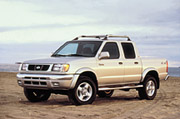
Although nearly every manufacturer has worked on prototype models of compact crew-cab pickups for several years, and several have sold small crew-cabs outside North America, the floodgates began to open in late ’98 with Nissan’s announcement of its Frontier crew-cab. Just a few months later at the ’99 North American International Auto Show, a handful of production, concept and soon-to-be-production crew-cab pickups pretty much stole the show. Some are being marketed as SUV crossovers, while others make no pretense, identified as actual crew-cab pickups.
Regardless of the marketing angles being applied, all of these trucks share a common layout with four conventional doors, two full rows of seating and a shorter-than-average pickup bed. Nissan’s sport utility truck concept vehicle made its public debut a few years ago as a working prototype with a fifth “door” in the form of a rear-window liftgate which, when combined with fold-down rear seats, allows long cargo to still be carried when necessary.
SUV or pickup?
Chevy has gone one step further, announcing a production model hybrid in the form of its new Avalanche. To be certain, many manufacturers have experimented with pickup/SUV hybrids for the past several years, and some personal-use crew-cab pickups are even being passed off as crossover trucks. However, apart from Nissan’s SUT, which is strictly a one-off concept truck, the Avalanche represents the first “production ready” example of a true hybrid. Although the Avalanche will be badged as a 2002 model, sales are expected to begin in early 2001.What separates the Avalanche from the everyday crew-cab and SUV crowd is Chevy’s convert-a-cab system. The convert-a-cab features a “midgate” and a storable rear window between the rear seat and the cargo area. Combined with folding rear seat, these features allow the convert-a-cab to be reconfigured into any of several permutations in seconds, by one person, without tools.
In its standard configuration, the Avalanche provides the Silverado/Tahoe’s comfortable seating for up to five passengers, as well as a 5-foot-3-inch-long cargo bed. A lockable tailgate and storable three-piece cargo cover allow for SUV-secure storage in a pickup-durable cargo area.
On those occasions when it’s necessary to haul sheets of plywood or drywall, the rear seats and Midgate are folded out of the way to extend the capacity to a full 8 feet 1 inch with the tailgate closed. Using the cargo cover in this mode provides weathertight protection for your building materials when Mother Nature isn’t cooperating with your project schedule.
Crews in the news
During the past several months, a record number of new crew-cab models have been introduced, greatly increasing the available choices among these popular job site trucks. The biggest growth in the crew-cab segment is within the compact pickup offerings.Nissan, currently the “elder statesman” among the compact crew-cab pickups, took the opportunity to unveil a body update to its Frontier crew-cab during this year’s Chicago Auto Show. Although the crew-cab model was rolled out only one year ago, the basic Frontier design already has a few years on it.
GM also used the Chicago Auto Show venue to unveil its 2001 Chevrolet S-10 and GMC Sonoma compact crew-cab models. Sharing a nearly identical powertrain and chassis, the preliminary specifications for the S-10/Sonoma crew-cabs include: available four-wheel drive, a 190-HP Vortec 4300 V6 engine, a 4-foot-6-inch-long cargo bed, and a payload capacity of 1,125 pounds. Forward-opening rear doors and an adult-sized rear seat make the S-10 or Sonoma crew-cab a great choice when both passenger capacity and nimble maneuverability are required.
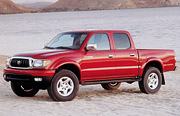
In yet another unveiling at the Chicago Auto Show, Toyota answered Nissan’s earlier launch by introducing its entry into the compact crew-cab market in the form of the Tacoma “Double Cab.” Preliminary specifications for the Double Cab include: available four-wheel drive, the choice of a 2.7-liter 150-HP four-cylinder or a 3.4-liter 190-HP V6 engine, and a 5-foot-1-inch-long cargo bed. Like the other compact crews, the Tacoma Double Cab is mostly based on its regular cab counterpart.
Dodge’s Dakota is again finding a spot as a segment buster with the new Dakota Quad Cab, landing right in between the traditional compact and full-size offerings. Late last year, we were able to put the Dakota Quad Cab through a brief test that included some light towing and it performed well.
Ford is temporarily staying out of compact crew-cabs, choosing instead to focus efforts on its hybrid SUV, the Explorer Sport Trac. Although the F-150 SuperCrew will mainly be marketed as a consumer vehicle, with the Super Duty models being the main offering for the business user, the SuperCrew’s 5-foot-6-inch cargo bed and full-size rear- seat may be a useful alternative for those users who don’t require the heavier suspension ratings of the Super Duty trucks. The shortened bed allows the SuperCrew to maintain the same overall length as the company’s 139-inch wheelbase SuperCab model.
In the lighter (half-ton) end of the full-size crew-cab arena, GM’s T800 models (Silverado/Sierra) are in the pipeline, slated for release within the next 24 months, while Dodge still remains conspicuously absent from the entire full-size crew-cab market. Speculative rumors have Freightliner, another of the DaimlerChrysler subsidiaries, designing the next generation of Dodge trucks.
GM’s new HD models raise the bar
After several years of testing work trucks, it becomes so easy to find flaws in a new design that a model review is frequently a case of saying, “This is a nice truck, but—” and then fill in the blanks where the designers and engineers stopped just a little short in their efforts.As of late this fall, “but—” will no longer be necessary when describing GM’s pickup offerings for the work truck market. The addition of the 2001 Heavy Duty Series means that Chevrolet and GMC will now have “the whole package,” from half-ton to 1 ton, from luxury to brawn. As for the HD Series itself, “the whole package” is an equally accurate description.
Many truck lines talk about ride quality, payload capacity, towing strength, horsepower and style, but frequently these terms are mutually exclusive, each describing different trucks within that particular line. Our initial testing has us convinced that choosing the HD Series will not require sacrificing one or more of a pickup’s attributes to obtain best-in-class performance in another area.
Although there are many important attributes for a work truck, the most important is the truck’s ability to work. Work skills can be easily summed up in three Ps: power from the engine, payload carried in the truck, and pulling strength to tow a heavy load.
Power
Ranging from the most powerful standard engine, to a purpose-built diesel, to the strongest available gas engine in the pickup truck market, GM’s new HD Series has the “power” side of the equation more than covered. With 300 HP, the standard Vortec 6000 V8 enjoys a wide lead over the 5.4-liter Ford or 5.9-liter Dodge offerings. At the opposite extreme, the Vortec 8100 V8 delivers 340 HP, a significant increase over both of the competitor’s V10 engines. It’s also important to note that the Vortec 8100’s V8 configuration uses approximately 20 percent fewer moving parts than a typical V10 engine, a big difference when looking at maintenance and overhaul costs.If maximum torque is a key consideration, then the Duramax Diesel 6600 V8 is the answer. Rated at 520 pounds-per-foot of torque, the Duramax 6600 has the advantage over the competitive diesel engine options. GM called upon Isuzu’s automotive diesel experience to co-develop the Duramax engine specifically for the HD Series pickups. Both of the competitive diesels were adapted from applications outside of the pickup truck market. While this distinction may be subtle in several aspects, an important difference becomes obvious the minute the engine is started.
Unlike its competition, the Duramax allows a normal conversation to be carried on in or out of the truck, with the engine running. Current and past diesel owners are all too familiar with the need to shut off their engines in order to be heard while ordering their morning cups of coffee at the local drive-thru. During our testing, every time somebody wanted to look under the hood, we were able to chat across the engine compartment with the engine running and without raising our voices.
Payload
All the horsepower and torque in the world won’t do you any good if you can’t use it to carry a load. Again, GM’s HD Series has a strong lead over its competitors in terms of both gross vehicle weight (GVW equals weight of truck, passengers and cargo) rating, and actual payload (equals weight of passengers and cargo).In the heavy 3/4-ton range, the 2500 HD has a 9,200-pound GVW rating, 400 pounds over Ford’s Super Duty F-250 or the Dodge Ram 2500. The payload capacity in this range is 4,029 pounds, again a significant improvement over the competition. In the 1-ton 3500 models, GVW jumps to 11,400 pounds and payload increases to 5,753 pounds, exceeding the competition in all areas except the payload when compared to Ford’s dual-rear-wheel F-350, where the difference is less than 100 pounds.
Here, it’s important to note that ride quality hasn’t been sacrificed to achieve these GVW and payload ratings on GM’s HD Series. Many work trucks carry their load with little consideration to how much the driver is being “worked” at the wheel, especially when the truck isn’t fully loaded. Our testing included driving while fully loaded and partially loaded, as well as empty except for passengers, the ride was comfortable and sure-footed.
Pulling
Sooner or later, you need to move more than any pickup can carry, so then it becomes necessary to hook onto a trailer. Not just a little utility trailer or a tow-behind cement mixer, rather a multi-axle heavy-duty trailer for moving cargo and equipment. While any pickup can handle the smaller projects, it requires a serious gross combination weight (GCW equals weight of truck, trailer, passengers and cargo) rating for many of the towing tasks typically found on a construction job site.The new HD pickups weigh in with a GCW rating of 22,000 pounds, an increase of 2,000 pounds over the competition. As for the maximum weight of the trailer being towed, the 2500 HD is rated for 15,900 pounds and the 3500 has a 15,700 pounds rating. In addition to towing capacity, the new HD pickups also bring a few towing-friendly features to the market.
Getting this extreme power to the ground will be accomplished by three transmissions ranging from the 4L80E automatic that debuted on the over 7,200-pound GVW 2500-series pickups (non-HD) in 99, to a six-speed ZF-built manual gearbox, and to an all-new Allison 1000-series five-speed automatic.
Tow/haul mode
When the light-duty Sierra and Silverado pickups were originally unveiled, GM’s Powertrain division introduced its new generation of four-speed electronic automatic transmissions, including the 4L80E. Many previous automatic-overdrive transmissions, across the entire industry, have been equipped with overdrive lockout switches to prevent shift hunting in and out of the overdrive gear. Although this provided a roundabout cure to the shift “busy-ness,” it still didn’t adjust the shift patterns for heavily loaded conditions.
The new transmissions dropped the overdrive lockout switch in favor of a “tow/haul” mode switch that alters all of the shift programming during heavily loaded conditions. In addition to modifying the overdrive operation, the tow/haul mode raises the shift point for all gears, ensuring that sufficient horsepower and torque will be available in the next gear. To protect the transmission itself from heavy load conditions, the shifts between gears are made quicker, minimizing wear on the friction linings used in the transmission’s clutches and bands.
Large four-wheel disc brakes
Given the loads that the HD pickups will carry and tow, stopping power is as important as engine horsepower. Although the grade braking feature of the Allison transmission helps to minimize brake wear, the HD’s brakes are definitely up to the task. A standard four-wheel disc, four-wheel ABS braking system provides shorter stopping distances, better pedal feel with reduced effort, quieter operation and significantly extended brake pad life. Audible wear sensors are used on all pads to warn the driver that maintenance will soon be required.Looking for a reprint of this article?
From high-res PDFs to custom plaques, order your copy today!