W&C's Excellence in Design Awards
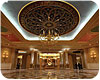
Venetian
Macao Resort
Walls & Ceilings is honored to present the winners of our annual Excellence in Design Awards contest. The categories awarded this year are Ceilings, Drywall, EIFS/Stucco, Interior Plaster/Ornamentation and Metal Framing. The entries were judged by a panel of W&C staff and members of its editorial advisory board.
We asked each company to submit a profile of the job. In this profile, each company talks about the job and some of the challenges, an overview of the finished product and why they should win.
Congratulations to all the recipients of the awards and to all those that submitted projects.
Yoshi’s
San Francisco
DRYWALL
The Raymond GroupYoshi’s San Francisco
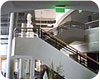
Yoshi’s Japanese Restaurant and Jazz Club opened its new venue at 1330 Fillmore in November 2007 as the centerpiece of the Fillmore Jazz District revitalization. A San Francisco Chronicle reporter recently described the San Francisco nightspot as having “… curving walls, wave-like soffits and a mix of light and dark wood. The club itself, washed in pale lavender light glowing from inside Plexiglas entry panels, is a two-story fan shaped amphitheater with a semi-circular stage.” The club seats approximately 100 persons on each of its two levels. The restaurant accommodates approximately 100 in its main dining floor with additional seating in the upper VIP lounge area.
Construction of this intricate building designed by architects Morimoto, Matano, and Kang began in 2006 and took 13 months to complete the framing and drywall scope. The original schedule showed a four-month framing and drywall duration; however the permitting process and re-designs extended the grand opening from May to December 2007. Due to the additional time added to the schedule, Raymond’s superintendent Mike Voss was able to work closely with the general contractor Qualogy Construction to coordinate the many curved walls, ceilings and soffits. Voss was also instrumental in coordinating the other trades to avoid conflicts in building the ever-changing design drawings on this project.
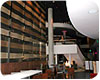
The finishing of this soffit was a challenge for taping foreman Josh Helmer because the adjacent two-story curtain wall puts the soffit into critical lighting conditions. Helmer overcame the challenge of the curves by going above and beyond the specified Level 4 finish, ensuring the highest quality of the final product.
Another construction challenge was encountered where the concrete deck above the restaurant transitions to a metal pan-deck above the jazz club. This posed additional challenges because the structural engineer required that soffits suspended from the pan-deck be supported by a grid of unistrut. This was a puzzle of unfamiliar pieces for crews to assemble 25 feet in the air following yet more radii. Crews quickly conquered the learning curve and met their production goals.
Materials/Products:
- Drywall and taping materials: USG
- Metal Studs: CEMCO
Walsh
College
CEILINGS
Ann Arbor Ceiling & Partition Co. LLCWalsh College, Troy, Mich.
The Walsh College Barry Center is a signature building addition to the Walsh College in Troy, Mich. This project features a new lecture hall, library, and conference and classroom space.
The interior ceilings were a complicated arrangement of modular components and custom layouts. Almost every lay-in ceiling was a sloped floating cloud resulting in a great deal of layout for the carpenters. In addition, throughout the rectangular grid ceiling system in the media center, trough lights and mechanical diffusers were placed at angles aligned with the exterior wall construction. This level of detail proved difficult and required precise coordination between the electrician, HVAC, and the ceiling installers.
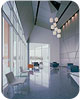
The most ornate feature in the building is the custom manufactured perforated metal ceilings and matching walls in the lobby and connector link. The architect, Valerio Dewalt Train, incorporated its folded plate design extending from the exterior skin through the windows and into the interior elements, such as the custom ceilings, walls and floors. Exterior joint lines, such as the seams in the exterior rainscreen and window mullions, repeat inside to align with interior building features, including the joints in the custom metal ceilings.
AACP worked very hard with the construction manager George W. Auch Co., to understand and coordinate the complex geometry required by these installations. Working from 3-D X, Y and Z coordinate points provided by the architect for joint lines and points of inflection, AACP had to offset the framing to be positioned in or out from each point to accurately accommodate the depth of the metal ceiling panels. The framing for these custom panels had to be in place before field measuring and fitting templates for the manufacture of the ceiling panels to ensure that they would fit properly. Each panel was fitted individually and hand bent to ensure accuracy to the field dimensions. The multiple slopes and varying panel sizes proved to be a daunting task for suppliers, subcontractors and carpenters to maintain the architect’s expected joint pattern and tight tolerances. No two panels were alike.
Another unique feature of the metal ceilings was the integration of the natural lighting and trough down lighting. In the lobby atrium there is a multi-story storefront/curtain wall that cascades light upon the metal ceilings and walls. This utilization of natural light and highly reflective surfaces reduces the need for artificial light, helping to achieve energy efficiency and sustainable building practices.
The entire construction team was dedicated and focused on the architect’s design intention, worked hard on the intricate details of these unique ceiling applications and ultimately achieved the exceptional results the client had expected.
Materials:
- Mars Ceiling Panels: Fineline Grid System: USG
- Custom Metal Panels: Aluminum Supply Co.
- Perforated Sheet Metal Stock: Harrington & King
First
National Bank of Desoto
EIFS/STUCCO
P&M Plastering Contractors Ltd.First National Bank, Desoto, Texas
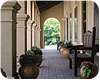
The Spanish Colonial revival architectural style of this uniquely designed 34,000 square foot banking facility was created with traditional lath and plaster and ArcusStone. The design is articulated by the clay tile roof and an intricate façade with courtyards, columns and arches. Design accents include fountains, an outdoor fireplace, ornamental iron and tile insets.
Ornate plaster detail created by hand-run molds is becoming a lost art, but fortunately, P&M Plastering’s experience runs deep. Lathing and plastering crews were able to create the many design details and precision work that makes this project unique. Craftsmen created a plaster canvas on which the interior and exterior tile was installed and the columns and detail on the arched entryway were created by filling negative molds with ArcusStone. Sixty-eight hundred lineal feet of plaster details were created with 28 hand run plaster molds. The architect specified that no foam shapes were to be used on the project. Quality finishing attention was necessary where the plaster finish abutted the many decorative elements.
Materials:
- ArcusStone Coat: ArcusStone
- Stucco: ParexLaHabra
Venetian
Macao Resort Hotel
INTERIOR PLASTER/ORNAMENTATION
Southwest Progressive EnterprisesVenetian Macao Resort Hotel, Macao, China
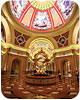
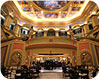
As the largest casino development in the word, the Venetian Macao is a highly themed gaming and retail destination. Designed as a series of experiences and environments, the casino floor encompasses five distinct gaming zones, each with their own set of finishes and design aesthetics influenced by an Asian sensibility. Additionally, the heavy “Italian” inspired public areas of the project required custom plaster techniques and products. A unique design palette was designed for each of these themed areas, creating custom wall finishes that enhance and compliment the overall design concept.
Materials used:
- Magna Stone by SPE
Downstream
Hotel and Casino
METAL FRAMING
Green Country InteriorsDownstream Hotel and Casino, Quapaw, Okla.
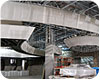
The new Downstream Casino Resort, located in northeast Oklahoma, offers 70,000 square feet of casino floor space plus a 12-story hotel with all of the amenities of Las Vegas. An integral component of the interior theme of the casino, owned by the Quapaw Tribe of Oklahoma, is the use of radiuses and curves to reflect the history of the tribe’s movement down the Ohio River to the Mississippi River and eventually west to Oklahoma.
Designed by JCJ Architecture, of Hartford, Conn., the Downstream Casino project utilized more than 10,000 feet of Flex-C Angle and nearly 9,000 feet of Flex-C Trac. The systems provided an easy way for builders to frame high quality curves by utilizing a simple, flexible metal track or plate for use with wood or metal studs. Installation of the Flex-C Trac and Flex-C Angle was done by Green Country Interiors, Tulsa, Okla. The job was on a tight schedule in order to be completed by the much-publicized grand opening date of July 4, 2008.
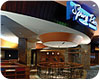
“We had hundreds of lifts at the site. Whenever we’re under the gun like that, all of the other trades are, too,” McGuire said. The general contractor, Manhattan Construction Co., of Tulsa, Okla., did a great job of coordinating and organizing, noted McGuire.
Materials:
- Drywall: National Gypsum Gold Bond, American Gypsum, Georgia-Pacific
- Insulation: Owens Corning
- Metal Framing: CEMCO
- EIFS: TEIFS
- Synthetic Stone: Impressions in Stone
- Ceilings: Armstrong, USG, 9Wood
- Flex-C Trac and Flex-C Angle: Flex-Ability Concepts
If you read this article, please circle number 206.
Looking for a reprint of this article?
From high-res PDFs to custom plaques, order your copy today!