Construction Safety
The Dangers of Drywall Stacks
Secure, Warn and Protect
Do you understand the importance of drywall safety?
Table of Contents
- Do They Know What You Know?
- Perceived Weight vs. Actual Weight
- One Irretrievable Moment (Accidents Happen)
- Requirements—Regulations
- We Want Everyone to Go Home Safely
Right before the first drywall sheet is hung, there is a brief time window when framing is complete, mechanicals are in place and every outlet and wire is in full view. Contractors, customers, inspectors and architects along with various trade and service professionals, can be found at the project site. They come to measure, inspect, approve and verify that no detail is overlooked before the walls are obscured by drywall. And this is also the time when jobs are typically stocked with drywall.
Stocking methods vary by structure, floor plan, job circumstance, geography and local custom. The merits of laying sheets flat vs. placing sheets upright has been debated for years with no consensus between parties who manufacture, distribute and install drywall. One faction believes drywall should always be laid flat while the other insists there is an unnecessary ergonomic impact for workers who deliver and install drywall. When stockers are required to place sheets on the floor and installers must then lift sheets off the floor, the repetitive action can take a physical toll on the musculoskeletal system.
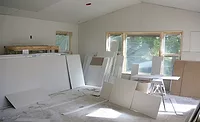
In a perfect world, all drywall deliveries would be made with a level site, easy access and all work done by hydraulic equipment—but this is not the real world of construction. One fact that is not in dispute, drywall is delivered and placed upright on jobs all across North America every work day. How do we warn and protect people who come in contact with upright drywall stacks and who have no knowledge of the potential harm they may encounter?
Do They Know What You Know?
While you may know how to safely handle and store drywall, never assume another person knows what you know—even when it is a tradesperson who is on the job every day.
Drywall professionals know that pulling a stack forward is hazardous. Imagine two drywall stockers loading a job when they see a plumber begin to pull drywall sheets away from the wall. Would they stand there and watch him do it? Of course not, they would call out or leap into action and prevent the person from pulling the sheets down on top of himself. Leaving a job with an unsecured vertical drywall stack and no warning provides the exact same potentially dangerous condition without a team of professional stockers on standby to prevent an accident.
A vertical stack of drywall does not have an obvious appearance of danger and does not necessarily merit the attention and caution one would give climbing a stair with no railing or avoiding close proximity to an unguarded opening in a floor. This is just one reason that people will stand close enough to a stack without realizing the hazard and be struck by falling drywall when someone else causes the stack to become unstable. Another cause of drywall accidents occurs when people who do not understand the weight of drywall pull it forward to check for an outlet or wire.
Perceived Weight vs. Actual Weight
How does this disconnect between the perceived weight and actual weight of the sheets occur? Ten sheets of drywall, placed on the floor, would be virtually impossible to lift all at once—and yet a vertical stack can be pulled forward one sheet at a time, with minimal effort.
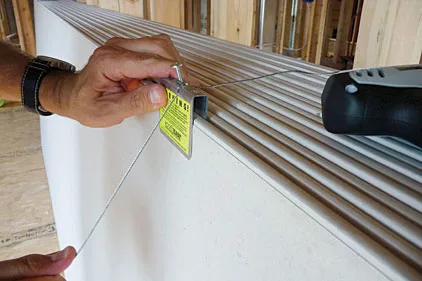
A stack weighing a thousand pounds, when tipped over, will gain momentum as it falls. By the time it reaches the floor, the force will reach 6,000 pounds. When drywall is delivered to the job and placed upright against a wall, special precautions must be taken. Drywall sheets placed on edge should always be secured against tipping and with a restraint method that can be easily reapplied. The stack should also be labeled with a warning or caution sign that states the potential danger of attempting to move heavy drywall sheets.
Brendan Nair of Kobrin Builders Supply, a Foundation Building Materials Co., understands the essential importance of drywall safety, “At Kobrin Builders Supply, safety is a top priority and our core value. We believe there is nothing we do that is so important that we cannot do it safely. We are not only concerned about our own employees’ safety, but are equally concerned about the safety of our customers, their employees, the general public, and the entire building community. There are multiple benefits of stocking drywall upright. However, significant hazards can be created with this process if precautions are not taken. Incidental or accidental drywall stack tip over can result in life changing injuries or death. We know that securing and placing a warning label on each stack of vertically stacked drywall results in a safer worksite and protects everyone who may be in the proximity of the stack.
“Kobrin Builders Supply has taken a proactive approach on this issue by securing all vertically stacked drywall with a securing device that not only secures but also warns of the potential hazards of each vertically stacked lift,” Nair continues. “Our company recognizes the multiple potential hazards on construction sites and we want to make sure we do not create any additional hazards to any jobsite. We know that securing and placing a warning label on each stack of vertically stacked drywall results in a safer worksite and protects everyone who may be in the proximity of the stack.”
One Irretrievable Moment
A registered professional engineer with a doctorate degree walked up to the second floor offices under construction at the company where she works to check on available electric outlet locations for a plotter and printer.
As the engineer entered the space, she saw drywall sheets had been placed upright, directly in front of the wall where she planned to check for an outlet.
Cautiously, she pulled on the drywall sheets and found that the stack was easy to pivot forward. All that was needed to verify the outlet location was to pull the sheets forward far enough to look behind the stack. At the exact moment the sheets tipped past vertical, the engineer knew she was in trouble. No longer able to control the sheets, the engineer, who played Division One basketball at Princeton, tried to avoid being struck by jumping out of the way, but there was no way to outmaneuver the force of ten 4-feet-by-12-feet drywall sheets in free fall. The sound of the impact and screams sent co-workers racing to her aid. The first person on the scene frantically tried to free the engineer but it took two more people to arrive until there was enough combined strength to remove the heavy sheets.
The emergency room doctor described her injuries as somewhere between a hit from an NFL linebacker and a serious car accident. The engineer could believe it—the pain was intense and she was in shock, it was difficult to process what had just happened—all from pulling on a few drywall sheets. The engineer was told she would need surgery but with a commitment to rehabilitation she would make a full recovery. And then day three brought a stunning call from her orthopedic doctor. Test results arrived that made the doctor fear her femoral artery was seriously damaged and sent her immediately to the emergency room at The Hospital of the University of Pennsylvania. For several hours, the engineer lived with the fear that she would lose her leg.
Looking back on the day of the accident, the engineer says, “It was not my finest moment,” but when asked what she believes would have made a difference to prevent her from pulling the drywall forward she responds, “A warning, it just never occurred to me that drywall weighed so much or could fall with that force, it was very frightening.” Asked about the progress of her recovery, “The accident happened over nine months ago and I have had major surgery, spent three months on crutches and I still go to physical therapy twice a week. It has been a long road but I will be back to 100 percent.”
Requirements—Regulations
Home builders have the added challenge of keeping jobs safe when home buyers and their families appear on the job before, during and after work hours. In order to keep customers, tradespeople and visitors safe from the hazard of falling drywall, more national, regional and local builders have begun to require edge stacked drywall to be secured as part of the subcontractor scope of work.
The Division of Occupational Safety and Health, known as Cal/OSHA, protects workers from health and safety hazards on the job in almost every workplace in California. Cal/OSHA by regulation may issue a citation and or penalty for unsecured drywall stacked on edge under the California Code of Regulations, T8CCR 1549(d). Piling Material.
Gypsum board, plywood, trusses, and similar material shall not be stacked on edge unless positively secured against tipping or falling.
We Want Everyone to Go Home Safely
Drywall accidents have occurred on residential and commercial jobs and the victims come from all walks of life and include a wide range of ages from infant to elderly. It is incumbent on the drywall industry to foster proactive and positive steps toward education in order to prevent drywall accidents from happening in the future.
Nair believes Kobrin is on the right track, “Kobrin Builders Supply has taken the leadership role in Florida by providing securement, warning, and protection to every vertically stacked lift of drywall. We feel it not only adds value to our services but more importantly we know it is the right thing to do. We want everyone to go home safely every day and are committed to doing our part to make that happen. After all, excellence is never an accident.
Looking for a reprint of this article?
From high-res PDFs to custom plaques, order your copy today!