Preserving a Heritage Starts with Pre blended Stucco
The use of stucco as an exterior plaster cladding dates back thousands of years but it wasn’t until the late 19th century when it became a popular construction material in the United States. Driven by advancements in Portland cement and the public obsession with Mediterranean architectural styles already prevalent in California, the Southwest and Florida, stucco gained a foothold across the United States, as well as Canada. The result was a boom in individual and multi-family housing, hotels, hospitals, retail centers, government and private sector offices, railroad stations and other structures constructed with stucco. Today, however, we’re challenged with finding the most effective and efficient ways to preserve our national stucco treasures before it’s too late.
Look no further than the award programs across the country or review the list of National Historic Landmarks to gain a full appreciation for the growing desire to preserve stucco structures. The incentives for owners, architects, specifiers, contractors, distributors and others vested parties may vary from tax incentives and LEED credits to patriotism and community goodwill but they share a common goal—retain or reclaim the interior and exterior beauty afforded a structure adorned with stucco. The approach and process to preservation has evolved over time, but in recent years it’s become critically grounded in the use of pre-blended stucco materials.
Originally used primarily on interior walls and ceilings as an ornamental finish for creating different reliefs, moldings, and cornices as well as providing a smooth finish over substrates, stucco mixed on site was not a particularly permanent or long-lasting building material. That changed with pre-blended stuccos that enhance quality and simplify production.
Some prominent U.S. manufacturers offer the convenience of premium pre-blended materials containing all the components required for a quality stucco base, scratch and brown coat, including alkaline resistant fibers, workability enhancers, and graded sands to add strength and reduce cracking. These bagged products, available in 80-pound bags or 3000-pound Super Sacks, are mixed with sand and water at the job site. In addition, other traditional cement manufacturers have improved their cement based formulas to include more workable blends that include fibers. The combination of these factors makes pre-blended stucco the preferred material on historic preservation projects.
As it goes with historic building expansions, innovations with exterior stucco coatings, along with elastomeric or acrylic finishes, pre-blended stucco will add to an extended building life with proper design techniques. These innovations also allow that virtually any color or texture can be achieved in preserving the original design and architectural feel, and add to the structure’s longevity.
The Perfect Project
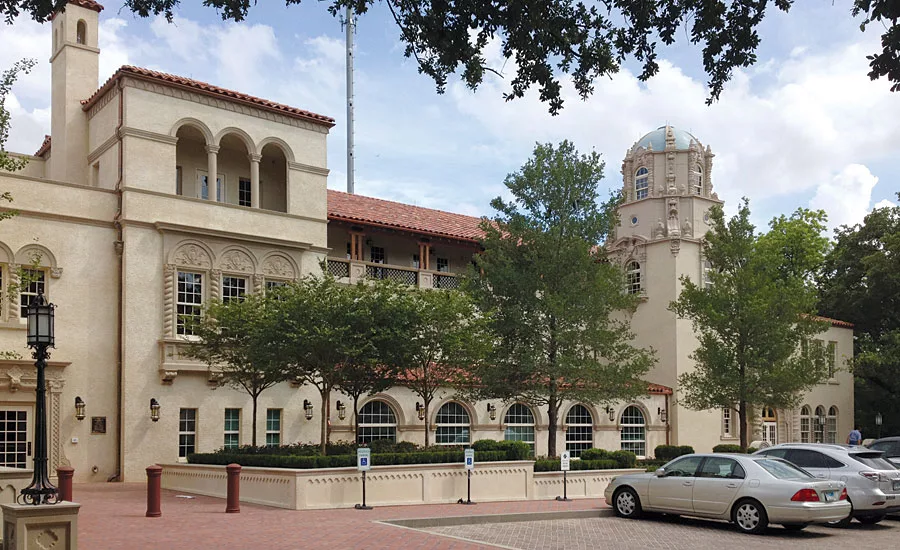
A perfect example is the Highland Park Town Hall project in Highland Park, Texas. The city known as The Towne of Highland Park is located just north of downtown Dallas and is the hometown of Southern Methodist University.
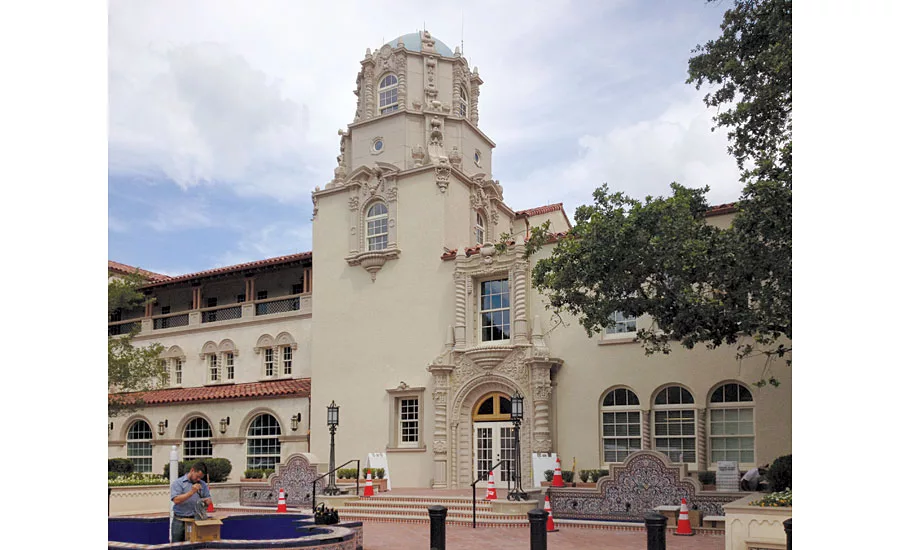
First constructed in 1924, the goal was to expand the original town hall building for other departmental facilities without losing the charm of the original Spanish Colonial architecture. The final design improved efficiency of electrical and HVAC systems in addition to adding space for updated communications and personnel. The renovation of the town hall and tower had to match the building’s original appearance, and the new construction had to follow the same architectural design which called for a seamless transition between the old and new structures.
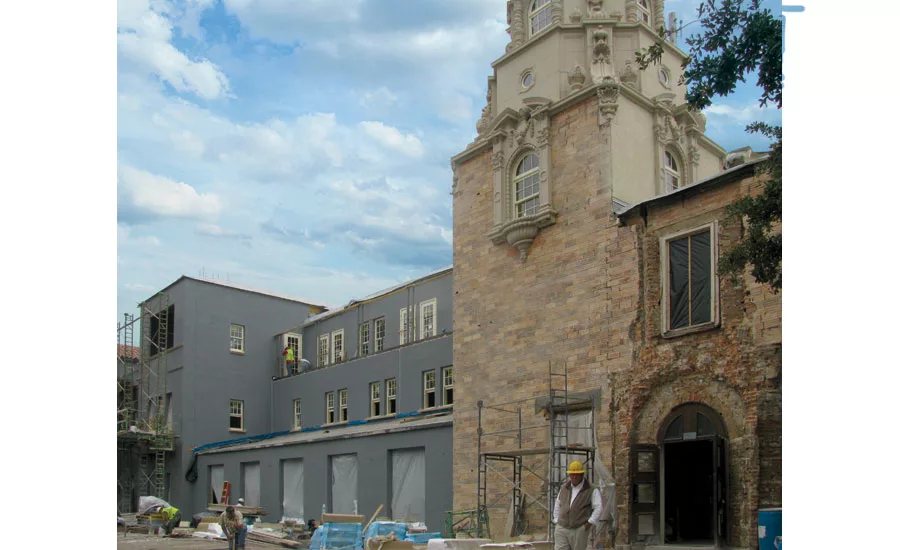
The design and mechanical changes posed a number of challenges. First, no lath or control joints could be used because of the aesthetic inconsistency between the old and new buildings. Secondly, the substrate under the old stucco was an uneven layer of clay fired masonry units that in some areas was as much as a 1¼-inch out of plane.
In consideration of the extraordinary history and significance of the structure, the architect engineer came up with a documented scope of work and project guidelines to ensure that the best materials and installation methods were used in light of the project’s extraordinary installation conditions.
The new addition to the building was installed using expanded metal lath without control joints to maintain the appearance of the original building. After carefully removing the old stucco and cleaning the surface, more than 15,000-square-feet of QUIKRETE Base Coat Stucco – Pump Grade was directly spray-applied over the clay brick veneer walls up to 1-inch thick. An extended cure time used in accordance with the project guidelines benefited the outcome in the application as well. Both sections were meticulously water fogged to provide a quality curing process. To complete the stucco aesthetics, an acrylic finish with a fine texture was applied to all stucco surfaces.
Multiple lifts (layers) of stucco were applied to level the uneven surfaces created by the brick substrate. To reduce possibility of surface cracks an extended cure time between lifts was included in the scope of work document. Cure times were no less than seven days between layers until the final surface plane was achieved. By adding this to the scope of work, the contractor was able to work at the pace of the material, not the financier.
At completion, the Highland Park Town Hall project truly achieved a seamless combination of old style stucco application with today’s new methods of performance. As a result, the project was awarded the Pinnacle Award, which is presented annually to the best stucco project of the year by the Texas Lathing & Plastering Contractors Association. While winning an award probably wasn’t the incentive for anyone involved with the project, the recognition certainly reinforces the value of using pre-blended stucco on an historic preservation.
Looking for a reprint of this article?
From high-res PDFs to custom plaques, order your copy today!





