Industry Voices: Protect Brand Integrity with Soundproofing

You’ve spent a restless night in a hotel because the guy next door decided to stumble back into his room at 3 a.m. and fell asleep with the TV blaring. Your company has moved into a new office building, and all you can hear is your colleague in the next room on a conference call with a client. Or maybe your neighbors keep their stereo blaring, no matter what time of day it is. All it took was a couple of badly soundproofed walls and your entire well being suffered.
Someone’s reputation suffered as well. Your impression of that hotel plummeted, and you probably conveyed your dissatisfaction to the hotel management, your friends, family, co-workers, and perhaps even on the review section of a travel Website.
And perhaps your colleagues and neighbors had a few uncomfortable moments when you went over to ask them to dial the conversation or the music down.
Now, in each case who are they going to blame? This is a problem that the architect or builder of the space they occupy should have addressed.
What this means is that your own reputation-and by extension your business-as an architect or contractor can be put at serious risk if you don’t address soundproofing proactively at the very beginning of the building planning process. Whether you’re building a home, an office, a hotel, or a hospital, any unwanted noise coming from a stereo, a conference room, a dining area, or lab, can ruin your customer’s experience. And that can raise the issue of poor construction.
That can be lethal for a business in this market. The integrity of your brand as an architect or contractor will be compromised if a customer starts thinking they have spent a huge amount of money on a new building that isn’t shielded against irritating external or internal noise. As a result, even though you’ve spent a lot of time and energy building a solid reputation for your business, all it takes is one dissatisfied client and you’ll end up with the wrong kind of publicity-as a designer/constructor of noisy buildings. You could start to see your reputation, referrals and your bottom line slip away, and in today’s unstable economy, you simply can’t afford that.
There are, and have been for some time, a number of easy and affordable soundproofing techniques available on the market. However, more often than not, they are employed after a building has been constructed-when you have to react to an existing problem-rather than being taken into consideration and planned for in advance.
It cannot be emphasized enough how important it is to consider soundproofing up front-during the design and development phase of a building. Not only is it good planning, but it will work out to be far more economical in the long run.
This article will highlight the five main soundproofing principles you need to be aware of for a new building: mass, mechanical decoupling/isolation, absorption, resonance, and conduction. We will then provide some practical guidance on easy-to-apply and inexpensive soundproofing techniques. Each of these principles is inter-related-and they are all important-but you don’t actually need to deal with every one in order to have effective soundproofing. Even two or three strategies will yield positive results.
When constructing a partition in virtually any building scenario, the more mass a room’s walls have, the better soundproofing you will achieve. Increased mass absorbs more sound, so less gets through the wall to the other side.
However, you would actually have to add a huge amount of mass on its own to a partition in order to see a substantial improvement in soundproofing. Simply adding layers of drywall by themselves to a standard wood stud wall or wood joist ceiling will only provide a marginal improvement. For example, doubling the number of drywall layers would only reduce sound transmission by about 4-5 dB.
If you want to achieve greater soundproofing results, your best option is to look at adding mass while also making improvements based on the other four principles cited below.
Principle 2: Absorption
Adding insulation inside a wall or ceiling cavity to absorb sound is a very well-known and commonly applied technique. It is also, of course, a great thermal insulator.
Builders and homeowners alike will often use fiberglass batts as their insulation of choice, and for many people that is enough. The advantage is that you do not have to worry too much about the thickness of the insulation in terms of its soundproofing effectiveness-you can use batts ranging from R13 all the way up to R19.
For stronger sound absorption, you might want to consider using a viscoelastic damping material like noiseproofing compound. Adding just one layer of the compound between two sheets of drywall can effectively eliminate up to 90 percent of noise, even at low-frequencies.
Principle 3: Mechanical Decoupling/Isolation
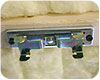
When you are building a new wall from scratch, mechanically decoupling or isolating a wall using double studs, staggered studs, sound clips, or a resilient channel prevents noise from moving from one side of the wall to the other through physical vibration. Instead, with mechanical decoupling, the sound vibrations are forced to pass through the air cavity within the wall, where some of them are lost.
Mechanically decoupling a wall is a proven soundproofing technique in most new construction cases, but it’s important to note that it is frequency-dependent. Here, decoupling a wall creates resonance that limits the soundproofing effectiveness against frequencies well above the resonance level (see Principle 4 below for more details about the principle of resonance and how to counteract it). In fact, from roughly half an octave above the level of resonance and below, decoupling can actually makes things worse.
So if you choose to employ mechanical decoupling, you should plan around the resonance and the low-frequency performance problems it can cause.
Depending on the characteristics of the room you’re designing, the use of noiseproofing clips might be a great help. Some noiseproofing clips are designed with maximum low-frequency sound isolation in mind, and they can reduce a significant amount of noise. Rated with sound transmission class values in the 60s, they are among the highest-performing sound clips available today.
Principle 4: Resonance
If you have effectively moved the resonance point of a wall by employing all three of the principles above, then you are less likely to encounter sound at lower frequencies, which will in turn reduce the wall’s ability to resonate (vibrate).
However, if resonance is still a problem, the best way to counter it is to dampen it by insulating the cavity.
Limp-mass materials like MLV (mass loaded vinyl) do not do a good job at damping the resonances of walls, but commercially available pre-damped drywall and flooring can provide better results. You will see the best results by combining noiseproofing compound with noiseproofing clips.
Principle 5: Conduction
While mechanical decoupling is very effective in blocking noise through the walls, conduction can cause serious soundproofing problems. It is a major contributor to flanking noise-sound that can travel over, under, or around a wall, and it can even pass through ductwork, plumbing, or sonic weak points like doors, electrical outlets, and sealing cracks.
One technique for reducing conduction is to use mechanical breaks or raise the overall sound-damping properties of the structure, and this can have a considerable effect.
You should also consider using an acoustic sealant to protect the remaining weak points when you are putting in the walls. And if you are doing some retrofitting work, the sealant can be applied to cracks between walls, ceilings, floors, windows or doors to effectively reduce noise transmission 100-fold or more.
It is increasingly important to consider soundproofing at the beginning of a project, rather than as an afterthought-that way, you can avoid problems with dissatisfied customers later down the line. Otherwise, no matter how impressive a new building may be, unwanted or irritating noise might be the only thing they remember.
By incorporating soundproofing strategies early on in the planning and construction, you can increase the value of the investment and strengthen your own brand. And that’s a sure way to keep your customers happy and coming back with more business.
Looking for a reprint of this article?
From high-res PDFs to custom plaques, order your copy today!