The Basics of Stucco
Throughout the discussion of stucco, it is important that one keeps in mind at all times, the differentiation between stucco being applied over a solid, i.e., concrete or block substrate, as compared to a wood or metal stud flexible substrate. There are many reasons for keeping this differentiation in mind, not the least of which is that the stucco over a solid substrate can be applied directly to the substrate, following ASTM C 932, whereas, stucco over frame, metal or wood flexible substrates, must include the requirements of ASTM C 1063, thus adding an entire new standard to the stucco requirements when applying it over the flexible substrate.
Stucco reference material
There are some basic stucco references that are essential for the designer, the consumer and the applicator. These references, although few in number, contain a wealth of information necessary for the proper design and the proper application of the product.• "Portland Cement Plaster (Stucco) Manual" by Portland Cement Association.
• Standard Specification for Application of Portland Cement Based Plaster-ASTM C 926.
• Standard Specification for Installation of Lathing and Furring to Receive Interior and Exterior Portland Cement-Based Plaster. ASTM C 1063.
• Standard Specification for Surface-Applied Bonding Compounds for Exterior Plastering-ASTM C 932.
Oftentimes, when things go wrong on a project, fingers start pointing from one to the other.
• Is it the problem of the materials?
• Is it the problem of the design? Was there adequate detail to accomplish the desired effect?
• Is a problem that the application was not done correctly? Did the applicator just goof up and do it wrong.
To ensure the performance of stucco, it should be designed to meet the national standards as set forth for the proper design and application of stucco. The Florida Building Code and the national model codes all reference ASTM C926 and ASTM C 1063 as the requirements for stucco. We'll take a look at these standards.
ASTM C 926
The first standard is ASTM C926 "Standard Specification for Application of Portland Cement Based Plaster (Stucco)."It should be noted that less than 5.2, solid surfaces (block or concrete) may have stucco applied directly on the solid surface if they achieve bond with the stucco. However, non-solid surfaces, such as steel stud or wood framing, require a metal base be installed prior to the application of the stucco. The requirement for the metal base is covered in ASTM C 1063. There is a world of difference between installation on a solid substrate and a metal base.
The thickness of stucco on a solid substrate is 5/8 or 1/2 inch. However, on metal base the thickness is 7/8 inch. The additional thickness of stucco on metal base is required to attain the desired hardened cementations properties.
The cost of stucco applied directly to a solid substrate is always less than on a non-solid substrate due to the additional metal base requirement and the additional thickness requirement for stucco on the metal base.
Recently, a CPA firm was considering building a new office and a contractor priced the stucco application for a stud wall and a solid wall at the same price. The requirements are so different that one of two things may have occurred. Either the contractor was planning to provide a substandard installation on the stud application or he was making additional profit for the application of stucco on the solid substrate. Additional discussions with the contractor did verify the anticipated large differential.
ASTM C 926 covers the stucco materials, the application, the curing and in the appendix it discusses bonding agents.
ASTM C 1063
ASTM C 1063 "Standard Specification for Installation of Lathing and Furring to Receive Interior and Exterior Portland Cement-Based Plaster."Some of the key items found in this standard include:
Control Joints. 7.11.4.1 Control joints shall be installed to delineate areas not more than 144 square feet in walls and not more than 100 square feet in horizontal applications. 7.11.4.2 Distance between control joints shall not exceed 18 feet in either direction or a length-to-width ratio of 21⁄2 to 1. It should be noted that control joints in stucco over solid substrate walls should be installed only at locations that they are installed in the solid substrate.
Accessories. 6.2.2 Accessories shall be fabricated from Zinc Alloy *99 percent pure. Zinc galvanized (zinc coated) steel, rigid PVC or CPVC plastic, or anodized aluminum alloy. Note 1. The selection of an appropriate type of material for accessories shall be determined by applicable surrounding climatic and environmental conditions specific to the project location, such as salt air, industrial pollution, high moisture, or humidity. Due to the variations in climatic conditions and coastal areas in Florida, this item is of particular importance and more attention should be paid to assure that the accessory selection is best for the specific location.
Lapping of Metal Plaster Base. 7.8. Metal lath shall be lapped 1/2 inch at the sides and 1 inch at the ends. Where paperback lath is used the lap should be paper-to-paper and lath-to-lath.
ASTM C 932
ASTM C 932 "Standard Specification for Surface-Applied Bonding Compounds for Exterior Plastering."A recent review of jobs selected throughout Florida found that approximately 80 percent of them were using an "interior"-bonding agent on the "exterior."
The correct bonding agent for use on exterior work shall meet the requirements of ASTM C 932. There is no addendum to this requirement. Oftentimes, when an interior grade-bonding agent is used, the stucco will de-bond and fall off of the project. The interior grade-bonding agent is less expensive and that is probably why it has become popular in use but it will eventually-if not early on-give big problems to the project. A recent school job was using an interior-bonding agent on the exterior and it was de-bonding even before the school building was finished.
To ensure that the proper standards are applied, the architect's specification should include phrases, such as:
• The Portland cement based stucco shall meet the requirements of ASTM C926.
• In areas requiring a metal base the requirements and standards of ASTM C 1063 shall be implemented.
Additionally, if a bonding agent is required (in accordance with ASTM C 926 5.2.2.3), for exterior use, it shall meet the ASTM C 932 standard for bonding agents. Remember on solid substrates another way to obtain good bond may be in accordance with ASTM C 926 5.2.2.2, that is using a "dash-bond" coat applied forcefully and directly to the solid substrate. Recently, MIT had the opportunity of reviewing a multi unit housing project whereon the applicator was using a chemical bonding agent. MIT recommended that they might try to utilize the "dash bond" coat. A couple months later, MIT had the opportunity to revisit the same project and the contractor reported that he had switched to the "dash bond coating" and was doing a better job and saving money.
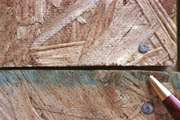
The frame substrate is oftentimes sheathed. When this is the condition, the sheathing must have a gap between sheets of sheathing. An 1/8-inch gap is normally the required gap, otherwise if the substrate gets wet, it will swell and with no gap, it will cause severe cracking of the stucco due to movement of the substrate (photo 1).
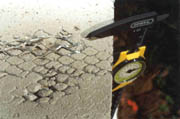
Table 1 in ASTM 932 spells out the proper thickness of stucco. The measurement on lath is from the back of the lath to the face of the coat being measured. For stucco on frame this is 7/8 inch. This illustration shows a measurement from the backside of the lath- not including the stucco beyond the backside of the lath (photo 2).
Some building codes require one layer of paper as a moisture barrier. In part of the country two layers are required. Let's take a look at the options.
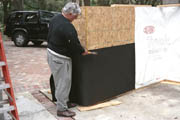
Years back, it was common that the builder would apply a layer of felt and the stucco applicator would apply paperbacked lath over the felt, thus achieving two layers of moisture barrier (photo 3).
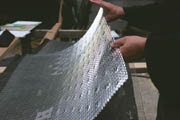
In today's way of building this would generally equate to the builder applying a wrap material such as Tyvek and the stucco contractor would apply over the wrap the paperbacked lath, thus achieving two layers (photo 4).
Gary Maylon's "The Metal Lath Handbook" explains that the felt is highly water resistant but also felt tends to have a very low vapor permeability. Therefore, moisture that finds its way into the structure oftentimes, when felt is used, has a difficult time escaping from the structure due to the low permeability of felt. He further explains that the lath industry generally recommends the use of Grade "D" paper that meets Federal Specifications UU-B-790A, which maintains a high degree of vapor permeability.
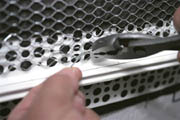
In accordance with ASTM C 1063 7.10.1.4 "Lath shall not be continuous through control joints, but shall be stopped and tied at each side (photo 5)." The lath should be discontinuous behind the control joints.
Joints in the accessories, being either metal or vinyl, are a potential point of water intrusion, which can cause deterioration, delamination, mold, mildew and more. Maylon's handbook suggests that at some joints it is essential that building paper be placed behind the joints and that a bed of good quality caulking be applied under the joints prior to the attachment of the horizontal expansion joint.
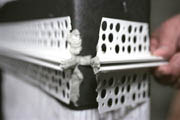
Although CSI format places caulking under Specification 07920-Sealants and Caulking. MIT recommends that the sealant and caulking of the stucco accessories also be covered under the stucco sections 09220 and 09205. Sealant and caulking are required in these sections because the sealant and caulking requirement of the accessories take place at the time of the stucco to work, as well as later when the normal caulk and paint takes place. It should be noted that at all intersections and ends of the metal accessories, caulking is required (photo 6).
The metal accessories should be caulked prior to stucco application. Some instructions, like from Alabama metals recommended that the control joints be set into a bed of caulk.
Sometimes, the stucco applicator thinks that this is paint and caulk recommendation, but to do it right it must be done at the time before the stucco is applied. Therefore, it becomes a function that the stucco trade does.
Point: This caulking should be done at all exterior corners, all interior corners, all butt ends, i.e., all joints in the metal lath. I would ask for the stucco contractor or the caulking company to demonstrate their technique on some of the problem areas. The caulking applicator should demonstrate that the caulk sticks to the accessory as well as to the stucco and substrate.
Looking for a reprint of this article?
From high-res PDFs to custom plaques, order your copy today!