Let's Get Real About Fall Protection for Scaffold Erectors
The Scaffold Industry Association calls for change.
There is no doubt that fall protection, particularly personal fall arrest equipment, has made tremendous advancements over the last 10 years or so. Harnesses, attachment hardware, ease of use and comfort are positive indicators that fall protection manufacturers have achieved impressive successes. While this has helped the scaffold erector and user, the regulations that were written more than a decade ago have not kept pace with the reality of the situation.
Frankly, nobody is behaving. The bottom line is that selective enforcement of the fall protection regulations has replaced consistent regulatory enforcement. Before we suggest a solution, a review of the regulations is required to identify the dichotomy of the situation.
The federal OSHA regulations, (state regulations are similar) require that an individual using personal fall arrest equipment comply with certain requirements, designed to ensure that the use of personal fall arrest equipment is effective in minimizing injuries and preventing deaths. These original requirements include:
 What
Experience Tells Us
What
Experience Tells Us
If experience is an indicator, nobody complies. Furthermore, nobody is enforcing all of these standards. When a general contractor requires 100 percent fall protection, either it’s not happening or they aren’t complying with the regulations listed above. Sure, the contractor is adamant about everybody being connected to something but will it really be in compliance if the errant employee falls? And if the employee were to fall, do we really care if he/she is in compliance as long as this employee is able to go home to spouse and family?
Here’s a solution: Waive the personal fall protection for scaffold erectors. Give erectors an exemption on the above requirements. This will eliminate the constant battle between the safety folks and the erectors. Sure, if an erector falls while tied off to the scaffold, he may damage the scaffold. If he is wearing a shock absorbing lanyard, chances are that the force on the scaffold will be considerably less than the 1,800 pounds and nowhere near the 5,000 pounds. Of course, the flip side of this is that the erector cannot argue that fall protection is impossible because a 5,000 pound anchor cannot be found.
For users, the situation is not similar. I do not advocate waiving the rules for these workers. Passive fall protection, such as a guardrail system, is typically available for scaffold users and is effective. If personal fall protection is required, suitable anchors can be located, either by constructing scaffolds to support potential fall forces, or choosing anchors that are outside the scaffold. Employers must continue to train their employees in fall hazard recognition and to advocate proper fall protection. For scaffolds, this would require complying with the regulations-all of them.
Consider this: Waive the 5,000 pound regulation for scaffold erectors. Waive the regulation limiting the free fall distance for erectors. This will legally permit scaffold erectors to tie off at their feet. Require all scaffold erectors to wear harnesses whenever they are elevated, with the understanding that they are to “tie off” when they are in a stationary mode. Require that all scaffold erectors utilize shock absorbing lanyards and/or retractable lanyards that help minimize the fall forces on the body. Allow the competent person to permit the leading edge erectors to work without fall protection, similar to leading edge steel erectors. Waive the regulation for deceleration distance.
Is the scaffold and access industry up to the challenge of providing reasonable solutions for scaffold erectors? Is OSHA willing to recognize the reality of the trade? Are we willing to do what is right and truly safe for the erector and user of scaffolds? The time has come to remove the cosmetic appearances currently imposed on the scaffold industry and complete Appendix B located within Subpart L of the scaffold regulations and clearly define fall protection for scaffold erectors. W&C
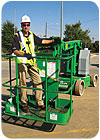
The motion of a boom lift creates the phenomenon not unlike a catapult. The boom can store sufficient energy during movement that it can literally launch the operator up and out of the basket. Scissor lifts and mast climbers don’t develop this type of force and consequently are not normally a concern for fall protection.
What all this means is that on scissor lifts and mast climbers we want to keep the worker from walking/falling off the platform while on boom lifts we want the worker not only to be protected from walking off the platform but also from being launched from the platform. This means the first line of protection on all lifts is the guardrail system. For boom lifts it is also necessary to restrain the employee so he/she never leaves the platform. A fall restraint system is required to do this. Therefore, on boom lifts, not only is there a guardrail system to protect the employee but also an anchor to hook the fall restraint system to. Please note that it is a restraint system, not a fall arrest system that is used.
These machines are sophisticated devices and the manufacturer is the authority on fall protection for his/her specific device. For example, scissor lifts may require the occupant to utilize personal fall arrest equipment attached to the specified anchor. The manufacturer may require other safety devices that are not required by the OSHA standards. If this is the case, you are expected to comply with those requirements provided they are more restrictive than the OSHA standards.
There is no doubt that fall protection, particularly personal fall arrest equipment, has made tremendous advancements over the last 10 years or so. Harnesses, attachment hardware, ease of use and comfort are positive indicators that fall protection manufacturers have achieved impressive successes. While this has helped the scaffold erector and user, the regulations that were written more than a decade ago have not kept pace with the reality of the situation.
Frankly, nobody is behaving. The bottom line is that selective enforcement of the fall protection regulations has replaced consistent regulatory enforcement. Before we suggest a solution, a review of the regulations is required to identify the dichotomy of the situation.
The federal OSHA regulations, (state regulations are similar) require that an individual using personal fall arrest equipment comply with certain requirements, designed to ensure that the use of personal fall arrest equipment is effective in minimizing injuries and preventing deaths. These original requirements include:
- Limiting the force on your body to 1,800 pounds;
- Limiting the free fall to 6 feet (Since the original requirements were issued, OSHA determined that the free fall could be more than 6 feet but the force on the body still could only be 1,800 pounds maximum);
- Limiting the deceleration distance to 3½ feet;
- Not allowing you to hit the level below, and;
- Using an adequate anchor. This anchor must be two times stronger than the load experienced or 5,000 pounds if the anchor is not designed.
If experience is an indicator, nobody complies. Furthermore, nobody is enforcing all of these standards. When a general contractor requires 100 percent fall protection, either it’s not happening or they aren’t complying with the regulations listed above. Sure, the contractor is adamant about everybody being connected to something but will it really be in compliance if the errant employee falls? And if the employee were to fall, do we really care if he/she is in compliance as long as this employee is able to go home to spouse and family?
Here’s a solution: Waive the personal fall protection for scaffold erectors. Give erectors an exemption on the above requirements. This will eliminate the constant battle between the safety folks and the erectors. Sure, if an erector falls while tied off to the scaffold, he may damage the scaffold. If he is wearing a shock absorbing lanyard, chances are that the force on the scaffold will be considerably less than the 1,800 pounds and nowhere near the 5,000 pounds. Of course, the flip side of this is that the erector cannot argue that fall protection is impossible because a 5,000 pound anchor cannot be found.
For users, the situation is not similar. I do not advocate waiving the rules for these workers. Passive fall protection, such as a guardrail system, is typically available for scaffold users and is effective. If personal fall protection is required, suitable anchors can be located, either by constructing scaffolds to support potential fall forces, or choosing anchors that are outside the scaffold. Employers must continue to train their employees in fall hazard recognition and to advocate proper fall protection. For scaffolds, this would require complying with the regulations-all of them.
Consider this: Waive the 5,000 pound regulation for scaffold erectors. Waive the regulation limiting the free fall distance for erectors. This will legally permit scaffold erectors to tie off at their feet. Require all scaffold erectors to wear harnesses whenever they are elevated, with the understanding that they are to “tie off” when they are in a stationary mode. Require that all scaffold erectors utilize shock absorbing lanyards and/or retractable lanyards that help minimize the fall forces on the body. Allow the competent person to permit the leading edge erectors to work without fall protection, similar to leading edge steel erectors. Waive the regulation for deceleration distance.
Is the scaffold and access industry up to the challenge of providing reasonable solutions for scaffold erectors? Is OSHA willing to recognize the reality of the trade? Are we willing to do what is right and truly safe for the erector and user of scaffolds? The time has come to remove the cosmetic appearances currently imposed on the scaffold industry and complete Appendix B located within Subpart L of the scaffold regulations and clearly define fall protection for scaffold erectors. W&C
Sidebar: SIA: We're Not Just About Scaffolds Anymore
Fall protection for aerial lift operators and users, while straightforward in my mind, seems to be a mysterious phenomenon. The Federal Occupational Safety and Health Administration standards that apply to aerial lifts can be a bit confusing. However, once explained, it becomes rather clear as to what is expected of aerial lift users. Besides the standards, a more basic concept can be applied to fall protection for aerial lifts: simply put, what’s the best way to keep users from falling? The American National Standards Institute has a number of classifications for the group of equipment known as aerial lifts. In construction, the four most common types include “Boom Supported Elevating Work Platforms,” “Manually Propelled Elevating Aerial Platforms,” “Self-Propelled Elevating Work Platforms,” and “Mast-Climbing Work Platforms.” On the job site, this equipment is also known as boom lifts, scissor lifts, and mast climbers.The motion of a boom lift creates the phenomenon not unlike a catapult. The boom can store sufficient energy during movement that it can literally launch the operator up and out of the basket. Scissor lifts and mast climbers don’t develop this type of force and consequently are not normally a concern for fall protection.
What all this means is that on scissor lifts and mast climbers we want to keep the worker from walking/falling off the platform while on boom lifts we want the worker not only to be protected from walking off the platform but also from being launched from the platform. This means the first line of protection on all lifts is the guardrail system. For boom lifts it is also necessary to restrain the employee so he/she never leaves the platform. A fall restraint system is required to do this. Therefore, on boom lifts, not only is there a guardrail system to protect the employee but also an anchor to hook the fall restraint system to. Please note that it is a restraint system, not a fall arrest system that is used.
These machines are sophisticated devices and the manufacturer is the authority on fall protection for his/her specific device. For example, scissor lifts may require the occupant to utilize personal fall arrest equipment attached to the specified anchor. The manufacturer may require other safety devices that are not required by the OSHA standards. If this is the case, you are expected to comply with those requirements provided they are more restrictive than the OSHA standards.
Looking for a reprint of this article?
From high-res PDFs to custom plaques, order your copy today!