Thinking Thermal
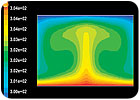
This thermographic image shows convective heat transfer due to liquid mixing.
With today’s rapidly rising energy costs, building and design professionals are well aware of the need for more sustainable, energy-efficient structures. Customers are beginning to become more budget-conscious and heed the call to make their buildings more environmentally friendly.
“The sustainable building movement is growing exponentially because, with today’s high energy prices, everyone is realizing that there are financial incentives to do the right thing,” says Lucas Hamilton, manager of Building Science Applications for CertainTeed Corp. “Sustainable building methods are designed, among other things, to reduce our overall energy consumption, which is a very important issue as we plan for the future.”
The study of building science has increasingly become a vital influence on builders and designers, and more are taking a systems approach to design. In building science, a building is ideally defined as a series of interrelated systems designed to provide comfort and safety to occupants with a high degree of energy efficiency. Building science takes into consideration the forces and stress placed on a structure by the occupants and environment and counteracts them with design methods that produce more sustainable results.
In the quest toward high energy efficiency, one of the most important design methods involves providing substantial thermal control throughout a building, or insulating it from the loss of valuable heated or cooled air, which accounts for a sizable chunk of the average utility bill.
By taking the following guidelines into consideration, building professionals can gain a higher understanding of thermal control and be able to construct energy efficient buildings that will benefit the customer as well as the environment.
Elements influencing building design
Building design is influenced by three main elements: the building envelope, mechanical systems and building occupants. The building envelope refers to the union of structural components in a building, including the exterior walls, the foundation, windows, doors and roof. Next in line, the mechanical equipment element encompasses all mechanical objects within a building, such as HVAC systems, lights, computers, printers, plumbing and security systems. Then, the activities and emissions of building occupants round out the list. Each living thing-person, animal or plant-occupying a building affects the energy efficiency of a building, as they all receive and radiate energy.These three elements are interconnected by three flows: heat flow, airflow and moisture flow. Since the impact of thermal control within the building envelope has a large impact on a building’s sustainability, we will focus on the measure of heat flow as it pertains to the structural components of the building. A thermally efficient building envelope creates an energy-efficient building, spaces that are more comfortable and healthful for occupants and buildings that are more durable and longer lasting.

This thermographic image of conduction through a divided glazing pane shows the transfer of heat between materials of different temperatures while in direct contact.
Heat Flow
Heat that flows in and out of a building is a major factor in determining the comfort level and operating cost. Heat has a natural tendency to flow from an area of high temperature to one of lower temperature. The greater the temperature difference, the faster heat transfers. During winter a heated building loses heat to the colder outside. Conversely, in the summer an air-conditioned building gains heat from outdoors.But, how can heat make its way inside and outside through solid exterior cladding and walls? There are three ways, actually-conduction, convection and radiation. In a building, these modes of heat transfer all occur at the same time and play an important role in the heat balance of a building.
Conduction
Conduction is probably the best known and the easiest to understand heat transfer process. It occurs when a material separates an area of high temperature from an area of low temperature, such as a wall. During the winter, the inside is warm and the outside is cold. Only the wall separates the two extremes. The inside surface of the wall warms and tries to reach the same temperature as the air inside of the building. As the inside wall surface heats up, the adjacent material also warms, and over time, heat from the inside transfers through the wall to the outside. This results in heat loss from the building to the colder temperatures outside.
The rate of heat transfer through the wall depends on two things. First, the temperature difference between inside and outside, and second, the nature of the material. Some materials transfer heat very well and are called conductors. Glass, concrete and all metals are examples of good conductors. Other materials, such as fiberglass and foam sheathings, transfer heat very poorly and are referred to as insulators.
Convection
Convection is the second most common mode of heat transfer. Heat transfer by convection occurs as a result of the movement of liquid or gas over a surface. Wind blowing against a building is an example of a gas moving over a surface. There are two types of convection, forced and natural. Natural convection occurs when the movement of liquid or gas is caused by density differences. For example, we’re all aware that warm air rises. This happens because it has a lower density than the surrounding cool air, and that’s what causes a hot air balloon to rise. Cool air does the opposite and drops. This heating and cooling creates convection loops adjacent to both the interior and exterior surfaces of a wall.
Convection can also take place inside of empty cavities. One example is the movement of air in a double pane window. For example, in winter, air is heated on the inside surface of the window cavity causing the air to rise. The air adjacent to the outside surface cools and drops. What results is a convection loop inside the window cavity that transfers heat from the inside to the outside.
A second type of convection is known as forced convection. Here, the movement of the liquid or gas is caused by outside forces. If winds are blowing, the air movement across the outside of the wall will be higher, increasing the rate of heat transfer. The rate of heat transfer by convection depends on the temperature difference, the velocity of the liquid or gas and what kind of liquid or gas is involved. For instance, heat transfers more quickly through water than through air.
Radiation
Radiation is the third type of heat transfer. Radiation heat transfer is by invisible electromagnetic waves from one object to another. Heat transfers from areas of higher temperature to areas of lower temperature. One common example of radiation heat transfer is from the sun. When you walk outside on a sunny day, you immediately feel the warmth from the sun even if the air is cold. Heat from the sun is being transferred through space by radiation.
Radiation also plays a role in heat transfer in a building. If you stand in front of a window on a cold day, your body radiates heat to the cold surface of the window and the result is you feeling colder. Likewise, if you stand in front of a window with the sun streaming in, you will feel warm as a result of the incoming solar radiation. This type of energy-solar radiation-is primarily short-wave radiation. Glass is nearly transparent to this short-wave radiant energy from the sun, and as a result, once sunlight enters a room, the sun’s energy is absorbed by the walls and the contents of the room and is converted to heat. At the same time, the warm objects in the room also emit radiant energy.
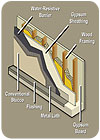
ASHRAE Parallel Path Flow Method
Breaking thermal bridging
Thermal bridging is the name given to the path that offers smooth travel for heat transfer in poorly insulated buildings. To throw an obstacle in this path and slow down heat transfer, we need to put some insulators between the conductors. Commercial insulation consists of cavity insulation, which occupies space inside the wall cavity, and insulation sheathing, which is on the outside of the external walls. There are a variety of materials that can be used for cavity insulation, including fiberglass, mineral wool, cellulose, open and closed-cell foam plastics, reflective insulation and radiant barriers. Insulating sheathing is usually made from expanded polystyrene, extruded polystyrene, polyisocyanurate (ISO board) or fiberglass board.Here’s a run-down of how thermal properties of various materials and systems are rated. As mentioned earlier, insulation materials and building envelope systems are characterized by their resistance to heat flow. Material performance can be rated according to thermal conductivity (k), thermal conductance (C) and thermal resistance (R-value). In the case of system performance, total thermal resistance is shown as RT and thermal transmittance is shown as U-factor or U-value. With material surface performance, emissivity ratings are indicated by the symbol “e” and reflectivity is indicated by the symbol “r”.When it comes to measuring thermal properties of building materials, the standard is ASTM C 518. Here, a heat-flow apparatus measures heat transfer through homogeneous materials, such as insulation. Several material properties, including thermal resistance, conductance and conductivity, can be determined from temperature, heat flux, area and thickness data. Another standard, ASTM C 1363 Hot Box measures the thermal performance of building envelope assemblies. Measurements include the effects of thermal bridging due to structural components, as well as insulated cavities.
When it’s time to calculate the heat flow of insulated building envelope assemblies, there are three different methods of varying complexity devised by the American Society of Heating, Refrigerating and Air-Conditioning Engineers (ASHRAE). These methods can all be found in Chapter 25 of the ASHRAE Handbook of Fundamentals. The first and simplest is the isothermal planes method. This is used when cross-sections have continuous, homogeneous layers. The second method, the parallel path flow method is used when cross-sections have structural and cavity areas and when components have similar thermal resistance. The third method, the modified zone method is used with steel framed assemblies. These assemblies have cross-sections with both structural and cavity areas.
Calculating heat flow can be as simple as adding thermal resistance in a system with homogeneous layers, as with the isothermal planes method, or as complex and complicated as the modified zone method. With the complexity of the modified zone method, it’s a good idea to use the free online calculator provided by the Oak Ridge National Laboratory (www.ornl.gov/sci/roofs+walls/ calculatores/modzone/index.html).
Structural components are highly conductive and create thermal bridges. For example, metals conduct 300 to 1,000 times more heat than most building materials. The thermal impact of a metal stud in a framed cavity is greater than the actual surface area of the stud, so metal has an exaggerated effect on heat transfer out of proportion to its physical size. This stresses the importance of choosing the proper insulation assembly.
Insulation Assemblies
The type of insulation assembly to use depends on the material used for the external walls of the building. External walls are typically concrete block, concrete tilt-up, metal, curtain walls (no cavities) or masonry façade (brick, block or concrete panels with insulateable cavities).Concrete block and tilt-up walls
With both types of concrete walls, insulating sheathing can be installed either on the interior or exterior of the concrete, with foam plastic insulation board being the most common choice of sheathing material. The location of the sheathing depends on the regional climate and the sheathing material used.
EIFS
EIFS refers to the Exterior Insulation and Finishing System, which resembles traditional stucco. When installing an EIFS, the manufacturer’s installation instructions must be followed. EIFS is a highly energy efficient cladding.
Steel Stud Cavity Walls
The most common wall assembly is the steel stud cavity wall, which includes a masonry façade. To improve the thermal performance and increase cavity condensation control, the designer can specify exterior insulating sheathings which increase cavity surface temperatures and improve energy efficiency as well. Incorporate exterior air barriers which also function as wind barriers to reduce air leakage. Specify interior air barriers to reduce the potential for convective loops and increase drying capability. Always incorporate water resistive barriers and provide ventilation and drainage space behind the masonry façade to reduce wetting the substrate materials and to promote drying. This exterior wall configuration is a cost-effective way to achieve thermal performance while managing moisture.
Metal Buildings
Metal buildings have their own set of installation and compliance recommendations. An authoritative publication covering ASHRAE 90.1 is available from the North American Insulation Manufacturers Association. It’s available online at www.naima.org. NAIMA’S reference for flexible fiberglass insulation used in metal buildings, Standard 202-96, provides information on thermal performance of metal building roof systems and wall systems. R-value and U-value data are listed for screw-down roofs and for sidewalls having varying cavity R-values and fastener spacing.
Fenestration
Fenestration refers to any opening in a building envelope, including windows, doors, curtain walls and skylights. The National Fenestration Rating Council (NFRC) offers a labeling and certification program for window and door products. Factors that affect window performance include frame type, glazing type, type of gas fill-argon vs. air, for example-and low-emittance coatings. When installing high-performance windows, one should look for the NFRC label. Here’s what to look for:
U-factor in windows is similar to R-value in insulation products; both are indicators of thermal performance. Energy Star U-factor recommendations are given by zone. With U-factor ratings, the lower the number, the greater the thermal resistance. This is just the opposite of R-values, in which the higher number is better. Another indicator to look for is Solar Heat Gain Coefficient (SHGC). This number-rating indicates a window’s efficiency in preventing solar radiation from entering and heating a building and from escaping the building in cold weather.
Since windows are generally made from thermally conductive steel or aluminum, it’s important to select thermally broken windows with an air space between components. A lower U-factor not only means increased energy efficiency, it means better condensation control on surfaces. Installing airtight systems will increase energy efficiency and reduce the potential for moisture accumulation. Hidden mounting flanges and metal surfaces need to be insulated to reduce surface condensation. The goal should be to have an airtight, moisture-resistant installation.
Sealing it all up
With the current embracing of the sustainable building design movement, the number of energy-saving, healthy, long-lasting buildings is bound to increase in the years to come, through both new construction and retro-fitting. Following these thermal control design guidelines should offer a good start toward achieving this goal.Looking for a reprint of this article?
From high-res PDFs to custom plaques, order your copy today!