Sweet Sounds of Collaboration
I love it when a plan comes together. Those of you who know me know that I like to push the envelope with my designs. If I can’t find an acoustic treatment that meets my needs, then I’ll design one.
I love it when a plan comes together.
Those of you who know me know that I like to push the envelope with my designs. If I can’t find an acoustic treatment that meets my needs, then I’ll design one. Unfortunately, I’m a lot better at designing things than I am at producing them (without my wife wrinkling up her nose). That’s why I feel very lucky when I’m part of a design and construction team having the exceptional talents to make a radical design work.
Curtis Incorporated’s newest recording studio and control room is just such a project.
 I designed the control room based on an acoustics theory called “Reflection Free Zone,” which isn’t really a new idea (it’s been around since the ’70s). Basically, the RFZ idea is to angle the front walls and ceiling so they don’t reflect sound from the front speakers directly towards the recording engineer. There are a lot of control rooms around the country that claim to be RFZ designs but most of them look like square rooms with the corners cut off to me.
For Curtis, I decided to take the RFZ theory to its extreme and shape the entire front half of the room to resemble a satellite dish. Calculating the dimensions and angles was a challenge but I really have to admire Steve Roach and his crew at CR&R Builders for their work in accurately creating the space. As demonstrated by our acoustics tests of the completed job, the reflections from the walls and ceilings of the control room are exactly where they should be in both time and space.
 “Acoustically the control room feels very open and diffusive,” says Jon Brennan, sound designer and music composer at Curtis Inc. “The room is a bit more lively than other control rooms; however opening the cabinet doors has a large effect on lowering the reverberation time and focusing the sound directly from the speakers.”
The adjoining studio also features variable acoustics in its design: large hinged boxes attached to the walls (affectionately known as “wall coffins”) allow a wide range of adjustments to the reverberation and diffusion characteristics of the studio.
 According to Jon Brennan, recording with adjustable acoustics changes the way recording is done. In other studios, it is common to place a performer in an area of the room that might have the desired acoustics, like a live area vs. a dead area. With adjustable acoustics, the entire room can be tuned or tailored to a specific performance. This adds flexibility for the Sound Designer not otherwise possible. For example, one song can have many different acoustic settings. In a multi-track recording, the room can be tuned for each instrument or part, allowing for a more dynamic and creative recording.
 Three of the most important characteristics of a successful, professional audio suite are quiet, quiet and quiet. Tom Schaefer and his team at Halpe Inc. did a remarkable job of designing the air handling system so it cannot be heard by the sensitive recording microphones used in the studio and control room.
In addition to monitoring and mixing, Brennan finds the acoustics and low noise floor of the control room to be ideal for the recording of sound effects. When recording Foley, it is important to be able to record and manipulate sound in the control room. There often isn’t time to set up mics in the studio and call a second engineer to run the session. We keep a mic “live” on the mixing desk to capture that moment’s creative inspiration.
 Another aspect of the design and construction of the audio suite is that the studio and control room are completely physically isolated from each other and the rest of the building. A great deal of credit for this goes to Jim Shirk and Chris Larger of Ketchum and Walton (www.ketchumandwalton.com), manufacturer representatives for Kinetics Noise Control. Both Shirk and Larger were on site to help instruct Steve’s crew on the correct assembly of the wall isolation clips, ceiling isolation hangers, floating floors and other acoustic treatments.
 Curtis’ newest audio suite has been an instant success. Brennan says, “Recordings and mixes from the control room have translated very well on other audio systems. This shows that the room is not coloring the sound. The very low noise floor in the control room and studio has added a greater amount of detail to both the recording and mixing. Being able to hear accurately has increased my speed, creativity and attention to detail.” W&C
WATCH THE PROGRESS
Those of you who would like to listen and watch the variable acoustics of the studio in action can do so at www.vimeo.com/4748682 or www.youtube.com/watch?v=eLjyAJTSVnk.
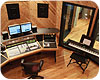
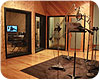
Front of the control room with the studio visible through the large custom designed soundproof windows.
I love it when a plan comes together.
Those of you who know me know that I like to push the envelope with my designs. If I can’t find an acoustic treatment that meets my needs, then I’ll design one. Unfortunately, I’m a lot better at designing things than I am at producing them (without my wife wrinkling up her nose). That’s why I feel very lucky when I’m part of a design and construction team having the exceptional talents to make a radical design work.
Curtis Incorporated’s newest recording studio and control room is just such a project.
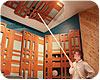
Studio Engineer Jon Brennan uses the proverbial 10-foot pole to open and close diffuser cabinet doors, adjusting the control room’s acoustics.
For Curtis, I decided to take the RFZ theory to its extreme and shape the entire front half of the room to resemble a satellite dish. Calculating the dimensions and angles was a challenge but I really have to admire Steve Roach and his crew at CR&R Builders for their work in accurately creating the space. As demonstrated by our acoustics tests of the completed job, the reflections from the walls and ceilings of the control room are exactly where they should be in both time and space.
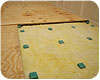
Kinetics RIM floating floor system helps to isolate the rooms.
CENTRAL CONTROL
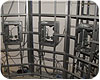
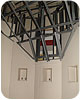
The control room features beautiful cherry wall storage cabinets that also serve as acoustic treatments. It has long been common practice to place bookshelves along the back wall of rooms used to listen to music or watch videos. The random pattern of books absorb some of the sound and diffuses the rest; making the room sound interesting. I took this old concept a bit further with the design of these wall cabinets. The reveal pattern of the cabinet doors and the spacing of the cabinet shelves were designed using a mathematical function called a “minimum length sequence.” The cabinet doors can be opened in varying degrees to adjust the reverberation, absorption, initial time delay and diffusion within the space. I take my hat off to Gene Mugler of Apex Cabinetry in Cincinnati for his craftsmanship in creating these cabinets. Acoustically they perform exactly as theory says they should. Visually they are stunning.Framing for the front wall of the control room. Both the control room and studio were built as separate rooms within a larger room within the building.
The adjoining studio also features variable acoustics in its design: large hinged boxes attached to the walls (affectionately known as “wall coffins”) allow a wide range of adjustments to the reverberation and diffusion characteristics of the studio.
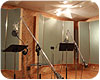
A view from the studio with the control room visible through the sound proof windows.
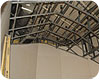
Framing of the control room ceiling, ready for two layers of gyp board.
SOUNDS GREAT
“I had a solo classical player in the studio recently,” Brennan says. “After closing about half of the doors, her instrument came to life and really utilized the natural reverb in the room.”CR&R construction took great care to prevent the floors and ceilings from touching the walls. Construction gaps were meticulously sealed with non-hardening caulk.
In addition to monitoring and mixing, Brennan finds the acoustics and low noise floor of the control room to be ideal for the recording of sound effects. When recording Foley, it is important to be able to record and manipulate sound in the control room. There often isn’t time to set up mics in the studio and call a second engineer to run the session. We keep a mic “live” on the mixing desk to capture that moment’s creative inspiration.
Walls and ceilings meet at compound angles.
“Wall Coffins” are used to adjust the acoustics of the studio.
WATCH THE PROGRESS
Those of you who would like to listen and watch the variable acoustics of the studio in action can do so at www.vimeo.com/4748682 or www.youtube.com/watch?v=eLjyAJTSVnk.
Looking for a reprint of this article?
From high-res PDFs to custom plaques, order your copy today!