Walls & Ceilings logo
search
cart
facebook twitter linkedin youtube youtube Spotify Podcasts Apple Podcasts Spotify Podcasts Apple Podcasts
  • Sign In
  • Create Account
  • Sign Out
  • My Account
Walls & Ceilings logo
  • NEWS
  • TOPICS
    • Drywall
    • Stucco/EIFS
    • Ceilings
    • Steel Framing
    • Fireproofing
    • Interior Plaster
    • Building Envelope
    • Insulation
    • Technology
    • Interior
    • Exterior
    • Women In Construction
  • COLUMNS
    • Up Front
    • All Things Gypsum
    • Art & Craft of Plastering
    • Stucco Stop
    • Steel Deal
    • Industry Voices
  • PRODUCTS
    • Buzz Guide
  • EVENTS
    • Industry Events
    • Webinars
    • BUILD Expo
  • MEDIA
    • Videos
    • Podcasts
    • Photo Galleries
    • BUILD26 Videos
    • Take our Quiz!
    • Infographics
  • EXCLUSIVE
    • Newsletters
    • Top 50 Contractors
    • Contractor of the Year
    • State of the Industry
    • W&C Store
    • Market Research
    • CEUs
    • Sponsor Insights
    • Custom Content & Marketing Services
  • DIRECTORY
  • EMAGAZINE
    • eMagazine
    • Advertise
    • Archive Issues
  • SIGN UP!

The Penn is Greener than the Sword


By Dave Lewandowski
February 16, 2006
Old ceiling tiles from the Business Administration Building are being reclaimed as part of the recycling program rather than being dumped in a landfill.


Following removal from the ceiling, old tiles are stacked on pallets. The old ceiling tiles do not have to be Armstrong products to qualify for the program.

The Pennsylvania State University's colors are blue and white but it is the school's commitment to "green" building practices and other environmental strategies that is causing other colleges and universities to take notice.

"We're not trying to change the world here, just our part of it," says Graham Spanier, president of Penn State.

The school's commitment is embodied in a program called the Environmental Stewardship Initiative. Managed by Steve Maruszewski, deputy associate vice president for the Office of Physical Plant and comprised of a team of 10 managers and directors that cuts across university functions, the Initiative has as one of its objectives to move the university toward more sustainable practices.
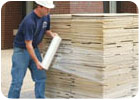


Once stacked, the tiles are shrink wrapped for pick-up.

And to help achieve that objective, the Initiative has identified as one of its seven goals to minimize solid waste production by enhancing policies and processes that reduce solid waste generation through reduction, reuse and recycling.

The newest process to be implemented as part of that goal is participation in the Ceiling Recycling Program conducted by Armstrong Ceilings.



The first major project on the Penn State campus to include ceiling recycling is the remodeling of the school's Business Administration Building.

Four steps

The program, which is the only one of its kind, enables building owners to ship old ceilings from renovation projects to a ceiling plant as an alternative to landfill disposal. Under the program, Armstrong even pays freight costs for shipping the old tiles, which it uses as raw materials in the manufacture of new tiles.

Since it introduced the program in 1999, the company has recycled more than 30,000,000 square feet of discarded ceiling tiles or enough tiles to cover 525 football fields. This represents nearly 21,000,000 pounds, or 10,500 tons, of construction waste that would have normally been dumped in landfills.

The program involves four steps. First, provisions for ceiling recycling should be included in the project specifications. Second, building owners need to verify that their old ceiling tiles can be recycled. The old tiles do not have to be Armstrong products to qualify for the program.

Following verification, owners must stack their old ceiling tiles on pallets and wrap them for pick-up. Once there is a full trailer load of old ceilings (30,000 square feet), the owner simply needs to contact Armstrong, which will then arrange for a truck to pick up the material and transfer it to its nearest manufacturing facility.

According to Al Matyasovsky, Supervisor of Central Support Services at Penn State, the decision to recycle old ceilings was an easy one because it was such a "natural" fit into the university's overall program.

"We already had processes in place to recycle traditional items such as cans, bottles and paper, as well as non-traditional items such as pallets, motor oil, scrap metal and other types of construction debris," says Matyasovsky. "As a result, recycling ceilings was an easy and simple addition since we didn't really have to do anything differently other than the handling."



Once there is a trailer load of old ceilings, a truck will pick up the material and transfer it to its nearest manufacturing facility.

Less cost, less landfilling

The first major project to include ceiling recycling is the remodeling of the campus's Business Administration Building. Built in 1973, the eight-story building houses a variety of offices and classrooms used by students, faculty and administration. It is currently vacant as a result of the construction of a new BAB building nearby.

"Now that everyone has moved out, it gives us the opportunity to remodel and upgrade the entire facility for re-use," Matyasovsky says.

Included in the demolition stage of the remodeling is the recycling of such construction waste as the metal casings from old light fixtures, metal ceiling grid, electrical conduit and nearly 50,000 square feet of old 2-foot-by-4-foot acoustical ceiling tiles.

"In the past, our only alternative was to send the discarded tiles to the landfill," Matyasovsky says.

He also notes that a project does not have to be a large one to recycle old ceiling tiles.

"Our position has always been that responsible waste management is not one ton or two tons at a time. It's one aluminum can at a time, one plastic bottle at a time, and now one ceiling tile at a time. Consequently, regardless of whether we're remodeling an entire building or a single classroom, we'll recycle ceilings whenever we can."

The key to the smaller jobs has been the ability to consolidate the old tiles. Armstrong keeps a trailer centrally parked at the campus as an accumulation point to facilitate the process. As tiles are removed, they are simply loaded into it. Once the trailer is full, it is hauled away and replaced with an empty one.

Time analyses show that the process for recycling ceilings is nearly as fast as dumping them, so the program has little, if any, adverse impact on demolition schedules. It can also be less costly than the cost of handling, transport, container and landfill fees.

In the case of Penn State, Matyasovsky notes that while it is still too early to definitively conduct a cost analysis, he believes the time and cost of stacking and wrapping the discarded tiles is about the same as that of hauling them to the transfer site. Where he believes savings will be achieved is in the elimination of the local tipping fee, which is nearly $60 per ton.

"The tiles also contribute to our county recycling report," he adds. "And, this is important because as our recycling tonnage goes up and our refuse tonnage goes down, we can qualify for additional grant money from the state, which helps support our total recycling program."

However, while cost is a consideration, it is, by no means, the only one.

"As a university, we want to remove as much as we can from the waste stream, and recycling ceilings is just one more example," Matyasovsky concludes.


If you read this article, please circle number 167.

Share This Story

Looking for a reprint of this article?
From high-res PDFs to custom plaques, order your copy today!

Dave Lewandowski is vice president of the Al Paul Lefton Company in Philadelphia. He writes extensively on topics related to the construction industry.

Recommended Content

JOIN TODAY
To unlock your recommendations.

Already have an account? Sign In

  • Abercrombie & Fitch

    EIFS in 2026: How Specialty Finishes Are Redefining Exterior Wall Systems

    As building codes, owner expectations, and design demands...
    Stucco/EIFS
    By: Regi Mendoza
  • proper air and vapor control

    From Energy Efficiency to Moisture Management: Why Air and Vapor Control Matter

    How proper air and vapor control within building...
    Building Envelope
    By: Benjamin Meyer AIA, LEED AP
  • Linear Metal Ceiling Beam Baffles

    Top 25 Ceiling Contractors of 2026

    Suspended ceilings demand precision, code compliance and...
    Ceilings
    By: John Wyatt and Tanja Kern
You must login or register in order to post a comment.

Report Abusive Comment

Manage My Account
  • eMagazine Subscription
  • Newsletters
  • Online Registration
  • Manage My Preferences
  • Subscription Customer Service

More Videos

Sponsored Content

Sponsored Content is a special paid section where industry companies provide high quality, objective, non-commercial content around topics of interest to the Walls & Ceilings audience. All Sponsored Content is supplied by the advertising company and any opinions expressed in this article are those of the author and not necessarily reflect the views of Walls & Ceilings or its parent company, BNP Media. Interested in participating in our Sponsored Content section? Contact your local rep!

close
  • medical professionals moving a patient on a stretcher through the halls of a medical building
    Sponsored byNational Gypsum Company

    What Does High Performance Mean When It Comes To Gypsum Boards?

Popular Stories

Linear Metal Ceiling Beam Baffles

Top 25 Ceiling Contractors of 2026

Wichita Biomedical Campus

Wichita Drywall Worker Dies After Scaffolding Fall

QXO Just Changed the Game-Here's What Contractors Are Asking

QXO Just Changed the Game-Here's What Contractors Are Asking

An interior drywalling work in progress

Boost Profits with AI Scheduling

Events

June 24, 2026

The Bright Side & Benefits of Designing with Integrated Lighting

Credits 1 AIA LU/HSW; 0.1 ICC CEU

This course will explore the pivotal role architects and lighting design play in creating safer, more sustainable spaces. Learn how to avoid common lighting mistakes and make informed decisions that create the best visual environment for occupants. 

January 1, 2030

Webinar Sponsorship Information

For webinar sponsorship information, visit www.bnpevents.com/webinars or email webinars@bnpmedia.com.

See our full library of webinars

View All Submit An Event

Products

2026 National Painting Cost Estimator

2026 National Painting Cost Estimator

See More Products

Related Articles

  • Brass Knuckle SmartCut Glove with A2 Protection

    The Perfect Medium-Duty Glove is Better than Ever

    See More
  • Saving the Environment One Square Foot of Ceiling at a Time

    See More
  • Board’s Always Greener on the Other Side

    See More

Related Products

See More Products
  • building codes illustated.jpg

    Building Codes Illustrated: A Guide to Understanding the 2021 International Building Code, 7th Edition

  • 1118749847.jpg

    The Gypsum Construction Handbook, 7th Edition

See More Products

Related Directories

  • The QUIKRETE Companies

    Concrete and mortar mixes, cements; concrete repair products, stucco, waterproofing, tile setting and blacktop products, floor underlayments and overlayments, sand and aggregates, concrete coatings, shotcrete products, bulk products, and other seasonal items.
×

Connect with the industry’s leading resource for unparalleled insights and education.

Join thousands of industry professionals today. Shouldn’t you know what they know?

JOIN NOW
  • RESOURCES
    • Advertise
    • Contact Us
    • Directories
    • Store
    • Want More
  • SIGN UP TODAY
    • Create Account
    • eMagazine
    • Newsletters
    • Customer Service
    • Manage Preferences
  • SERVICES
    • Marketing Services
    • Reprints
    • Market Research
    • List Rental
    • Survey/Respondent Access
  • STAY CONNECTED
    • LinkedIn
    • Facebook
    • Instagram
    • YouTube
    • X
  • PRIVACY
    • PRIVACY POLICY
    • TERMS & CONDITIONS
    • DO NOT SELL MY PERSONAL INFORMATION
    • PRIVACY REQUEST
    • ACCESSIBILITY

Copyright ©2026. All Rights Reserved BNP Media, Inc. and BNP Media II, LLC.

Design, CMS, Hosting & Web Development :: ePublishing
