Locked, Stocked and R smoking Value
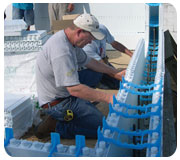
Michael Hanes, of Northern Shores Enterprises, trains Habitat volunteers how to install the Quad-Lock system.
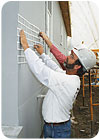
Applying the templates for the Custom Brick
Partnering with the Habitat for Humanity Macomb County Chapter, the ICFA’s Lyman believes Habitat’s choice of using ICFs with a SIPs roof greatly benefits the homeowner and the Habitat affiliate.
“When Habitat builds an ICF home, not only does it lower the energy bill for the homeowner, giving them more disposable income, but it also lowers the risk to the mortgage company,” Lyman said, suggesting that the savings in energy can be used to pay off principal in the mortgage, placed in other investments or could provide better living conditions for the family.
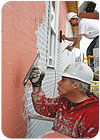
Applying the acrylic finish over the template system
THE HEAT GOES ON
As noted in last year’s feature about Habitat, one of the conditions on which potential candidates receive a Habitat home is the amount of “sweat equity” each participating family is expected to put in for the project. If the homeowner is not able to work the required 400 hours for a particular project, the balance of that time can be transferred to another Habitat project. In the case of the Roseville home, other future Habitat homeowners worked this project along with Michael and Beverly Alford, and son, Michael Jr., proud owners of this home.Beginning in late summer, the first phase of the build was training workers on the ICF installation. The products were supplied by Quad-Lock Building Systems, a company located in Surrey, British Columbia, whose Midwest sales representative, Harry Treu, and company distributor, Northern Shores’ Michael Hanes, located out of Caro, Mich., were on hand to train, work and field supervise the forms installation.
“It made sense to build in the Detroit area because of its cold climate and to have something that was energy efficient, very quiet, stable and resistant to severe weather conditions,” says Treu, explaining that most of the ICF projects he is involved with in the Midwest are higher-end homes. Although the home is modest in design, with approximately 1,500 square feet in space, every inch of the house will outperform its neighboring homes when the utility bill arrives.
“For the foundation we used our 8-inch product, for some of the entrance we used a 10-inch wall and for the first floor we used 6-inch walls. You can transition into different width walls depending on what you’re doing,” says Treu. “Our system will withstand winds of over 200 miles per hour, whereas stick-built will only withstand winds of 50 mph.”
Because they were training non-construction professionals on how to use the Quad-Lock system, Hanes and Treu worked very closely with the volunteers to ensure that all installation steps were followed as thoroughly as possible. These two were so committed to the project, they were there throughout the whole process of the ICF installation. Treu comments that Hanes pretty much served as de facto foreman and treated the build with as much passion as if he were building his own house. In fact, when a shipment of the product was to be delivered late, Hanes went above and beyond to ensure that material was there on time. A sponsoring area company would come in one week, followed by another company the next week. Through it all, the Quad-Lock staff made sure to be available for each training session.
“Actually, a few construction people that drove by stopped and came in and worked, just so they could learn how to use the (ICF) system,” says Treu. “They put their toolbelts on and went to work. They were a big help, had construction experience and they just wanted to learn the Quad-Lock system.”
BY THE TIME THEY GOT TO EIFS
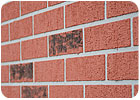
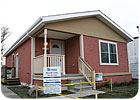
When the home’s shell had been erected and the SIPs roof, donated by Pacemaker Building Systems, was installed, the exterior was ready for its finish. To meet the requirements of the local area, which were mostly brick bungalow homes, manufacturer Dryvit accommodated the request and suggested utilizing its Textured Acrylic Finish System product line for the exterior. Under the TAFS product umbrella, the Custom Brick was appropriate for its veneer. The TAFS and Custom Brick is a system that has the appearance of brick. Because EIFS’ manufacturers demand a certified applicator, the task had to be outsourced to an experienced contractor.“I have always had a good relationship with Dryvit and have worked closely with John Powers and Bob Dazel (of the company) on several large projects throughout Michigan,” says Jim Blackburn of Diversified Plastering Inc., of Eaton Rapids, Mich., a plastering/stucco/EIFS contractor that has extensive experience with the EIFS line.
He explained the benefits of using the TAFS are the durability of the product and its ability to endure over years with little maintenance. Additionally, it is a lightweight product and also highly energy efficient, complementing the ICF system’s R-value performance. He also said Dryvit has an excellent warranty for the TAFS product, which also adds value to the home and potential resale value. He likes the fact that the product is virtually maintenance free and has several finish options.
Dryvit product information states that TAFS can be applied one of two ways: with a tinted primer and textured acrylic finish used over a high-impact wall, or with a basecoat with embedded reinforcing mesh, tinted primer and textured acrylic finish. The manufacturer recommends the second method over ICF construction. The product has a 10-year limited warranty.
Diversified Plastering applied the product during a colder-than-average November. Because of harsh weather conditions, the company cocooned the house with reinforced plastic so it could contain heat from propane tanks and apply the finish system with ease.
“Working in winter conditions adds more time to the job but also allows for a more controlled atmosphere to work and apply the system,” says Blackburn. “Dryvit Custom Brick is the newest look in the industry and is an excellent product due to its light weight and energy efficiency. It is very comparable to actual brick or stone.”
By applying the TAFS system over ICFs, the home’s HVAC system shouldn’t have to work so hard, thus reducing the amount of energy consumed and lowering prices. An additional bonus to this system is the STC rating, which is approximately 55. The Alford family - with a home that has walls poured with concrete and the energy-efficient TAFS on its exterior - will not hear the heavy traffic outside.
DEDICATION TIME
The Alfords were presented with the keys to their new home less than one week from Christmastime. (The February issue of W&C will have a news report regarding the event.)“Our family is very grateful for the opportunity we are being given, and we would as a family like to say a very big thank you to Habitat, the ICFA and all the people who volunteered,” said Beverly Alford.
During the entire process, the Alford’s were constantly involved in building the home. Lyman says the ICFA is extremely pleased that the Alfords were engaged in the project and their involvement in the project is a testament to their deservedness.
Sidebar: TEAMWORK
Teamwork helped to complete Habitat home by ChristmasKnown collectively as Trade Partners, a collection of business and construction professionals helped make a Roseville home a reality for the Alford family:
GM (General Motors)
GMAC Financial Services
Habitat for Humanity
ICFA (Insulating Concrete Form Association)
Quad-Lock
PaceMaker
Andersen Windows
Form-A-Drain
CertainTeed
Cosella Dorken
Diversified Plastering Inc.
Dryvit
Northern Shores Enterprises
Randazzo Heating
Dehondt Electric
Straight Up Drywall
Wind-Lock
Walls & Ceilings Magazine
ED+C Magazine
Sidebar: STEP-BY-STEP
Because not much has been published regarding the application process of this type of finish onto ICFs, Blackburn has provided a detailed step-by-step process of what Diversified did for this project:- We inspected the substrate for any problem areas: missing foam on ICF blocks, gaps and leveled out the substrate.
- A working platform was constructed that included scaffolding, planks and guardrails to ensure safety.
- The ICF foam block was rasped, which roughs up the substrate to adhere the finish system onto. Additionally, we straightened out corners and variations in walls when necessary.
- We applied basecoat and adhered the fiberglass screen to walls.
- Non-cementitious basecoat tinted to grout color of choice was applied next.
- Measurements were taken and we applied the Custom Brick templates to the walls.
- We then applied the acrylic finish over the templates, floating a pattern to enhance a true brick look.
- We checked the finish over the templates and applied tinting to the bricks for an authentic look.
- Next, the walls were ground with masonry stone to rough up the acrylic finish for a more custom look on the bricks.
- Pulling off the templates, we checked for grout and brick touch-up on the finish.
- Cleaning the windows, we also made sure the job site was orderly when we left.
Looking for a reprint of this article?
From high-res PDFs to custom plaques, order your copy today!