Fire Fighters
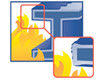
Figure 1: Intumescent coating expansion (used with the permission of International Paint).
The use of intumescent materials to inhibit thermal transmission and flame passage is used to provide fire protection for exposed heavy steel and is a technique that is growing in popularity for firestops and joint systems. While the specification of intumescent systems is becoming more common, an understanding of the science behind the intumescing process generally is not.
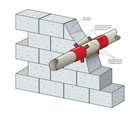
Figure
2: Typical methods used to
protect pipe penetrations are pipe collars,
sealants or cast-in-place devices.
Passive fire protection is one of the oldest methods of fire protection (originally dating back to the Roman Empire). In the U.S., passive fire protection dates back to the 1800s when masonry and brick became popular after conflagrations burned entire cities to the ground. In modern construction, passive fire protection remains a key element of the defense of buildings and structures against loss of life and property and maintenance of business continuity. Fire-resistive coatings protect structural elements in a building from rapid temperature rise, and firestop systems protect penetrations through walls and ceilings against smoke and fire spread. One popular technique for both fire-resistive coating and firestop applications involves intumescent materials, which expand to fill voids and form a thermally resistive char layer when exposed to heat and fire.
SCIENCE OF INTUMESCENT MATERIALS
The three main components of an intumescent material are the acid source, the carbon supplier, and the blowing agent, which engage in a sequence that creates the beneficial expansion and char layer. When the acid source (or catalyst) is exposed to heat, it releases an acid. The catalytic acid reacts with the carbon supplier, causing the carbon to soften and form a viscous char. When the material heats even further, the blowing agent releases a non-flammable gas which creates tiny bubbles in the viscous char. As the bubbly char hardens, it forms a light outer char layer on the intumescent material. This process continues as more of the virgin intumescent material is converted to an insulating char layer.[1] This insulating char layer protects the substrate (intumescent coatings) and inhibits flame passage (firestops).
Intumescent materials can swell from three to 50 times their original size, depending on ambient conditions and the efficiency of the intumescent material chemical makeup.[2] This swelling is the mechanism that allows thin coatings to be effective protection.
Figure
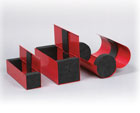
3: Cables can be protected with intumescent putties or mortars, or pass-through
devices as shown above. Photo used with permission by 3M.
Due to their paint-like properties, intumescent coatings are popular choices among architects for protecting exposed steel members. Some properties of intumescent coatings offer advantages over cementitious spray-applied fire resistive materials (SFRM). The adhesion, or bond strength, of intumescent coatings can exceed that of cementitious SFRM. The intumescent coating can usually be applied in several different finishes, which is aesthetically attractive to architects. Many intumescent coatings are also used with a topcoat, which can come in various colors. Some would argue that other advantages of intumescent coatings include the speed of application, ability to protect complex shapes, and ease of inspection and maintenance.[3]
Fire-resistance Ratings
The protection afforded by various intumescent coating products are determined by tests such as ASTM E119, Standard Test Methods for Fire Tests of Building Construction and Materials. This test, which is the basis for the UL Designs in Volume I of the UL Fire Resistance Directory, exposes assemblies to a fire in a furnace and evaluates their abilities to withstand heat. The hourly rating index, which is the result of the test, is based on performance in the furnace, not based on performance in an actual fire.
Typical thin-film intumescent coatings can be listed for up to a two-hour fire-resistance rating by UL, although some products are listed for up to four-hour protection for a restrained beam condition.[4]
Application Methods
To achieve maximum bond strength, and thus effectiveness in a fire, intumescent coatings need to be applied correctly. Intumescent coatings should be applied by qualified applicators, and such applicators should always follow the manufacturer’s instructions for each application. Normally, intumescent coatings will require a cleaner steel surface than what is required for cementitious SFRM. However, the bond strength for an intumescent coating can also be signifcantly higher than that of an SFRM, potentially providing a more efficient method of protection.
After the surface has been properly prepared, intumescent coatings require a primer before the application. Then the intumescent coating is applied (usually sprayed on) in one or more layers until final dry film thickness (DFT) is achieved. A required DFT for intumescent coatings typically ranges from 0.03 inches to 0.5 inches, compared to a final thickness for an SFRM which can range from 0.5 inches to 2 inches. The DFT should be measured in accordance with applicable standards, such as AWCI Technical Manual 12-B, Standard Practice for the Testing and Inspection of Field-Applied Thin Film Intumescent Fire Resistive Materials.
Intumescent Coating Options
There are various categories of intumescent coatings. Thin film intumescent coatings usually provide a lower fire-resistance rating than thick film products. There are water-based thin films, solvent-based thin films, and epoxy-based thick films.
Although they achieve similar fire-resistance ratings, water-based and solvent-based thin film intumescent coatings are used in different applications. Because of the chemical makeup, solvent-based intumescent coatings are more suitable for exterior applications than water-based intumescent coatings. As such, water-based intumescent coatings are only UL-rated for interior protection.
The popular application for thin-film intumescent coatings is for exposed steel. However, there are situations, such as with historic building renovations, when additional protection may be required for exposed timber or other combustible assemblies.[5] Intumescent coatings can also be used to protect such assemblies. As with any application, the requirements of the local building code and Authorities Having Jurisdiction should be consulted to determine protection requirements.
Architects are beginning to select epoxy-based thick films based on experience with products employed successfully in industrial sectors such as off-shore and marine applications. Epoxy-based thick films can be used for exterior industrial applications such as petrochemical plants, or for tunnel applications. Thick film intumescent coatings may require a reinforcing mesh depending on the required DFT.
Figure
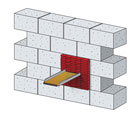
4: Fire pillows protecting a cable tray.
Photo used with permission of ASTROflame.
One of the primary functions of passive fire protection is compartmentalization. Compartmentalization provides walls and separation assemblies with a specified level of fire resistance. By compartmentalizing a building, the rate of the spread of fire is significantly reduced or even stopped completely, increasing fire-fighting efficiency.[6]
Along with specifying the required fire-resistance rating of separation assemblies, building codes require that penetrations in such fire-rated walls be protected to maintain the integrity of the wall rating. In most building codes, the protection offered by firestops is prescribed in terms of an F rating and a T rating. These ratings are determined by standardized tests such as ASTM E814, Standard Test Method for Fire Tests of Through-Penetration Fire Stops or UL 1479, Fire Tests of Through-Penetration Firestops. The F rating refers to the index of the amount of time that the firestop assembly can prevent flame passage through to the unexposed side in the test. The T rating refers to the amount of time that the firestop assembly can prevent flame passage through to the unexposed side, as well as prevent the unexposed side from reaching a critical temperature of 181 degrees C (325 degrees F) under test conditions.[7]
For smoke-tight barriers, UL 1479 also provides an L rating as part of the test results. The L rating is based on the amount of air leakage allowed through the test sample.
The most common penetrations in buildings are those required for distribution of buildings services (e.g., mechanical, electrical, plumbing systems). Intumescent materials are used in various forms to expand at the through-penetration and seal the penetration to prevent fire spread to an adjacent compartment. Some examples of penetrating items are described in more detail below.
Pipes
Various categories of pipes often need to pass through both vertical and horizontal assemblies within a building. Typical methods used to protect pipe penetrations are pipe collars (Figure 2), sealants, or cast-in-place devices.
Inside a pipe collar is a ring of intumescent material that expands to close gaps when exposed to heat. Pipe collars can be cast (inset before pouring concrete), semi-cast, or surface-mounted. Applicable building codes should be referenced for differences between the requirements for firestopping for combustible and non-combustible pipes.
Other products used to protect pipe penetrations include sealants, caulks, putties, and wrap strips. Depending on the installation (e.g., new construction or retrofit), these products are applied around the pipe for the entire penetration length, or just at the base of the penetration.
Cables
Running cable in a building often requires penetrating walls and floors/ceilings. Cables can be protected with intumescent putties or mortars. Some manufacturers also market “pass-through” devices, as shown in Figure 3. Such devices can be installed during construction as a placeholder, or post-construction in the case of a retrofit. These devices are listed to maintain their specified fire-resistance ratings for 0 to 100 percent cable fill.
When cable trays penetrate a fire barrier, they can leave space that needs to be protected. Such spaces can be filled with intumescent fire pillows or bricks that can be custom fit to unique applications, as shown in Figure 4. The benefit of fire pillows is their ability to be removed, rearranged, and then reinstalled. Some fire pillows require the use of a mesh cover screen in order to meet the listed design parameters.
It should be noted that a specific intumescent product is not rated for a certain hourly protection, rather it is the product used in a listed firestop assembly that achieves a specified rating.
CONCLUSION
There are many different uses for intumescent materials in the fire protection community. Intumescent solutions are also a suitable option for other applications such as joints (e.g. head-of-wall, floor-to-floor, etc.) and perimeter containment systems (curtain walls), which are not discussed in this article. As the construction industry continues to move forward and adopt more efficient and viable solutions to fire protection, intumescent materials will play a greater role. W&C
References:
1- Pehrson, Richard. Computer Modeling of Intumescent Penetration Seals. Master’s Thesis, WPI, 1993.
2- Ibid.
3- Huffman, Lori. Journal of Protective Coatings and Linings, v 24, n12, December 2007, p 12-15.
4- Underwriters Laboratories. UL Fire Resistance Directory, 2008.
5- Albi Clad FP. www.albi.com
6- Confining Fires. NFPA Handbook, 19th edition: Section 12, p 12-7.
7- ASTM E814 – 06.
Looking for a reprint of this article?
From high-res PDFs to custom plaques, order your copy today!