K.I.S.S. Your Other CI Cladding Too
When It Comes To A Cladding, You Want One That Weathers Well, Is Impact Resistant, Easy To Apply, And All In All: Simple. When It Comes To A CI Exterior Cladding, Choose EIFS.

It’s as old as the Pyramids. An ancient building technique that in its basic form, contains very few ingredients. A simple combination of water, sand and lime or gypsum, and voila! You have plaster. In one form or another the basic three ingredient component still exists. Somewhere over time a veneer plaster coating was “upgraded” to become an exterior coating or cladding, then was enhanced with a binder, and we had stucco. The stucco of today still has that basic ingredient combination and, like the relatively newer engineered EIFS, falls under the moniker of simplicity offering ultimate sophistication.
When I say stucco I’m referring to the three coat version. The bread-and-butter assembly. A cladding that weathers well, is impact resistant and in some areas, common for exterior claddings.
Three Coat Stucco
Three coat stucco does a superb job of functioning as a durable exterior cladding and depending on the skills of the applicators, it can be finished to replicate any desired look. Other performance attributes of three coat stucco is that in particular configurations it can contribute to a one-hour fire rated wall assembly, it can be applied as an interior finish and directly applied to hard cement surfaces or cement masonry units, it is a beast of a cladding--obviously in its durability—but because it is labor intensive to apply. (You may recall in my last article, that I stated because EIFS was lightweight and easy to apply, applicators gravitated to it.) Stucco must be hydrated for a period of time, for each layer, always! I point this out with capitals and exclamation points to express my frustration with the industry giving way to this basic tenet and instead kowtowing to a pre-determined building schedule.
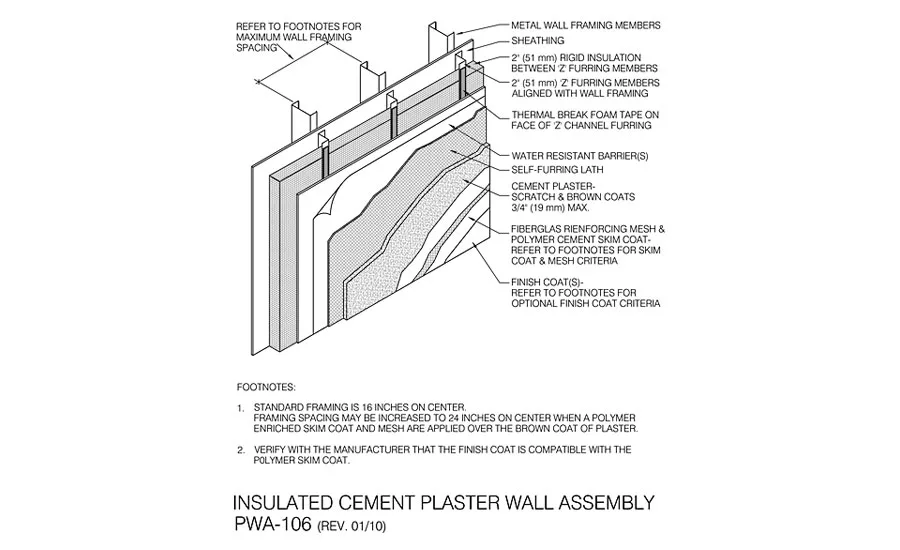
So, let me steer this to the subject of this column; the use of a three coat cladding and continuous insulation. Rather the myriad of possibilities for the use of three coat stucco and CI.
CI Stucco Assemblies
In my storied career there were many projects where we applied stucco over foam. Most popular (and still the norm today) was the application of one coat stucco over tongue and groove, dimpled, EPS foam. I did apply quite a bit of three coat over EPS and XPS. Having become familiar with the one coat versions, when it came to three coat we simply blew up the dimensions of the stucco accessories to accommodate the added thickness of the foam. It looked a little like this: Starting at the sheathed wall assembly we applied the two layers of WRB, we then marked the paper with a crayon where every stud location was and installed the trims.
At the bottom J-weep, we had a metal piece made up just like the normal 7/8-inch version but added the equivalent of the thickness of the foam to the weep dimension, then we put the foam in place and transferred the stud location mark from the paper to the face of the foam with the same crayon, then the wire went on, mostly stucco netting, and we hand nailed it off per code.
Lastly, we put the control joints at the locations specified on the plans and wire tied them to the lath. These didn’t have to be made any bigger since they were being placed on top of the foam, and we never cut the lath beneath them. When we had to have expansion joints, we just use back-to-back casing beads made to accommodate the larger thickness. In a mind’s eye view we only modified the perimeter stops to accommodate the thickness of the added foam component; all other accessories were the same old size for the three coat.
One note here—the stucco seemed to crack a bit more over the extruded foams than the EPS foams. In retrospect, I believe it was because the stucco didn’t stick to the extruded foam smooth surface compared to the adhesion on the EPS foams.
And here is where we go down a dark hole to our sometimes nonsensical, super-engineered-cacophony-of-parts-and-layers, current CI stucco market.
Further Considerations
I lay no claim to the above methods success except for the version I used for which I received no call-backs for at least thirty years. But what is not figured in these other assemblies is the terminations. How does one install the stucco stops or weep screeds? And what about the encapsulation of a foam insulation layer for say, a fire rated condition? And my biggest question: Why two walls or two systems? Isn’t the first one good enough?
Most of the EIFS manufacturers now have CI stucco assemblies. They provide details that address these questions but involve multiple layers of products and stucco accessories. Some of these in normal configurations with others, installed to flash or support a given area and to function as an attachment point for the next stucco accessory. Pieces and parts, added layers, multiple configurations. Most of these stucco systems put out by the EIFS manufacturers are for residential installations. And in defense of these manufacturers, developed by a market need.
There is one stand-alone Stucco System I am aware of that addresses all of the aforementioned issues. This system uses proprietary manufactured stucco accessories, installation of an insulating layer with no fastener penetrations and lath attachments that maintain uniform furring. The company is Brand X Metals (brandxmetals.com) and its system is Diamond Furr; I urge you to check out the website.
Simplicity for the Win
Let me tie this up in a neat little package for you. When it comes to protecting your building, simplicity begets performance. Keep it dry first, allow for air control, moisture control, and then insulate. In that order. EIFS offers the best option for CI, hands-down. If you must use a CI stucco cladding, do a bit of research and select the simplest version. Perhaps one that offers minimal layers and minimal stucco components. Remember, water doesn’t know which cladding it is trying to get into, nor does it care about how many layers it has to go through or how many engineered configurations are in place to repel it. So, when it comes to a continuous insulation exterior cladding, one should select EIFS first. Keep It Simple Silly.
Looking for a reprint of this article?
From high-res PDFs to custom plaques, order your copy today!





