High Performance Building Envelope: Looking Beyond High-Performance Claddings
Today’s buildings are more airtight, more energy efficient and environmentally friendly than at any time in the past. There is a strong desire by architects to seek high-performance exteriors for buildings they design.
As architects, we should be open to a variety of options and methods for exterior envelopes of building claddings. Architects must balance the aesthetics, the cost and the feasibility of the cladding against code compliance. A good designer should not be constrained to the premise that there is only one answer to any given scenario. Similarly, there are optional methods to manage moisture for exteriors.
Some consultants try to force-fit his or her methodology of moisture control onto every client. A designer must evaluate several factors prior to designing the envelope. We still hear about leaky buildings and all architects are concerned and desire to provide their client a weather-tight structure. True today as it was two decades ago, the lack of or improperly designed or installed flashings at transitions should be the primary consideration in designing exterior envelopes. Architects should not dismiss the lessons of the past or tried-and-true details that have proven themselves over decades of service.
Don't be oversold
Most people hear the term “high-performance cladding” and think rainscreen. We would challenge those to be more open-minded. The term “high-performance cladding” is appropriate and as it sounds like we are talking about cars rather than buildings, there are similarities. High-performance cars are great, but can everyone afford one? Does everyone need one? Someone who sells high-performance cars would answer yes to both questions. Envelope consultants with motives similar to the high-pressure car salesmen should make architects think of the motives of that person. As architects, we have clients who trust us to be professional, honest and educated about construction, and spend their money wisely. Architects should not allow themselves to be taken by or become advocates for high-pressure car salesmen.What is a rainscreen? Simply put, it is standing the exterior cladding off the substrate with furring or battens. While extra drainage that rainscreens offer seems the way to go, there are ramifications to consider before plunging head-first into the panacea known as rainscreen. If any architect, designer, builder, developer or contractor thinks that merely having a rainscreen cladding will eliminate any water intrusion problems or potential litigation of their association with the construction of the building, think again. Two facts prove the previous statement:
• Code authorities have been pressured to mandate “rainscreen” as the only viable method of construction. After a full decade of pressure, the building codes in the United States have not significantly changed with regard to rainscreen and exterior walls. Conventional methods are allowed and rainscreen remains an option, not a code requirement.
• The primary reason code authorities are reluctant to mandate a rainscreen is the overwhelming evidence that conventional cladding systems per the building code and ASTM standards, when installed correctly with flashings, appropriate design details and professional workmanship perform as they were intended. There are thousands of successful buildings with no rainscreen performing very well in a variety of climates across the United States. This is an undisputable fact.
Do not throw common science out the window
This does not mean one should ignore the use of a rainscreen assembly or abandon the design principle of rainscreen. Some buildings would be best served and should have additional drainage. However, when designing with rainscreen, architects cannot abandon basic laws of science and must consider the ramifications of a rainscreen design. If an architect does not consider these ramifications, a clever attorney most certainly will. It is also a fact that rainscreen assemblies are more complicated to construct. And while most architects are convinced that the tradesmen today are not the skilled tradesmen of decades ago, we seem eager to make systems more complicated. Here are a few additional caveats with rainscreen assemblies an architect may want to consider:Code compliance. If a completed building enters into a litigation scenario, the design team that specified a conventional code-compliant cladding with ASTM standards and good flashing details will have an excellent foundation for their defense. If and when problems occur with convention claddings, described and proven in the building codes and standards, investigation teams look for faulty details and poor workmanship. We are not aware of any litigation that was successful against a design firm for failing to specify a rainscreen cladding. Creative unconventional designs, no matter how well-intentioned, are aptly named “creative.” While the details and workmanship are still a primary issue, we have to ask ourselves the following. Did the unconventional “creative” design contribute to the problem or possibly create a new one?
One example of an unintentional consequence is a strapped rainscreen over traditional building paper. The designer called for vertical wood straps over the asphaltic saturated building paper. Basic science tells us, building paper wrinkles when wet, the wrinkles tend to be mostly horizontal in direction. This means the water would be directed in a horizontal direction until the water hits the vertical wood strapping and is diverted downward along the strap. The building paper wrinkles differently every time it gets wet and thus the path for the water varies. With the strapped rainscreen system, the vertical path is now constant, this continual water path at the same location every time will leech out the bitumens from the building paper in a shorter period of time than a conventional assembly. This will cause the paper to turn brittle and lose its water resistance. We have heard the argument “not that much water gets behind the cladding.” This begs the question, Why the pressure treated strapping if you did not anticipate the moisture? For that matter, why rainscreen if you did not anticipate that much water in the system? The primary issue is to think about the consequences of changing a traditional design and ask questions.
Be cautious of using pressure treated wood furring in designing rainscreen claddings. This can be a challenge with anything other than Type V buildings. As an example, Type III buildings require fire treated wood and noncombustible finishes. Wood cannot be pressure treated and fire treated. If fire treated wood is used, the wood must not get wet, contact with moisture deteriorates the fire treatment; a catch-22 an architect should prefer to avoid.
Wind Pressure and Design. Architects must be concerned with the wind pressure design for the building. There are two major factors when considering wind design for buildings. The first is the Main Wind Force Resisting System (MWFRS). The MWFRS includes structural components like wall framing, floor and roof diaphragms and shear walls. The second is the Components and Cladding. This section of the code deals with elements such as roof sheathing, exterior siding, doors, windows and soffits. Even when this is done, it is amazing how many times the “discontinuity” factor is neglected. Buildings exposed to wind are affected differently at various locations on the building. This is known as the discontinuity factor and is one of four factors used to arrive at the design wind pressure. The other three are: Combined height of the building; the importance factor of the building; and the wind stagnation pressure of the building. Some claddings, such as metal panels, have varying attachment requirements at the corners of the buildings to account for the discontinuity factor. If you decide to design a rainscreen, you will have to calculate that factor as well and make the necessary adjustments. The same is true for windows at specific locations as they will be exposed to a higher wind velocity and this must be taken into consideration when selecting windows. All of this information is in the I codes. Chapter Three in the IRC refers to this as the Component and Cladding pressure zones. The IBC component and cladding requirements are in chapter 16. Both codes are based on the more advanced methods found in ASCE (American Society of Civil Engineers) standard 7-02. Our firm routinely calculates this discontinuity factor and will typically specify that higher pressure number as the lowest rating for all windows on the building. The reason is that we know job sites and field personnel: A window is a window to them and Murphy’s law dictates the lower rated window will end up in the required higher rated opening.
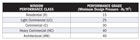
Windows. All buildings have them and all windows leak. When we say all windows leak, this is not meant to demean the window industry, it’s simply a fact. The proof is the American Architectural Manufacturer’s Association’s rating system that pressure tests for windows. The window industry recognizes that not every window will be subjected to the same harsh environment and people do not need to spend exorbitant amount of money for windows on single-family homes with overhangs. It works the other way too; windows for a single family home are not appropriate for a 10-story building on the coast. All windows leak at a certain point in a pressure test. Commonly a developer chooses a window or an architect specifies a window with little regard to the performance class of the window. Not all windows have an AAMA performance class rating. Windows certified by AAMA are recommended to be specified per the class rating based upon site particulars. There are five AAMA design classes for windows.
Each class of window is manufactured and tested to a designed pressure rating. Codes have designated criteria to assess each site with exposure categories and windows should be specified that meet the criteria. Surprisingly many designers and builders specify or install windows with the lowest performance class in buildings needing a higher performance rating. These windows are installed, leak and some consultants believe if only a rainscreen system was used, there would be no problems. The truth is a rainscreen wall system will not elevate the design pressure rating for the window and has little to nothing to do with a leaking window. Our advice is not to try and save money on less expensive windows in an attempt to afford a rainscreen cladding. Our firm has noticed that window flashings have improved over the last few years, but window leaks continue as they frequently fail the AAMA field testing procedures. A good design practice on larger projects is to have a percentage of windows tested in-situ on the building prior to proceeding with the project. It is recommended to use only an AAMA-certified testing lab as these labs have no financial interest with the window manufacturer or developer.
Windows off the shelf from the local lumberyard may be fine for single-family homes with overhangs and limited exposure. They are not fine for large buildings, buildings with no overhangs or buildings exposed to wind-driven rain. All windows are not created equal. Expensive looking windows do not automatically mean a window that can pass a high-pressure rating.
Conclusions
Architects need to understand the code pressure rating system for components and claddings and how to calculate these design pressures for a variety of buildings. Architects should also decide on the exposure and discontinuity of the walls and how much additional protection is needed and what options are at their disposal. If an owner wants rainscreen and can afford it, you should provide a rainscreen. Be cautious of presuming to recommend rainscreen as the best and only option in all cases. Subcontractors who have recommended what they thought or were sold as the best and newest technology have often found themselves on the losing end of many a litigation case.Our firm has noticed that flashings are getting better on construction sites. This would make sill pans not required. Before spending extra time and money on a rainscreen cladding and expensive sill pans, consider spending some time and money on understanding component and cladding pressure design ratings, windows that meet design pressure ratings and flashing procedures.
Looking for a reprint of this article?
From high-res PDFs to custom plaques, order your copy today!





