Energy Savings Makes Cents

If you could sell or offer your customers a sure fire investment of $1,700 in a seven-year CD and guarantee your customers a 10 percent return on the principle annually, would they buy? What if the accrued interest would be given to them annually tax free so they could nearly double their money in seven years? Would they invest? What if this investment instrument would be backed by a local company dedicated to reducing energy consumption in their community? This investment would even reduce their personal carbon footprint. Would they invest? If the energy efficiency provided by this investment was compared to auto mileage, meaning that a car previously getting 30 mpg would increase to 6,000 mpg,* would they invest?
Did you know that there are specific government programs and tax incentives, both federal and local, that support this type of investment?** Did you realize that your customers would sleep better at night and live more comfortably having made this investment? Do these claims seem outlandish, and too good to be true?
It is not too good to be true and it is ultimately very simple. In fact, many of us are already in the business of selling this investment. The investment that you are asking customers to make is not in some secured investment found in a far-off country. It is very local-your customer’s home or building. Simply, it is insulation. Insulation will use less energy, save money, reduce greenhouse gas emissions and reduce your customer’s carbon footprint. More importantly, your customer will be more comfortable now.
Insulating a home or building is one of the quickest and most cost effective ways to reduce energy consumption. Doing this delivers a positive and immediate impact on the environment and makes us less dependent on foreign oil. Insulating a home’s walls and refinishing a basement delivers immediate dividends that include-but are not restricted to-comfort and long-term value added to a home. With the continuous insulation, your customers will pay less for their heating or cooling. The building or home will be more comfortable and your customers will have extra cash in their pockets.
The U.S. Dept. of Energy reports that heating and cooling accounts for 50 to 70 percent of the energy used in the average home or building, and inadequate insulation and air leakage is a major causes of energy waste.***.

Annual Energy Savings
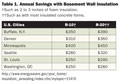
The energy cost savings of basement wall insulation vary depending on the local climate, type of heating system, fuel cost and occupant lifestyle. Typical annual cost savings by R value in a few U.S. cities are provided in Table 1 for a 1,500-square-foot home with a conditioned basement heated by natural gas ($0.72/therm).
This report shows that R-20 does not double the performance of the wall but can cost twice as much! Generally the second R-10 you add only delivers a little more than 1 percent of a return on your investment and a tenth of the performance. The chart below is simple and does not include the additional returns that are received as energy prices continue to climb. Look at an energy increase as adding to the principle of the initial investment. Savings always goes up in value over time. The seven year payback calculation is based on the average length someone stays in a home before selling and moving. Essentially, when you sell the building you recoup most of your original investment and the principle investment can be withdrawn when the building is sold. But the value that was invested stays with the building. So insulation becomes a wealth building instrument for the local community because the investment stays in place.
Understanding R value and performance is very important when you are promoting this type of an investment to a building owner. R value is a measure of a material’s resistance to heat transfer. A higher R value indicates better thermal resistance. Yet if we are honest with ourselves we all know that bigger is not always better. Even investing into R value is subject to a basic economic principle known as the law of diminishing returns. In a government study on thermal performance, an unexpected result was exposed about the return on investment that insulation delivers in a basement (see Table 1).
Additionally, more insulation changes the dynamics of the wall, movement of moisture and vapor transition through your wall system. How does slowing the drying affect dew point calculations? Where does that moisture go if it can’t move to the dry side? What does water do when it is trapped?
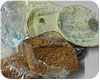
Here is an analogy: You buy two loaves of bread. The one purchased at the grocery store is wrapped in a plastic bag and sealed tight; the other loaf of bread is fresh from the bakery and is in a paper bag. Suppose “you pass GO and collect $200.00,” and now you can eat out every night for the next two weeks. Lucky you, but you have forgotten all about the bread. Upon your return to the mundane life of eating at home again, what do you discover? Which loaf of bread is dry and rock hard, and which one is a science project that has the Center for Disease Control camped outside your home? This is what could happen in your walls when you trap moisture inside a cool and dark place. What happened to the bread in the paper bag? Well the bread is rock hard, petrified, if you will. The paper bag allowed the moisture to escape eliminating an essential requirement for mold to grow moisture.
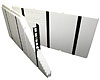
So, R value is not the only factor to consider. Perhaps as important to thermal performance and moisture control is the impact of air leakage, the unwanted air infiltrating through the wall. Studies show that conventional framing with fiberglass insulation has .5 air changes per hour. This means that 50 percent of your home’s air volume is being exchanged every hour, and this air must constantly be heated or cooled. Additionally, uncontrolled air leaks through unwanted places transport moisture, mold, fiberglass dust, and other allergens.*** Continuous insulation panels, having an interlocking thermal barrier, will reduce air flow and air leaks keeping indoor temperatures constant, controlled, comfortable and clean. These benefits are like compounded interest on your customer’s initial investment: efficient home heating and cooling, reduced energy consumption, and improved environment.
Insulating your basement or any of your walls with continuous insulation panels is fast, easy and cost effective.
Continuous insulation systems are a wise investment for your home, for your pocket book and for the environment.
Multi- Step, Multi-Part Approach/Pre-Assembled Approach
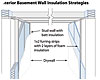
Insulated basements can help reduce energy costs. It is estimated that up to 30 percent of a home’s energy can be lost through the basement’s wall and rim joist. Basement walls are controversial and difficult to insulate and seal. Moisture control should be carefully considered, and the advantages and disadvantages of each approach should be weighed against the economic costs. If you plan on marketing your services, or are considering an energy efficient basement upgrade, first you have to tackle any moisture issues that may already exist. Throwing insulation on a basement wall, and hoping for the best can lead to trouble.
Moisture seeping in from outside of the house will get into the insulation, and, in the case of fiber-based insulation, it will dampen and reduce its efficiency. Trapped moisture can also cause mold and mildew to grow and this mold and mildew is dangerous to your health. The first thing to do is get control of humidity problems in your basement. It’s pointless having an energy efficient basement that’s making you sick. There are great resources on the web available for tackling this difficult job. www.buildingscience.com/documents/digests/bsd-103-understanding-basements/files/bsd-103_understanding-basements.pdf
More Savings:
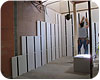
Requires less insulation (1,475 square feet of wall insulation for a 32-foot-by-60-foot basement with 8-foot walls, compared with 1,920 square feet including the ceiling)
Continuous insulation easily achieves continuous thermal and air leakage boundaries and includes wire chases for power management.
Requires little, if any, increase in the size of the heating and cooling equipment. The heat loss and air leakage through the basement ceiling is similar to that through the exterior walls of the basement.
For more information on ways to save energy and reduce your home’s heating and cooling costs, visit www.r21walls.com.
References
*EPS insulation returns up to 200 times the amount of energy required to produce it. www.epsmolders.org/PDF_FILES/EPS%20LCA%20brochure.pdf
**Programs in your state, visit www.dsireusa.org Database of State Incentives for Renewable & Efficiency (DSIRE).
***The United States Department of Energy (USDOE) states that heating and cooling accounts for 50 to 70% www.ornl.gov/sci/roofs+walls/insulation/ins_01.html
Looking for a reprint of this article?
From high-res PDFs to custom plaques, order your copy today!