Walls & Ceilings logo
search
cart
facebook twitter linkedin youtube youtube Spotify Podcasts Apple Podcasts Spotify Podcasts Apple Podcasts
  • Sign In
  • Create Account
  • Sign Out
  • My Account
Walls & Ceilings logo
  • NEWS
  • TOPICS
    • Drywall
    • Stucco/EIFS
    • Ceilings
    • Steel Framing
    • Fireproofing
    • Interior Plaster
    • Building Envelope
    • Insulation
    • Technology
    • Interior
    • Exterior
    • Women In Construction
  • COLUMNS
    • Up Front
    • All Things Gypsum
    • Art & Craft of Plastering
    • Stucco Stop
    • Steel Deal
    • Industry Voices
  • PRODUCTS
    • Buzz Guide
  • EVENTS
    • Industry Events
    • Webinars
    • BUILD Expo
  • MEDIA
    • Videos
    • Podcasts
    • Photo Galleries
    • BUILD26 Videos
    • Take our Quiz!
    • Infographics
  • EXCLUSIVE
    • Newsletters
    • Top 50 Contractors
    • Contractor of the Year
    • State of the Industry
    • W&C Store
    • Market Research
    • CEUs
    • Sponsor Insights
    • Custom Content & Marketing Services
  • DIRECTORY
  • EMAGAZINE
    • eMagazine
    • Advertise
    • Archive Issues
  • SIGN UP!
ColumnsDrywallAll Things Gypsum

Green Board Ceiling Framing Language to Change

By Michael Gardner
January 9, 2013

Building codes evolve to address changes in how structures are constructed. EIFS, for example, were largely unknown in the United States until the early 1980s. Once the systems achieved broad acceptance, language was placed into model codes to address EIFS materials and application methods.
gyp

The need to add language to model codes is obvious; the desire to remove language is less apparent. Blame human nature for the latter approach. When faced with an option to remove language (or throw away something we don’t need) the concept that “someone somewhere might want to do it the old way/ I might need it in the future” generally seems to make us reluctant to boot out the old. Even to our detriment.

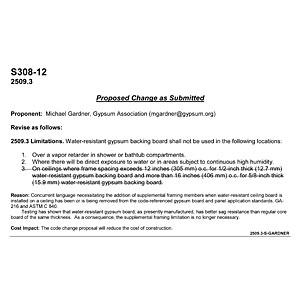
Sometimes, however, you have to purge the proverbial closet of outdated items. Such is the mind-set that led the Gypsum Association to submit a proposal to remove language from the International Building Code that requires supplemental framing when water-resistant gypsum board (“green board”) is applied to a bathroom ceiling. Current language in Section 2509 requires the ceiling support framing members to which the board is applied to be installed at no more than 12 inches on center for 1/2-inch-thick-green board or 16 inches on center for 5/8-inch-thick green board. A proposal from the Association to delete the language was approved by the voting members of the International Code Council during the October 2012 Final Action Hearings.


TOUGHER TODAY

The historic perception of green board is that it is more susceptible to sag than other board products. While that may have been the instance when it was first introduced in the 1960s, advances in materials science have made today’s contemporary water resistant boards no more or less susceptible to sag than any other gypsum board.

In addition, the humidified deflection values for green board in the 2011 edition of ASTM C1396 are identical to the values for regular wallboard and type X board. Both regular and type X board are commonly applied to bathroom ceilings. Neither requires any supplemental support framing when installed on a ceiling.

The approved proposal, S 308-12, will remove text that has been embedded in code documents and standards for many decades. During the early 1980s, concerns about humid bathroom environments created the impression that green board ceilings could sag disproportionately. The solution for addressing this was to ban the application, and in 1988 the Uniform Building Code was amended to prohibit the use of green board on bathroom ceilings.

For reasons that require little explanation, the gypsum industry was not necessarily supportive of the ban, apparently believing that the problem installations were generally the result of poor application techniques, but grudgingly agreed to have it inserted into the code. Resolution came in 1994 in the form of code language that mandated a closer spacing of framing members when green board is applied on a ceiling.

The supplemental framing language gradually migrated to other codes, and in 2000 it was placed in the first editions of the IBC and the International Residential Code. In the mid-90s, it was incorporated into ASTM C840 and GA-216, the standards referenced by the IBC that define the criteria for the application of green board.


HARD LANGUAGE

Because of improvements to the product manufacturing process, the supplemental framing language was reduced to “gotcha” status that only served to hamstring the contractor. Noting that the language is outdated, the two independent committees with oversight for the ASTM C840 and GA-216 standards each agreed to remove the language from the upcoming edition of each document. To eliminate a discrepancy between the code and the documents it references, the association submitted the code change proposal that was approved. A similar proposal will be submitted to remove similar text from the IRC. NFPA 5000 will be addressed at the next opportunity.

Another proposal submitted by the Gypsum Association and approved during the final hearings corrected an odd situation that can most politely be called an oversight.

For many years, Section 2308.9 of the IBC has listed 1/2-inch-thick gypsum board as a material acceptable for use when structurally bracing an exterior building wall. Oddly, while the prescriptive language lists nail-applied 1/2-inch-thick wallboard as an acceptable bracing material, the language had never been updated to allow the use of 5/8-inch-thick gypsum board or to permit screw fastening of gypsum board when it is used as part of a bracing system.

Confronted by these omissions, association staff authored a proposal to insert 5/8-inch-thick gypsum board and the screw fastening method into the IBC. The approved proposal, S 289-12, was modified slightly in final action by a coordinating proposal submitted by the wood industry. The Gypsum Association agreed with the wood industry proposal and testified in support of the modification.

In retrospect, it is not surprising that the oversight in the IBC language had gone unnoticed for many years. The specific language in the IBC that regulates wall bracing is somewhat disjointed and scattered throughout the code. It is difficult to follow its logic and flow. In addition, while bracing methods are used to construct buildings built to the IBC, they are used more often with residential dwellings constructed to the IRC. And the same language issue does not exist in the IRC.

 Neither modification takes effect until the 2015 edition of the IBC has been adopted by the jurisdiction of authority. As noted above, The Gypsum Association will introduce a proposal to remove the supplemental framing language from the 2015 edition of the IRC. The initial hearing process for the proposal will occur in late April 2013 and the Final Action Hearings on the proposal will be in late October 2013. W&C 

KEYWORDS: building codes fasteners

Share This Story

Looking for a reprint of this article?
From high-res PDFs to custom plaques, order your copy today!

Michael Gardner is the president of M Gardner Services LLC, a consulting firm that assists organizations with issues involving industry standards and building codes, meeting management, and external collaboration and outreach. Prior to establishing MGS, he was the executive vice president of Compliance Programs for the International Code Council. He is also the former CEO of the Gypsum Association, currently serves as a special technical advisor to the Wall & Ceiling Alliance and can be reached at michael@mgardnerservices.com.

Recommended Content

JOIN TODAY
To unlock your recommendations.

Already have an account? Sign In

  • Abercrombie & Fitch

    EIFS in 2026: How Specialty Finishes Are Redefining Exterior Wall Systems

    As building codes, owner expectations, and design demands...
    Stucco/EIFS
    By: Regi Mendoza
  • proper air and vapor control

    From Energy Efficiency to Moisture Management: Why Air and Vapor Control Matter

    How proper air and vapor control within building...
    Building Envelope
    By: Benjamin Meyer AIA, LEED AP
  • Linear Metal Ceiling Beam Baffles

    Top 25 Ceiling Contractors of 2026

    Suspended ceilings demand precision, code compliance and...
    Ceilings
    By: John Wyatt and Tanja Kern
You must login or register in order to post a comment.

Report Abusive Comment

Manage My Account
  • eMagazine Subscription
  • Newsletters
  • Online Registration
  • Manage My Preferences
  • Subscription Customer Service

More Videos

Sponsored Content

Sponsored Content is a special paid section where industry companies provide high quality, objective, non-commercial content around topics of interest to the Walls & Ceilings audience. All Sponsored Content is supplied by the advertising company and any opinions expressed in this article are those of the author and not necessarily reflect the views of Walls & Ceilings or its parent company, BNP Media. Interested in participating in our Sponsored Content section? Contact your local rep!

close
  • medical professionals moving a patient on a stretcher through the halls of a medical building
    Sponsored byNational Gypsum Company

    What Does High Performance Mean When It Comes To Gypsum Boards?

Popular Stories

Linear Metal Ceiling Beam Baffles

Top 25 Ceiling Contractors of 2026

Wichita Biomedical Campus

Wichita Drywall Worker Dies After Scaffolding Fall

QXO Just Changed the Game-Here's What Contractors Are Asking

QXO Just Changed the Game-Here's What Contractors Are Asking

An interior drywalling work in progress

Boost Profits with AI Scheduling

Events

June 24, 2026

The Bright Side & Benefits of Designing with Integrated Lighting

Credits 1 AIA LU/HSW; 0.1 ICC CEU

This course will explore the pivotal role architects and lighting design play in creating safer, more sustainable spaces. Learn how to avoid common lighting mistakes and make informed decisions that create the best visual environment for occupants. 

January 1, 2030

Webinar Sponsorship Information

For webinar sponsorship information, visit www.bnpevents.com/webinars or email webinars@bnpmedia.com.

See our full library of webinars

View All Submit An Event

Products

2026 National Painting Cost Estimator

2026 National Painting Cost Estimator

See More Products

Related Articles

  • All Things Gypsum: Addressing Misconceptions about Green Board

    See More
  • All Things Gypsum: Penetrating Fire-Rated Gypsum Board Ceiling Systems

    See More
  • NCCER Women In Construction White Paper

    NCCER Asks Women: What’s It Like to Work in Construction and What Needs to Change?

    See More

Related Products

See More Products
  • M:\General Shared\__AEC Store Katie Z\AEC Store\Images\Walls & Ceilings\new site\Contractors_guide-change-or.gif

    Contractor's Guide to Change Orders

  • 978-0-7643-3022-3.jpg

    Award-winning Green Roof Designs: Green Roofs for Healthy Cities

  • smo-green-standard-edition-log-book.png

    Log Book - Green Standard Edition

See More Products
×

Connect with the industry’s leading resource for unparalleled insights and education.

Join thousands of industry professionals today. Shouldn’t you know what they know?

JOIN NOW
  • RESOURCES
    • Advertise
    • Contact Us
    • Directories
    • Store
    • Want More
  • SIGN UP TODAY
    • Create Account
    • eMagazine
    • Newsletters
    • Customer Service
    • Manage Preferences
  • SERVICES
    • Marketing Services
    • Reprints
    • Market Research
    • List Rental
    • Survey/Respondent Access
  • STAY CONNECTED
    • LinkedIn
    • Facebook
    • Instagram
    • YouTube
    • X
  • PRIVACY
    • PRIVACY POLICY
    • TERMS & CONDITIONS
    • DO NOT SELL MY PERSONAL INFORMATION
    • PRIVACY REQUEST
    • ACCESSIBILITY

Copyright ©2026. All Rights Reserved BNP Media, Inc. and BNP Media II, LLC.

Design, CMS, Hosting & Web Development :: ePublishing