The Changing Economics of Metal Stud Framing
The growing global market for the light gauge steel framing industry.
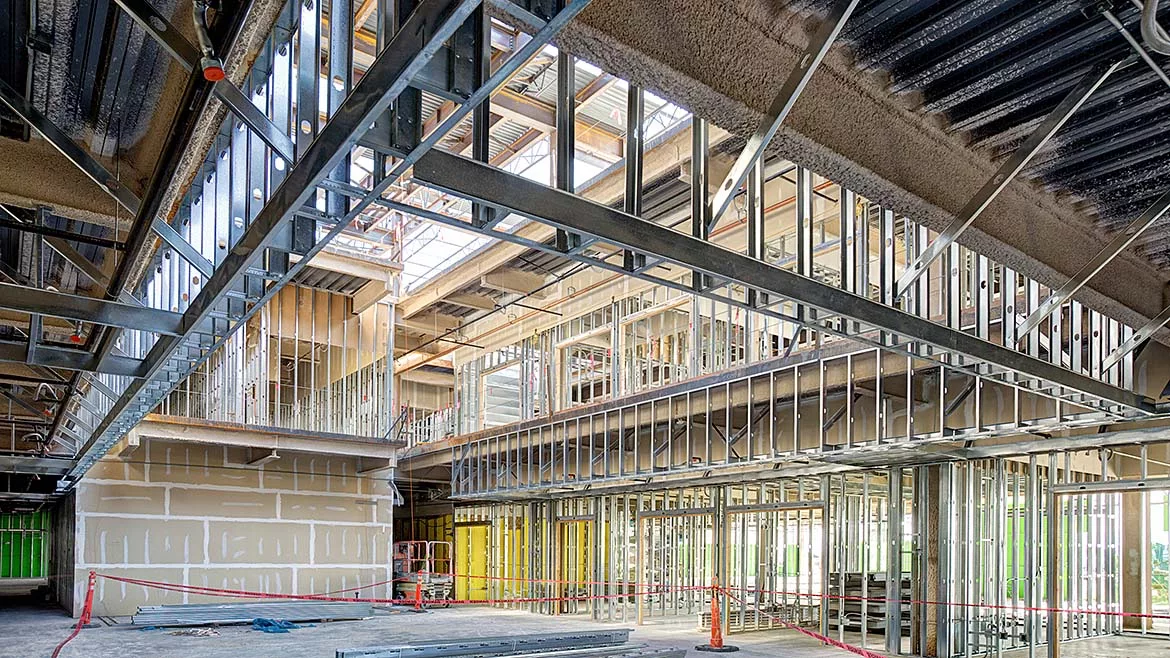
The global light gauge steel framing market was valued at USD $33.07 billion in 2024 and is projected to reach USD $49.16 billion by 2031, growing at a compound annual growth rate of 5.08 percent from 2024 to 2031. Looking forward, by 2040, in just 15 years, the global LGSF market will be in the neighborhood of $75 billion, [more than] double the 2024 value.
This is wonderful news for the LGSF industry—but will also bring many challenges.
In this article, I will focus on the labor and installation [contracting] side of the equation and how technology must be adopted to capitalize on this massive growth cycle.
The construction industry is buzzing with how technology can make it more efficient, safer, better quality and more sustainable.
The LGSF industry is a hotbed for new tech and is long overdue a transformation.
However:
- Decades old means and methods are stubborn to phase out;
- The design + approval + code compliance + specification + installation and inspection processes are not friendly to change;
- We have been using, assembling, and installing the same C-shapes and U-shapes for the past 75 years, and;
- Traditional shapes require massive amounts of measuring, marking, cutting, clamping, and screwing as each piece is essentially custom installed into the building.
We keep building the same way hoping for a better result, time after time, after time. While the ever-complex (difficult) build designs, code compliance, labor availability and construction costs that are continuously rising, our current build methods are not sustainable.
The Ever-Rising Cost of Labor
While labor and construction costs soar out of control, combined with high interest rates, the future of many building projects and contractors margins are in jeopardy.
For example,only. Wage packages across the country vary.
*Based on Northern California Carpenters – Carpenters Wage & Fringe Benefits Package (effective 7.1.2024)
Plus/minus 30 percent variance per [each] 20-year term
** 2020 Fringe Benefits Package includes:
Health
& Welfare = $12.87 + Pension = $11.40 + Annuity = $ 3.16 + Vacation
= $3.37 + Work Fee = $2.52 + Apprentice Training = 1.26+ Vacation /
Holiday / Sick Admin. = $0.10 + Industry Promotion = $0.07 + Carpenters
International Training Fund = $0.14 + Contract Work Preservation = $0.05
+ Carpenter Employers Contract Admin. = $0.07 = TOTAL = $35.01
Furthermore, Workers’ Comp mod rates and comp packages are based on man hours worked and past safety performance. So, the more man-hours worked, the more worker comp. dollars you must put in. The better your safety record the bigger your excess premium return.
The economic stack of carpenters’ base wage and benefits package is on a one-way mission to the moon and beyond. While carpenters’ pay packages and escalating worker comp. costs may never reverse, the way that we stack labor vs. material cost can, and must change, to harness [gain] control over our budgets, margins, and rising build costs.
This means we will pay more for materials that add more value; smart materials that will effectively reduce total installed cost, by reducing labor cost, by significantly increasing productivity, improving quality, reducing over-orders and waste, while also eliminating many safety risks, hence lowering safety cost, too.
Smart materials will reduce labor cost by significantly reducing labor days to complete the same amount of work. This will lead to schedule reductions as well.
Less field man-hours = less workers comp expense = less chance for safety risks.
The Restrictive Design Plus Means & Methods of LGSF
Over the past 40 years, LGSF labor and benefits cost has increased 104 percent, while LGSF means and methods have remained fundamentally the same. The LGSF industry has been using the same C-shapes [studs] and U-shapes [tracks] since the 1950s. While these are strong and efficient [members] shapes, these traditional shapes are the root cause of excessive labor, over building/stacking of materials for more strength, poor quality, safety risks and excessive material waste.
Some of the inherent [built-in] downsides of traditional metal stud framing:
- Raw Material: Quality standards and roll-forming methods
- Installation Quality: Build-up of materials and lack of installation standards
- Safety Risks: Ladders and lifts—cutting and screwing operations
- Waste: Over-ordering, due to poor material estimates and material cuts (yield)
- Scrap and Clean-up: Much labor is spent cleaning up scrap materials. Plus, much material is pushed to the landfill or recycled.
It takes a tremendous amount of labor and consumables, (chop saw blades, screw guns and screws), to custom fit-ups and assemble these traditional stud-and-track into rough-framed walls.
Unpredictable labor (skill level and efficiency) is the biggest thief of your margin and cause of loss.
Other factors that rob your [planned] install and impact your bottom-line.
- Out‐of‐sequence work;
- Remobilizations/“go backs”;
- Ramp‐up/ramp‐down labor forces;
- Response time to RFIs and change order requests;
- Constructability issues, and;
- Trade stacking, crowding, or other crew over-manning issues.
This excessive use of labor, to custom build each project, has become ever-increasingly burdensome and expensive, with high risks of spending more money than you have in your [estimate] competitive bid.
Design for Manufacturing and Assembly
It’s critical to use modern technologies for more efficient and effective installations as these new standards emerge. While multi-trade [on-site] coordination is getting more and more complex, Advanced BIM modeling, DfMA, prefab, kitting, panelizing and robotic lay-out methods are becoming increasingly popular.
Examples of some meaningful material improvements using basic DfMA Principles over the years include:
- CEMCO: Sure-Board and Sure-Span floor joist
- ClarkDietrich: TradeReady Rim Track
- Brady Innovations: SLP-TRK Brand Slotted Track & ProX Header
Simpson Strong-Tie: DBC Drywall Bridging Connector
Examples of New Evolving Materials & Methods
For exterior panelization, FRAMECAD is the best example I have seen of DfMA principles and BIM technology. The system, now a mainstay in the industry, has successfully changed the economics of LGSF building.
Steel framing construction and processes are increasingly used by building companies all around the world. The versatile nature of steel framing allows the rapid and effective construction of commercial buildings, mid-rise and residential buildings, warehousing, facades and modular buildings, pods and more.
Design and construction flexibility is enabled with the system—delivering web joist, trusses, structural framing, and internal partitioning suitable for a diverse range of construction types. Because of the time-saving and quality assurance gained across a wide selection of applications, it’s obvious why framing is the future of construction.
For interior walls, some companies have created a game-changing package of technology by combining BIM technologies and mixed reality. For example, Hyperframe leverages DfMA manufacturing principles and incorporates snap connectors into traditional wall studs and tracks, enabling snap-together connections that do not require cutting or screwing.
The combination of these value points restacks the economics of the LGSF trades while keeping workmen safer and their fully burdened pay packages intact.
The old adage “Work Smarter Not Harder” applies here.
Looking for a reprint of this article?
From high-res PDFs to custom plaques, order your copy today!