Understanding Truss Uplift
Having this knowledge can help prevent drywall cracking.
Being educated on new solutions for the drywall industry has the potential to drastically reduce contractor callbacks, while also raising the standards of the trade. As contractors, educating ourselves on new installation methods and evolving products can solve longstanding industry problems, plus it gives us an advantage over the competition.
Drywall cracking due to Truss Uplift is one of the many common complications we face in today's market where aesthetics are a major concern. The problem is more prevalent in cold weather climates, but can be avoided and solved by properly utilizing the floating interior angle technique. Understanding how truss uplift occurs allows us to avoid the associated problems of drywall cracking. Simply stated, the problem is that wood moves, sometimes a lot, and drywall doesn't. The more you attach drywall to wood i.e. the truss framing, the more likely cracks will appear in the ceiling. The solution is simple: attach the drywall to less wood, allowing the structure to move, shrink and expand without forming cracks in the drywall around the perimeter of the ceiling. This article will discuss four methods of protecting against truss uplift drywall cracking.
To understand truss uplift we first need to know what truss rafters are. Trusses are pre-engineered and manufactured assemblies that take the place of conventional rafters, ceiling joists and basic roof constructions. The trusses are a combination of wood members connected together with metal plates forming triangular units. They are commonly installed across the entire width of a structure, which transfers the bearing loads to the outside walls and down to the foundation, eliminating interior load bearing reference points.
Truss Uplift
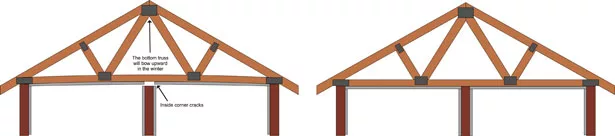
Structures of buildings showing signs of interior ceiling corner cracking in the winter can be associated with truss uplift. Roof truss uplift occurs when the bottom chords of a truss are exposed to significantly different moisture or temperature condition than the rest of the truss. If done properly, the bottom chords of a truss are buried in heavy insulation. In colder months the warm temperatures from the ceiling below combined with the thickness of the insulation dries out the bottom chords causing them to shrink. This is in contrast to the top chords, above the insulation, which are absorbing moisture and being kept damp from the higher humidity in the attic. The dampness of the top chords of a truss causes them to expand. This differential movement in the top and bottom chords of a truss causes them to arch up in the center (see Figure A). Because the truss ends are secured to a building's exterior walls, locations that resist outward thrust, the truss bottom chords expand along the length of the structure and the force pushes it upwards into the attic space creating unflattering cracks along the inside corner of interior partition walls.
Cause
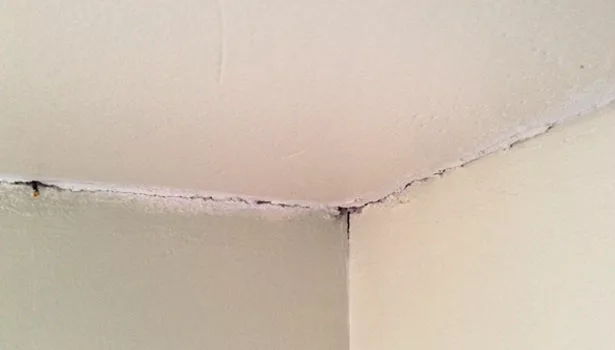
Truss uplift is not a structural problem, but it does cause cosmetic problems. When the trusses arch up they pull away from the top plates at the ceiling-wall juncture of central interior wall partitions. This movement, which can cause simple hairline cracks or create larger gaps along the corners, is a cosmetic problem that is an eyesore and a turnoff to most homeowners (see Figure B). The building contractor will be held responsible and in turn the drywall contractor will be called in to re-tape the corners and to fix popped screws, only to have the problem reoccur the following season when temperatures begin to drop. The problem is continuous as the ceiling/wall juncture cracks open in the winter and close in the summer.
Solutions
Framing Prevention
The best prevention is to allow the trusses to move. The key is to eliminate truss uplift cracks and screw pops. To accomplish this we need to attach the ceiling panel along the partition differently. This means not fastening the ceiling drywall to the truss rafters near the interior partition walls.
When building a new house the framing contractor should secure the interior partitions to the trusses with truss clips. This keeps the partition wall stable and plumb while allowing the trusses to move up and down.
Drywall Hanging Prevention
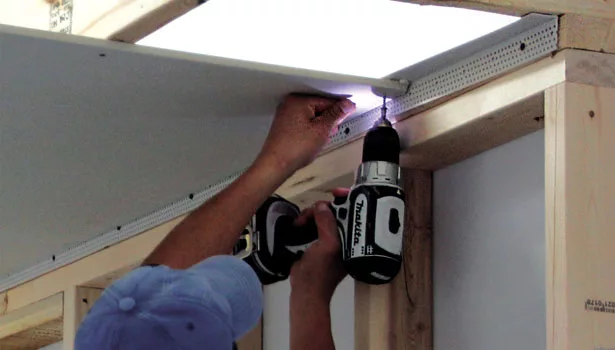
The floating interior angle technique solves this problem by attaching the ceiling drywall to the top of interior partition walls instead of the trusses. Most truss movement occurs over a period of time, the floating interior angle installation technique allows the drywall to flex near the corners preventing cracking. In other words the truss does not just pop up or slam down. The movement is gradual so the drywall flexes slowly as the rafter moves up, but the drywall inside corner stays in place. This proven solution allows the truss to move and keeps the corner stationary, leading to no cracks and happy customers.
Achieving the Floating
Interior Angle:
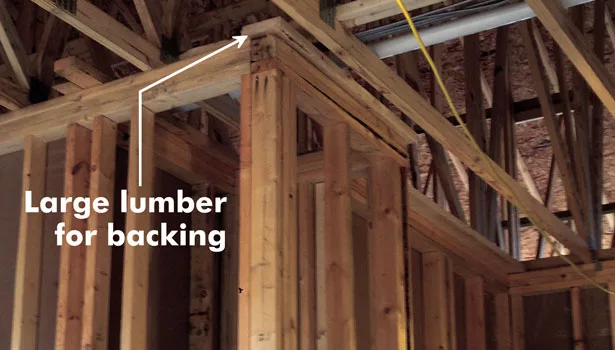
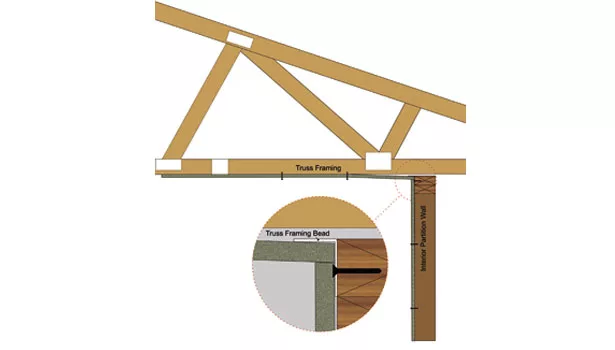
Using large lumber that is installed during framing by the carpenter is one way to accomplish a floating interior angle. The wood is used as a ceiling backing. Normally a 2x6 or 2x8 lumber is installed by nailing it to the top plate of the truss, providing a stationary backing for the inside corner. Drywall is then attached to that backing and not the truss (see Figure C). This method can be time consuming, and the lumber is still susceptible to shrinkage.
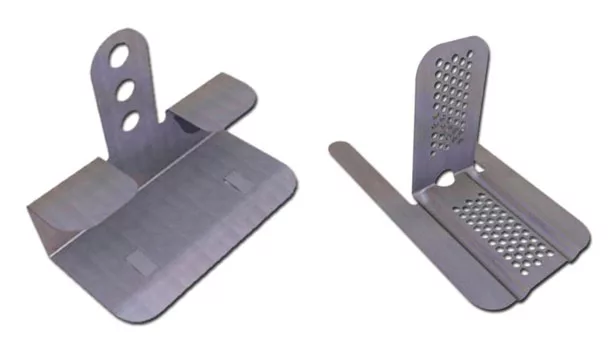
The use of metal clips is another option. These are typically installed by the drywall contractor. The clips are fastened to the top plate and then the drywall is either fastened to the clip or set/slipped into the clip. The clip functions as a backing at the inside corner allowing the truss to move during uplift while maintaining a stationary inside corner. This system requires a lot of clips and results in a non-continuous backing system that only provides points of protection.
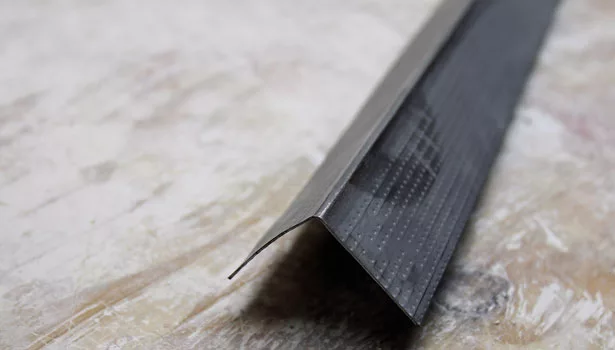
A utility steel angle is another option. The angle is installed by either the carpenters or the drywall hangers. The steel angle attaches to the top plate and the drywall is then screwed to the steel angle in between the trusses and it keeps the inside corner stationary during truss uplift. The utility angle provides a continuous backing system, but the thin gauged steel is susceptible to job site damage and the screws are more difficult to start.
Another option is to use a rigid vinyl truss backing angle, available from Trim-Tex for example. Installed by carpenters or drywall hangers, the vinyl angle attaches to the top plate. The ceiling drywall is then screwed to the truss backing, similar to the utility steel angle. Like the steel angle, truss backing angle offers continuous crack protection. It also has the benefit of screws starting easier, and being resistant to job site damage.
Looking for a reprint of this article?
From high-res PDFs to custom plaques, order your copy today!





