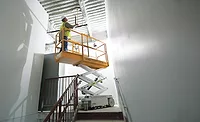
The Truth About Low-Level Lifts
The Magic Number
There’s a misconception that general contracting projects like framing, painting and installing HVAC, electrical systems or drywall requires a specific-sized scissor lift. But there is more to choosing the best lift for your job than just how high it can go.
Although low-level scissor lifts come in various sizes in height, they go above and beyond their size in terms of capabilities. With close examination of the job, the specs and the features of the low-level access lifts, you’ll quickly find that their labels don’t do them justice. Low-level access lifts are designed to increase safety, efficiency, ease of use and convenience, giving users the ability to complete 90 percent of the jobs typically reserved for other sized lifts. An added benefit is that, because of their size and maneuverability, the low-level lifts can be the first piece of equipment on the site and the last to leave.
The Truth About Working Height
A majority of jobs completed on any construction project or in any maintenance or industrial application occur in that 18- to 20-foot working height range. Lift heights of low-level access lifts typically are from 8 to 14 feet, but 6 feet need to be added to calculate the working height. Therefore, the working height for most low-level access lifts is between 14 and 20 feet. While they are slightly lower, they typically offer more in terms of speed, versatility, safety and lower lifecycle cost.
Give Me Space
One of the key factors to consider when evaluating a lift beyond just height is working space. For contractors, ample space for working and carrying tools is critical to efficiency and safety. Whether hanging drywall or installing HVAC, extra space and capacity allows for an extra person, as well as easy access to all the materials needed to efficiently accomplish the task. This translates to significant time savings because fewer trips up and down are necessary.
Some low-level lifts typically offer an average capacity of 500 pounds, resulting in diminished capacity for drywall, ductwork or other materials. Many low-level lifts have two-person occupancy but also can hold more weightÑup to 750 pounds on some models. Again, the results are fewer trips up and down and faster project completion.
Platform sizes on low-level lifts range from 25-30 inches wide by 60-70 inches long. For even more room, extensions add up to 36 inches of platform length.
Stepping Up
A scissor lift that can handle the weight and capacity of two workers plus all the tools certainly is a productivity benefit. Finding a feature that also provides easy access for those workers and their materials not only can enhance productivity, but safety, as well. The potential for increased safety and productivity makes entry height a critical aspect to consider.
Low-level scissor lifts are designed to cater to the contractor and maintenance markets with entry heights as low as 20 inchesÑonly one stepÑwhich makes getting on and off the platform easier and safer. The lower height reduces the potential for injuries. Users get even easier access with full swing gates. They can step onto the platform with tools and materials in hand instead of ducking under and moving materials up and over bars or chains.
Taking a Load Off
Getting jobs done quickly and without causing inadvertent damage is key to meeting time constraints and staying on top of the bottom line. The last thing a contractor wants to do is spend time and money on repairs that easily could have been prevented.
Heavier lifts have higher concentrated wheel loads that can damage delicate flooring like tile, mezzanine floors and raised floors. Also, because of their weight, they typically can’t access work on freshly poured concrete until it has fully cured, which could take up to 30 days and delay projects. Since taller lifts can weigh as much as 3,300 pounds, the risk of causing damage to floors in finished spaces like hospitals and campuses is greater. Low-level lifts can weigh as little as 600 pounds, and some feature dual front wheels that help disperse the weight and wheel-load concentration. Together, those aspects allow operators to tackle projects on freshly poured concrete sooner and access jobs on delicate flooring with no damage.
To further prevent damage in finished spaces, many units also feature non-marking wheels that prevent scuffs on hard surfaces. Some low-level lifts are also equipped with counter-rotating wheels; while one wheel rotates down, the other rotates up. This motion reduces the friction point so the lift can maneuver over carpet without causing tears.
Heed the Hydraulics
Heavier lifts aren’t the only thing that can damage floors; hydraulic systems can be a culprit, as well. Hydraulic systems that operate the lift’s steering, driving and lifting have more routing with six to eight connection points. If these points become loose, fluid can leak and cause damage.
The hydraulic system on low-level lifts typically only powers them up and down, while battery power operates the driving and steering. This configuration has only two connection points, so the chance of a leak is greatly reduced. Some even feature a fully contained hydraulic system, so even if a leak occurs the fluid does not escape to damage carpeting or create hazards.
Getting Around (or Under)
Maneuvering between studs and walls, around tight corners or into small spaces can be challenging with a large lift. Many are no wider than 32 inches, well within the width of most doorways in commercial, industrial and government buildings. However, those with higher stowed heights can make ducking under doorways or into elevators with drywall or framing on board nearly impossible. It also limits the range of work that can be performed. In addition, wider lifts with wider turning radiuses might not be able to maneuver around tight corners.
Low-level scissor lifts can be as narrow as 25 inches and they feature stowed heights as low as 66 inches. This provides more clearance for getting under doorways and into elevators, even with taller materials on board. Users can choose the right lift with the right working height for the job.
Low-level lifts also feature platform lengths as short as 47 inches, so they can easily fit in any elevator in the United States that’s built to code. In addition, some models allow operators to turn in shorter radiuses, some as low as zero, for easier maneuverability around tight corners and into hallways or small offices without assistance from other crewmembers.
A Tough Climb
Using low-level lifts increases efficiency and productivity. More important than those benefits, however, is the impact these lifts have on worker safety, especially when compared to ladders. According to OSHA, falls from ladders are one of the leading causes of occupational injuries and fatalities. Users also can suffer from less serious injuries like bruising and tenderness on the soles of their feet from standing on a ladder’s narrow rungs for extended periods of time.
The Final Show
The benefits of the thoughtful design of low-level scissor lifts aren’t just smoke and mirrors. Whether you’re hanging drywall, installing sprinkler systems, painting or doing electrical work, your lift’s features should allow you and your employees to get all these jobs done safely and easily. With 14- to 20-foot working heights, low-level lifts are revealing that the “higher is always better”perception is the real illusion.
Looking for a reprint of this article?
From high-res PDFs to custom plaques, order your copy today!