LEED Fellow CORNER
German Innovation for High-Performance Buildings (Part II)
As I noted in my article in the April issue of EDC, Germany is one of the world’s top three leaders in innovation, yet German advances for high-performance buildings have not readily made it to the U.S. This, in large part, can be attributed to policies. German policy at every level of government also supports the implementation of these innovations. German standards, based on European energy law, are regularly updated to reflect advancing technology. Also, building codes are informed by a national goal for per-person energy use far lower than U.S. consumption patterns. Some of Germany’s leading policy examples are cited here, showing how the public and private sectors can work together to create attractive, sustainable, livable environments through regulation, incentives and planning.
Green Roofs
While we also have green roofs in the U.S., German incentives and regulations have made vegetated roofs abundant throughout the country. In fact, Germany leads the world, which is the result of federal funding to reduce CO2 emissions and energy consumption and the Federal Nature Protection Act requiring green-space offsets. Now some 10 percent of all German roofs are green, and about three-quarters of these have extensive systems that are thinner, lighter and have less soil than intensive systems. These roofs, introduced 50 years ago, became increasingly common in the ‘80s and are now the subject of active research.
About one-third of German cities have regulations requiring certain amounts of green roof space. Two cities stand out among them. In Stuttgart, the state capital of Baden-Wuerttemberg, green roofs are a condition of development. The city has more than 3 million square feet of green roof area with another 15 million square feet in the planning stage. Start-up grants are offered, city staff members provide free consultation and reduced rainwater fees are in place.
In the federal capital of Berlin, reduced rainwater fees are also one of the local incentives. The vast development at Potsdamer Platz is a showcase project for rainwater reuse, with some green roof areas. Vegetated roofs help absorb rainwater, with excess runoff collected for toilet flushing, fire suppression, irrigation and feeding into an urban surface water system that is part of an attractive pedestrian environment.
Active Solar
In 2012, nearly 1 percent of Germany’s primary energy was derived from solar energy (contributing to 12 percent for all renewables), seven times the 2011 U.S. level. This is a result of progressive political measures and related incentives that have become even more aggressive since Germany shut down several nuclear power plants in reaction to the 2011 meltdown of the Fukushima nuclear plant. (In 2012, only 8 percent of Germany’s primary energy came from nuclear power.) Germany now has thermal power plants in place where solar energy produces steam used to generate electricity.
Germany’s Regulations for Renewable Energies, enacted in 2009, require that all new buildings use some form of renewable energy. These federal requirements are sometimes augmented by state regulations. For example, in 2007 Baden-Wuerttemberg required major residential heating system renovations to obtain at least 10 percent of their energy from renewable sources. Related incentives set rates for net metering, where electricity generated on the site offsets utility-supplied power, and solar systems receive subsidies obtained through extra fees levied on all electricity users.
Besides using a lot of building-integrated photovoltaics, Germans have perfected the use of roof-mounted solar collectors for thermal heat generation. This heat can also drive absorption chillers, thus providing cooling to air-conditioning systems without any prior conversion to electricity. This process is used in the Oskar von Miller Forum, discussed in Part I.
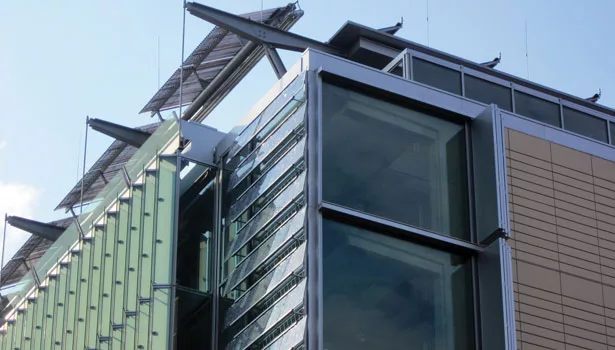
Further, some buildings employ complex active solar systems in which thermal systems are placed below photovoltaics and transport the heat for solar water and/or space heating use, and potentially also to absorption chillers. This also keeps the photovoltaics cooler and, thus, more efficient.
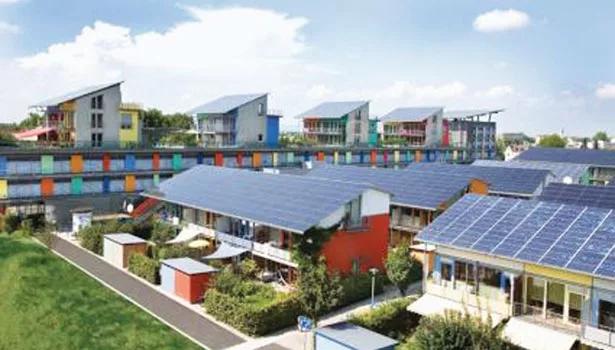
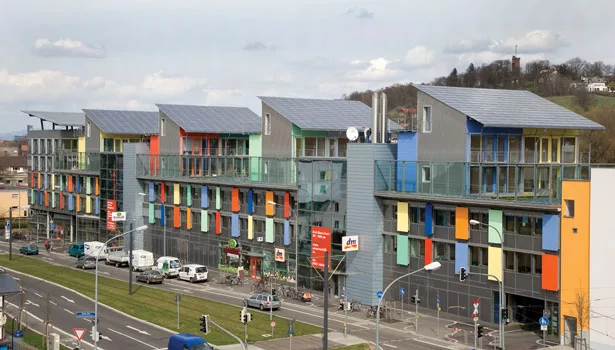
A particularly notable solar project is an entire solar community designed by architect Rolf Disch and built in 1998 on the redeveloped military base Vauban in Freiburg. Disch created a mixed-use building, which he called “Solar Ship,” that houses retail and office space on two floors above ground-level parking and also has nine residential penthouses. This building produces 1.1 times the electricity it consumes. Behind the building, people live in row houses where the characteristically space- and energy-conscious German occupants consume an average of 2,200 kilowatts per home per year, one-third that of a typical California home. This is achieved through passive solar heating and super-insulation, as well as overhanging roofs with solar photovoltaics that produce 6,300 kilowatts per home per year, almost three times as much as the home consumes.
Vauban’s 2,200 kilowatts per home does not include the transportation energy associated with the occupants, the embodied energy of the construction itself or the occupants’ consumption of food and other consumables. Thomas Rühle’s firm in Germany now promotes the 2000-Watt Society, a Swiss concept that does take these items into account.
“The vision of the 2000-Watt Society is based on a personal need of 17,500 kilowatt-hours a year on global average. This corresponds to a continuous requirement of 2,000 watts,” Rühle says. “In Switzerland or Germany the figure is three times higher: 6,000 watts per person. 2000-Watt, continuously, corresponds to 1 ton of CO2 per year. The aim is to reach this goal in the next 50 to 100 years. The scope includes the embodied energy used for the building construction, the operation of the building and its transportation needs—for a commercial building, those induced by the employees and visitors.”
In order to achieve these stringent targets, now being pursued by some communities and commercial developments in Germany, Rühle says that building tenants in both residential and commercial spaces in Germany often have leases that stipulate renewable energy goals as well as consumption limits, and that locally sourced construction materials and efficient transport options during operations are encouraged.
Planning/Transportation
Pedestrian and play zones: Back in the ‘70s, German leaders found that removing cars from inner cities stimulated shopping there. Freiburg, a city of 230,000 today in southern Germany, was the first German city to ban cars from its downtown core. Many other cities followed—once a critical mass of retail business owners bought into this new concept, pedestrian zones sprang up everywhere. In residential areas, streets were also closed to traffic and designated as Play Streets (Spielstrassen). Where traffic was still allowed, traffic-calming measures, such as drive-lane offsets, paved pedestrian crosswalk zones, and landscape bulb-outs and islands were implemented.
Now the practice is adapting to current reality. With the economy lagging in recent years, a retail sales slump and an increased number of panhandlers have made some of the downtown pedestrian zones somewhat less appealing. New initiatives are allowing calmed traffic to be reintroduced into some of these pedestrian zones.
By observing Germany’s continued implementation of new ideas and German planning successes and difficulties closely, the U.S. can learn from the experiences.
Vauban, Freiburg’s planned solar community, has a network of interior trails that ties into a light rail system, and its streets allow for short-term access and loading since all parking is peripheral. Such innovative plans may gain a stronghold nationally and internationally because of their success in making alternative travel modes more appealing.
Integrated regional transportation networks: There is no reason that various local, regional and long-distance trains cannot use the same track width and system. With proper scheduling and management, a comprehensive system of urban trams and all types of trains can interconnect with shared tracks. Commuter trains that run on regional and intercity tracks can also enter cities and subway systems.
This concept, called “Karlsruher Modell” or more simply “tram-train,” was introduced in Karlsruhe, Germany (the town where I grew up and obtained one of my degrees), in the ‘60s when the city pulled up all existing tram tracks to match them with the regional and long-distance trains. This model could offer strategic guidance to U.S. cities willing to invest in public transportation to relieve increasing pressure from the energy consumption, pollution, congestion, accidents, and road construction and maintenance associated with automobiles.
With the policy and community innovations outlined here and the building innovation described in my related previous article in the April issue of EDC, Germany has positioned itself well to lead the quest for high-performance built environments. These examples might inspire all of us to drive innovation toward a more sustainable society through research, design, education, advocacy, exchange, implementation and sharing.
Looking for a reprint of this article?
From high-res PDFs to custom plaques, order your copy today!





