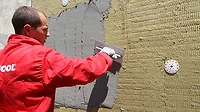
Why EIFS Are Number One
10 (More) Reasons Why EIFS Should Be Your #1 Choice
In the summer of 2008, I wrote an article for the Minnesota Lath and Plaster Bureau newsletter On the Wall entitled “Ten New Reasons Why EIFS Should Be Your #1 Choice of Cladding.”¹ Recently, I came to realize that six years later, that list of reasons is incomplete. So, I set out to compile a more complete list and actually came up with several more. I am not going to tell you exactly how many more, because it might obligate me to write yet another article on this versatile product. Here however are the next ten reasons I came up with, not necessarily in order of importance.
11. EIFS has less impact on the Environment
In the 1980’s chlorofluorocarbons (CFCs) began to be phased out in the manufacture of refrigerants, solvents, plastics, propellants and as blowing agents for foam plastics. It was determined that CFC’s were a major contributor to the depletion of the ozone layer high above us in the stratosphere surrounding the planet. HFCs then became the accepted alternative. Although HFCs do not contribute to ozone depletion, it has been determined that they are potent greenhouse gases.
While expanded polystyrene used in EIFS does employ Pentane, a known greenhouse gas as a blowing agent, it is relatively benign with a GWP of 7.²
In terms of its carbon footprint, EIFS produces 1686 Grams of CO²/ square foot wall area for all stages of its life cycle. Compare that with stucco which produces 4906 CO²/ square foot wall area; Aluminum at 4973 CO²/ square foot wall area; Cedar at 3997 CO²/ sf wall area; Vinyl at 4581 CO²/ square foot wall area; and brick at 8303 CO²/ square foot wall area. That is to say that one square-foot of brick produces nearly 5 times the carbon emissions as one square-foot of EIFS.²
12. EIFS is the Original Continuous Insulation Finish System
With that said maybe we need to change the acronym to CIFS? Unfortunately, CIFS also stands for “Common Internet Filing System.” Of course that interchangeability with construction lingo never stopped Microsoft from naming their operating system “Windows.”
The reality is that insulation that is interrupted by framing, such as Z-furring to support the cladding material is discontinuous “Exterior Insulation” and not “Continuous Insulation.” Z-furring especially, when it runs parallel with metal studs, negates the value of the insulation by reintroducing thermal bridging. This can result in as much as a 70 percent loss in thermal efficiency. Moreover, if the Z-furring is oriented perpendicular (horizontal) to the studs the attachment points are regulated by the spacing of the framing. Therefore if both the framing and the Z-furring are placed at 16-inch centers, we are relying on one fastener positioned every 256 square inches to support the weight of both the sheathing (2.5 pounds per square feet) and the cladding. Take for instance stucco as an example: Stucco weighs approximately 10.3 pounds per square foot. Doing the math then, that one fastener every 256 square inches is supporting 22.7 pounds of load.³
13. EIFS Employ K.I.S.S. Methodology
There have been a couple variations on this acronym, however I prefer “Keep-It-Simple-Stupid.” A couple of years ago I had the opportunity to visit a major window manufacturer. The reason I was there was to talk to their technical staff about doing a presentation on wrapping rough window openings for the annual building officials institute. One of the tech guys presented a typical installation using adhesive membrane flashings and housewrap. I kind of lost track of the number of steps after the 60th photo.
Once the cladding is around the window, how do we know if all of those membranes and housewraps are properly integrated? The fact is the EIFS manufacturers have figured out a better way. Fluid applied barriers take the guesswork out of the procedure, by providing continuity to the air and water-resistive barrier; without the worry for pinholes, fastener penetrations and reverse laps of traditional dinosaur flashing methods.
14. EIFS Works with Cavity Insulation
As the regulations for more thermally efficient walls becomes even more stringent, wall assembly designs may become too impractical and costly to implement. This is especially true in cold climates like we have here in Minnesota. EIFS meets this challenge by working synergistically with cavity wall insulation. Fiberglass batt insulation is cheap. Why not use it to your advantage? EIFS with Drainage, is vapor permeable so that also works to your advantage in this regard. However, a note of caution is warranted at this point: You need to have a well designed and implemented air barrier and the correct ratio of continuous insulation to cavity insulation for your climate zone.
15. Try This with Metal Panels
Have you noticed the proliferation of metal panels being used on new and remodeled car dealerships lately? This seems to be a rebranding effort to convey a modern/futuristic theme. But metal panels are expensive with the cheapest being around $25/square feet and up to $50. Never to shy away from a challenge, new EIFS finishes can achieve much the same look at about a third of the cost of metal panels. Did I mention that EIFS can turn radiuses?
16. EIFS is Impact Resistant
The EIFS industry has long guided the architectural community that EIFS has its proper place on a building. This has led to the conclusion that it should not be used where adjacent to pedestrian traffic or any area subject to more than normal abuse. What has not been well conveyed is that the impact resistance of EIFS can be increased exponentially by using heavier weighted reinforcing mesh along with standard mesh. When you have the time, go to You Tube and do a search on “EIFS Impact Test” or “EIFS Missile Test.” You might be surprised at what you will see.
Beyond that known aspect of EIFS, the industry now also has “High Impact” basecoats that can provide even better in service impact resistance in a typical application; and when combined with heavier reinforcing mesh, can achieve ultra-high impact resistance without the necessity of multiple layers of reinforcing mesh.
17. EIFS is Sustainable
It’s funny how a word can take on such a complex meaning. Looking in my 1995 Merriam-Webster Dictionary, “sustainable” is described as an adjective derived from the root word “sustain.” As it relates to construction, sustainability refers to the process of being environmentally responsible throughout a building’s life cycle; from design through construction, operation, maintenance and eventual demolition. Sustainability then expands the conventional building model beyond the practical concerns of durability, comfort, utility and economy to include the overall impact of the building on the efficient use of energy and other resources. EIFS meets that criteria better than any other cladding out there.
But what of those naysayers who still believe that EIFS cannot stand the test of time? Somebody made an unqualified speculation that the life cycle of EIFS is 25 years. Not true.
With that said the Minnesota Lath and Plaster Bureau would like to invite everyone reading this article to a huge event on August 11, 2017. On that date approximately three years from now it will mark the 25th anniversary of when the Mall of America opened. For those of you that were not aware of it, the MOA is clad in EIFS. So beyond ensuring the safety of the shoppers at the mall that day, we anticipate to gather to watch the EIFS dematerialize. Obviously, that is not going to happen.
Although some may elude to its projected demise, if anything the surface of the EIFS may need some updating. That may entail simply freshening up the existing coatings. Perhaps not so unusual for the age of a shopping mall.
18. Today’s EIFS Stay Cleaner
Virtually all of the major EIFS manufacturers provide finish formulations which include dirt pick-up resistance. Even newer breakthroughs are wholly different technologies that use rainwater as a catalyst to literally wash a building of soiling. This may include formulations that emulate the organic microstructure of hydrophobic plant leaves or photocatalytics that oxidate dirt and pollution on the surface of the finish.
19. EIFS Shows Restraint
The Coefficient of Linear Thermal Expansion for Expanded Polystyrene and Extruded Polystyrene is: 0.000035 inches/inches/degrees Fahrenheit. This is a measurement of the insulation board’s ability to expand and contract relative to temperature extremes. Assuming a temperature drop from a mean temperature of 70 to -30 degrees Fahrenheit, an unrestrained 4-foot-by-8-foot piece of XPS can be expected to contract in the length direction 0.336 inches (.000035 x 96 inches x 100 degrees F = 0.336) or in fractional terms approximately 5/16 inches. In the opposite direction going from a mean of 70 up to say 110 degrees F, an unrestrained piece of XPS can be expected to expand in the length direction 0.13 inches or approximately 1/8 inches. Using a 2-foot-by-4-foot piece of unrestrained EPS as an example the results are 0.17 inches (5/32 inches) and 0.07 (1/16 inches) respectively.³
So why should we care? “What happens to insulation board that is friction fit between Z-furring? That’s right, it is expanding and contracting. As demonstrated above, the contraction can be as much as 5/16 inches. As another example, what if mechanical fasteners are used to attach the insulation board and cladding in a CI assembly? While the insulation board is now being restrained, those fasteners will be subject to some back and forth toggling action as a result of thermal changes.
In its use in EIFS, specially formulated adhesive is installed in a notched trowel pattern on the back face of the board. This adhesion uniformly resists board movement (restraint). Also in an EIFS system, a thin polymer modified base coat membrane with embedded reinforcing mesh provides resiliency in accommodating any residual movement stresses.
20. EIFS Owns the CI Debate
I am often amazed at the lengths that some designers go through to achieve the look of EIFS while excluding the product from their construction documents. Complex belt and suspender assemblies are articulated with two-dimensional drawings that are hard to understand and even harder to construct in the field. We’re talking exterior insulation systems with peel and stick air/water barriers, drainage mats/drainage planes with furring and attachment systems which more resemble a kid’s erector set than a wall assembly. Don’t forget the insulation board; EPS is just too simple. Simplicity does not mean that you are sacrificing performance. Unlike unproven “Frankenstein” approaches to CI strategies:
- EIFS meet the requirements of the NFPA 285 Fire Test and has had to jump through that hoop to sustain its recognition in the building code for nearly as long as it has existed.
- EIFS offer a dual functioning air and water barrier integral to its installation.
- EIFS offer a built in drainage medium integral to its installation.
- EIFS are light weight with a deflection criteria of L/240 and does not have to be supported by any additional framing/furring in its installation.
- EIFS do not require multiple trades in its installation.
References
On the Wall, “Ten New Reasons Why EIFS Should Be Your #1 Choice of Cladding,” by Pedracine. A publication of the Minnesota Lath and Plaster Bureau, 2008.
National Institute of Standards and Technology, BEES v4.0 analysis 2007
Plaster Assemblies: Exterior Insulation on Framed Walls, Steven Pedracine, Dave Bryan, A publication of the Minnesota Lath and Plaster Bureau, 2014.
Looking for a reprint of this article?
From high-res PDFs to custom plaques, order your copy today!