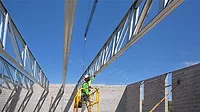
How Steel Trusses Perform
One of the most efficient systems in a low- to mid-rise structure is none other than the truss assembly supporting the roof. This is true especially when the trusses are fabricated with cold-formed steel chords and webs with rolled edges. The pairing of high-strength, yet lightweight steel with a rolled U-shaped chord design offers a resilience and durability that can’t be matched by any other system.
“Of all commonly used construction materials, only steel framing offers the unique combination of strength, light weight and the ability to absorb high wind and seismic loads,” says Larry Williams, executive director of the Steel Framing Industry Association. “Add in the fact that steel is noncombustible and the most recycled material on earth, and it presents a compelling argument for steel.”
Indeed, building owners and developers have a definitive choice. While they may find a less expensive material such as wood, they won’t find a better performing, safer, more durable material for truss assemblies than cold-formed steel.
Wall and ceiling framing subcontractors benefit as well because cold-formed steel is economical to install. You can save money and man-hours because cold-formed steel trusses are lightweight, easy to handle and, due to their strength, fewer are generally required for installation than other types of trusses.
Cold-formed steel trusses can also be installed at 4 feet-on-center and greater spacing, whereas wood trusses typically require 2 feet-on-center engineering and plywood for lateral bracing. As a result, installation proceeds faster and saves money. In fact, some cold-formed steel trusses save as much as 20 percent on labor costs due to their rigidity and minimal bracing requirements. In the end, the truss installer earns praise—and hopefully more contracts.
“General contractors want us to meet their construction timelines,” says Robert Brannon, president, Brannon Specialties Inc., a Miami, Florida-based truss installer. “Cold-formed steel trusses help us make that happen.”
Cold-formed steel trusses provide five key benefits: 1) strength, 2) labor cost savings, 3) durability, 4) flexibility and 5) safety.
Strength Helps Deliver Quality
No building component combines strength and stiffness like cold-formed steel. Cold-formed steel structures—wall framing, flooring joists and trusses—have greater strength properties than alternative systems and use less material to achieve that result.
In terms of overall truss geometry and dimensions, cold-formed steel trusses are like other wood and steel joists, but offer exceptional dimensional stability.
“Today’s steelmaking processes produce framing members with unparalleled precision and consistency in chemical and mechanical properties,” says Williams. “As a result, contractors don’t have to worry about shrinkage, twists, cracks or bows during installation, or construction defect claims after the job is finished.”
Some cold-formed steel truss systems offer greater lateral strength. TrusSteel members, for example, have edges rolled into a patented U shape—a much deeper and more rigid flange. They also require less bracing.
In addition, the TrusSteel system uses rigid, bolt-like double-shear fastening technology to connect the chords and webs. This increases the rigidity and lateral strength of the system. The U-shaped chords, special fasteners and multiple web shapes make it pound-for-pound the strongest and stiffest cold-formed steel truss system available.
Labor Cost Savings Improves the Bottom Line
Cold-formed steel is labor-friendly because stiff and strong trusses allow installers to erect precise structures—roof lines that plane accurately and eaves and soffits that align properly. This provides exceptional interior finish results—ceilings that finish flat and monolithically, for example—keeping the installer’s work off project punch lists.
Stiffness also translates into faster installations. Cold-formed steel trusses resist bending (or “butterflying”) when lifted on their sides, and crews can walk on the bottom chords without damaging them.
Furthermore, cold-formed steel truss installation requires no special tools—only the tools installers already use to erect light-gauge metal framing, such as screw guns and clamps. Truss-to-truss connections and some truss-to-bearing connections generally must be made with proprietary hangers and clips.
Finally, cold-formed steel trusses can be group-assembled on the ground—a process called rafting. The completed assembly requires a crane to lift into position, but the approach saves time for the installer. It may also reduce workers’ compensation insurance rates.
Durability Means Fewer Callbacks
Cold-formed steel systems save installers money down the road because they install straight the first time. In addition, they offer a cleaner, more precise install than wood-framed trusses, which leads to a lower risk of wallboard fastener pops and, ultimately, fewer callbacks.
“Once a steel stud has been formed the contractor can count on that stud remaining straight and true for the lifetime of that wall or the building,” says Williams. “On the other hand, materials like wood can shrink, swell and twist, which could have expensive and possible disastrous consequences for structural, mechanical and finish systems.”
Cold-formed steel has other lasting benefits. Steel does not rot, spawl, split or absorb moisture. It also resists pests and will not function as a food source for mold. Moreover, it is protected from corrosion when the steel has a coating that meets ASTM A1003-Standard Specification for Steel Sheet, Carbon, Metallic- and Nonmetallic-Coated for Cold-Formed Framing Members. The recognized test standard for measuring corrosion resistance is ASTM B117-Standard Practice for Operating Salt Spray (Fog) Apparatus. Compliance to these standards is assured through the SFIA’s Compliance Program, which is a mandated program that all SFIA members must meet.
“Cold-formed steel is protected against corrosion with a metallic coating,” adds Williams. “A recent 10-year study by the National Association of Home Builders found that this coating will protect steel framing for up to 1,000 years when installed inside the building envelope.”
Flexibility Provides Amazing Results
Cold-formed steel truss systems give architects and engineers flexibility when designing their structures. The systems can clear spans in excess of 80 feet, which leads to some amazing spaces.
TrusSteel ARC trusses provides smoothly-curved chords—the perfect solution for framing curved roofs, barrel-vaulted canopies and other radius designs. Installers can avoid the clumsy overbuilding frequently required to create curves with segmented chords. Each truss is pre-engineered to exact specifications, so installers can expect consistent curves from truss to truss.
Need design assistance? Highly specialized software provides accurate design output no matter what the roof lines—pitched or flat, as well as with or without hips, gables and gambrels.
Safety Minimizes Injuries
Cold-formed steel trusses tend to be safe for crews. The rolled, U-shaped edges of TrusSteel’s chords and webs, for example, have a curved gripping surface that protects workers from scrapes and cuts when handling the trusses. The open-throat design of the chords also makes them extra-light to lift and minimizes the potential for back strain among workers.
Since cold-formed steel trusses are laterally stiff and resist folding, workers can count on them not to twist and bow when guiding them into place. This helps speed installation and minimizes problems on the job. It also means fewer workers are needed for cold-formed steel truss installs than wood and other framing systems. Fast installation times and fewer man-hours to erect means fewer workers are at risk of an injury.
Considering all the factors, cold-formed steel trusses offer contractors an unbeatable variety of benefits—strength, labor cost savings, durability, flexibility and safety. Cold-formed steel trusses do not emit moisture or fumes, and also resist fires and insects. Practical to use on so many types of building projects, they provide an unmatched value for construction professionals.
Looking for a reprint of this article?
From high-res PDFs to custom plaques, order your copy today!