Can’t Stand the Heat? Use EIFS
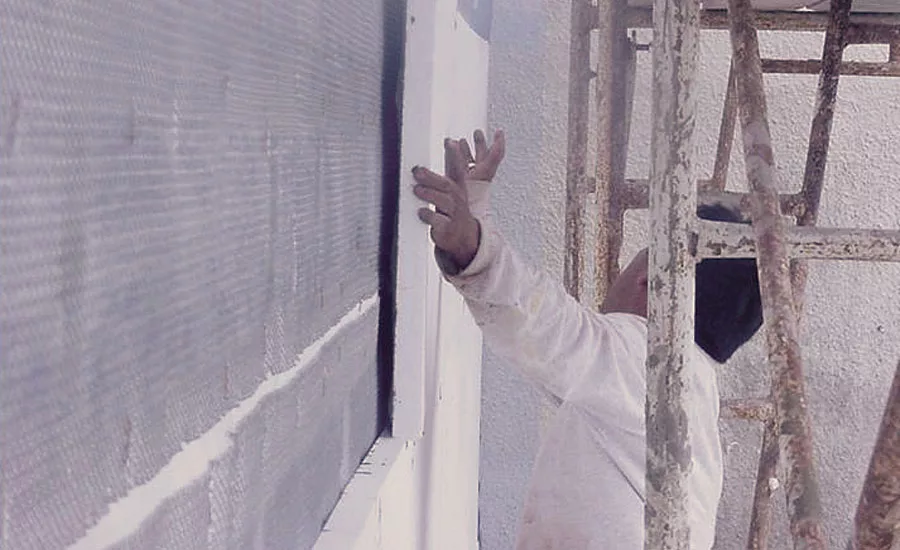
Metal lath, over wood framed structure, used as adhesive surface for EIFS re-cladding. Note gap between sheets of lath.
It started as an idea, and then turned into a concept, then an urgent “or else” movement. It is the new buzz word to which we are now building our modern structures, it is called sustainability.
In common thought terms, it is the idea of constructing a building that uses less energy which requires less generation of energy which leaves us a healthier planet. There are many facets to sustainability such as water conservation, lighting and temperature controls, daylighting and urban density (walking instead of driving) but for our little micro world of stucco and EIFS, I wish to explore the sustainability that is EIFS.
I have long been an advocate of the EIFS cladding, the system of simplicity with complex performance attributes, unmatched by any other cladding. And as a first thought for new construction, it is the go-to first choice. I believe that for the current continuous insulation requirements to achieve code compliance for building performance, EIFS wins hands-down. Brick, wood, smooth, texture, metal, faux and theme all are attainable looks for any building, using EIFS. What an exciting cladding industry we get to play with.
New construction is where all the focus and attention goes when looking at EIFS, but, there is another very large stable of buildings waiting to be noticed, waiting to be updated, and waiting, and waiting, all the while consuming energy. I am speaking of our existing built environment, the building you are probably sitting in right now, reading this article, wondering where the heck I’m taking you. It is because of the ease at which an EIFS cladding can be applied there exists but a couple of surfaces where it cannot be applied. So, okay, glass is the only one that comes to mind, you can’t have the EIFS.
Saving Time and Money
Although I have written about using EIFS to re-clad buildings before, I feel it’s more pertinent today and wish to recall two examples of an EIFS re-clad that have significance. The first was my parent’s house in Tucson, Ariz. They lived in a single story ranch style CMU plain ol’ house. The summers in Arizona can be a little warm, reaching temperatures of 100 and overnight lows in the ’80s. This continues for months and CMU being the thermal mass that it is, just absorbs all of that heat, stores it, then obeys the second law of thermal dynamics and lets the heat go it into the house where it’s cool. Needless to say the air conditioning ran continuously, gobbling up energy, depleting my dad’s wallet. So, dad’s first attempt was to have an insulating coating sprayed on the exterior which was being sold as “help from the heat” back in the 70’s. The house looked great!
Years later he replaced all of the single pane windows with triple-pane glass windows purchased and installed by a company that had a booth at the County Fair. Again the house looked great, and according to my dad, it helped lower the utility bill. Fast forward a few years and my plastering brothers and I got together and put an EIF system on their house. We adhered 1½-inch of EPS, netted it, finished it with a medium sand finish and jazzed up the front with a faux stone wainscot. My dad was beside himself, he had a nice looking house, quieter (my moms’ claim) and best of all less expensive to cool in the summer. Dad claimed a 40 percent savings from one year to the next.
Sitting around the dining table my brothers, my father and I all surmised the reason for this great savings and improvement in efficiency was due to the CMU exterior walls. The cool air being pumped into the house was now cooling the CMU walls and with them being thermal masses, now wrapped in an EPS thermal blanket, held the cool, slowly and constantly releasing it back into the house. That was 15 years ago and the house has since been sold, but still looks good today.
The Best Option
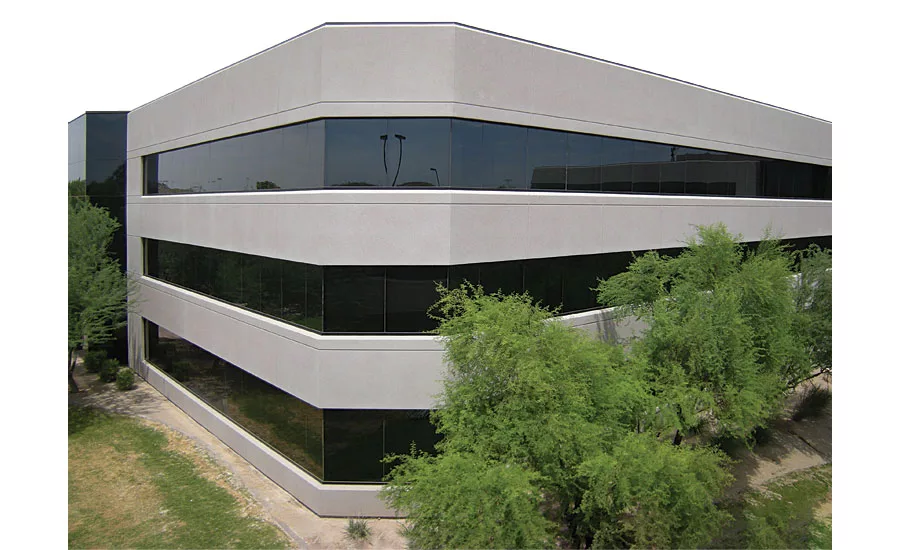
A large campus for a major insurance company located in the Southwest had four large three-story buildings with a GFRC cladding. Each panel was approximately 30-feet by 12-feet, was finished to resemble granite and was joined to the next by sealant joints at the perimeters. Remember the heat in Tucson, Ariz.? Well, this Southwest location was even hotter, and the panels just couldn’t keep up with the thermal swings. Some had large cracks some small, some with multiple cracks, most experienced sealant adhesion failure, all contributing to moisture intrusion issues.
The cladding became a constant maintenance nightmare. Attempts were made to seal the cracks with silicone to no avail. I was contacted by MKB, a large commercial sub-contractor and EIFS professional installer, to work with them on figuring out the best case scenario to use EIFS as a new cladding (MKB the GC and the owners had ruled out all other cladding options). We quickly determined that because it would remain occupied during remediation, removal of the affected cladding would be next to impossible. The panels weighed a ton, and exposing the wall cavities could cause a host of issues to the building structure and its occupants. There was a lot of concern as to the integrity of the walls once the panels were removed too.
We concluded that EIFS was the best option; two inches of EPS foam were adhered to the panels, then base coat and mesh, and a spray applied stone finish to match the original look of the building. We had to work out some details where the system met the windows, which remained and doors and at the parapet locations but overall it was a painless application.
Due to the then sensitive nature of applying an EIFS cladding to an insurance companies building—oh the irony—we were not able to document the performance before and after, officially. I did hear from the contractor that the GC told them that the owners were very happy with the whole project and that they had realized an energy cost savings, were happy with the look and relieved that their issues had been resolved. This was 12 years ago, and the buildings still look great today.
It’s an Easy Solution
In both cases there was no need to remove or add anything to the structures before applying the EIFS cladding. That is the beauty of EIFS as a re-clad solution; one doesn’t have to make major changes to an existing building. Of course you have to clean the surface and possibly do an adhesion check for surfaces other than the manufacturers “approved substrates” when you adhere the foam for the EIFS. In most cases there is no trip to the dump to dispose of an old cladding … sustainable!
Most worn out or energy inefficient or just out of date claddings, are already code compliant as it relates to WRB’s and drainage. Take the insurance building for example. The WRB and wall cavity insulation and all other code compliant components remained in place to function as intended. All we did was add a functional barrier that happened to increase the thermal performance of the cladding and spice up the appearance. Oh yeah, did I mention that we only added about a pound per square foot of weight to the whole thing? Yet another bonus of EIFS, it’s lightweight.
Cracked stucco exteriors, brick with the mortar cracking or falling out, CMU walls, tilt-up concrete and a host of textured panels all make the list of the multitude of claddings that can be directly adhered to. When it comes to wood sidings or questionable surfaces that may be crumbling or unstable, an expanded metal lath can be attached as a suitable adhesive surface for the foam. Nails and staples for wood framing, cut-nails or shot pins for the hard surfaces, even tile. When it comes to tiled surfaces it is best to fasten the lath to the grout joint areas not directly through the tile. And, since the lath is just an adhesive surface, there is no need to overlap it, in fact you can leave spaces between sheets (small).
Once the foam is adhered, all of the affected surfaces underneath are hidden form the elements where they can just stay, rest, be. No more degradation because it is protected by the EIFS. Common sense should prevail; if the surface is too far gone or severely damaged with large holes and missing parts, don’t try to apply anything on top, sometimes it is too far gone to fix, sometimes. Be sure to check with the tech rep of the EIFS product you are using for those questionable surfaces.
I have always envisioned an EIFS re-clad cottage industry, where sustainably minded contractors would scour the residential and commercial built environment, hawking the solution to underperforming energy inefficient buildings, improving the tired landscape of cookie cutter houses and ’60s-era commercial architecture.
“There is no need to tear down that seasoned building, that tired cladding, that gosh ugly painted behemoth, rather re-EIFS it” would be their mantra. I can see the show on television right now.
Looking for a reprint of this article?
From high-res PDFs to custom plaques, order your copy today!





