A Guide to Choosing a High Performance Housewrap
Tip #1: Don’t mix water with wood. Tip #2: Don’t let damp wood stay wet. Intuitive? Of course it is. Wet wood rots. Yet, this is a lesson the building industry has had to learn the hard way–and more than once–since necessarily stringent building codes have gone into effect in recent years. The well-intended codes are our industry’s effort to create airtight buildings. Good news for energy consumption, bad news for damp walls. Fortunately building science has taught industry professionals a thing or two about the movement of air and moisture in and around a building envelope. We can now create airtight buildings that also fend off unwanted, unavoidable moisture that originates both inside and outside of the structure.
Use of housewrap is no doubt a best practice in builders’ efforts toward airtight construction, with a general preference for the high-performance variety. There is a high demand for housewrap and as a result, there are several products on the market. How do you know which one performs the best? Before buying one brand over another, ask these seven questions to make sure the housewrap passes muster.
1. Is the Housewrap Durable?
It’s an obvious question, but an important one. A durable housewrap is one that stays in place, has exceptional tear strength, and can stand up to surfactants and UV rays.
First and foremost, a housewrap that does not stay put is not going to be effective. It won’t perform at all until it is either re-installed or repaired. These do-overs take time, subject building materials to the elements, and cost builders money. Avoid these flimsy scenarios by opting for a high-performance material that has exceptional tear resistance and is designed to withstand heavy winds and job site rigors. These are the stay-put housewraps that minimize burdensome repairs and ultimately perform as effective air barriers.
Once installed, a durable housewrap will need to play nice with the surfactants it encounters. Surfactants are found in wood tannins, cedar oils and turpentine within some cladding, and are present in soap solutions used to pressure wash vinyl or other siding. Surfactants reduce the surface tension of water, allowing it to flow more easily through the pore structure of the housewrap. This consequently decreases a housewrap’s water holdout so that the sheathing is no longer protected from wind-driven rain and water damage. Housewraps with superior surfactant resistance will minimize water penetration and the resulting component degradation.
Housewraps with high surfactant resistance are especially critical when installing under vinyl and wood siding, brick, stone and stucco.
Finally, housewraps must be able to withstand the ultraviolet rays they will endure before being covered by cladding. Even limited exposure to ultraviolet rays causes some housewraps to deteriorate. It’s best to work with a high-performance material that incorporates UV inhibitors into its coating and fibers. While most builders clad over housewrap shortly after installation, it is considered a good idea to use a housewrap with a minimum six-month UV rating.
2. Does the Housewrap Breathe?
A building wrap must breathe to prevent moisture vapor from getting trapped in the wall cavity. Builders should work with high-tech housewraps that are able to balance water holdout with an optimal perm rating of 10 to 20 perms. This perm rating ensures that while water is prevented from entering the wall cavity, ideal levels of moisture vapor are allowed to escape. This is important because moisture vapor will happen throughout the life of a building and is caused as much by outdoor factors like the weather as it is indoor activities like cooking and showering.
3. Can the Housewrap Serve as an Effective Air Barrier?
It should. It is not too lofty a goal to expect a housewrap to perform as an air barrier that helps reduce air infiltration. This is a key point considering the average 2,500 square-foot house has more than half a mile of cracks and crevices that are subjected to wind and wind-driven rain. Notably, according to the U.S. Department of Energy and Enegy Star, continuous air barriers can reduce energy costs as much as 15 to 20 percent in a home. High-performance housewraps serve as effective air barriers by reducing convective wind washing against sheathings and air infiltration into stud wall cavities. When installed as part of an air barrier assembly, a housewrap has the ability to reduce drafts in homes, increase indoor comfort, and decrease energy use by reducing the amount of non-conditioned air that enters and exits conditioned wall cavities.
It is important to understand that housewraps that qualify as air barrier materials must be installed in strict accordance with the manufacturer’s instructions in order to perform as required. A well-installed housewrap system that includes proper flashing and sealing around penetrations will improve the overall thermal efficiency and performance of the building’s wall system.
4. Does the Housewrap Come with a Warranty?
A good warranty speaks volumes about the quality of a product. Some high-performance housewraps on the market back builders with excellent warranties on labor and materials. Be sure to choose a housewrap that offers one.
5. Is the Housewrap Easy to Handle and Install?
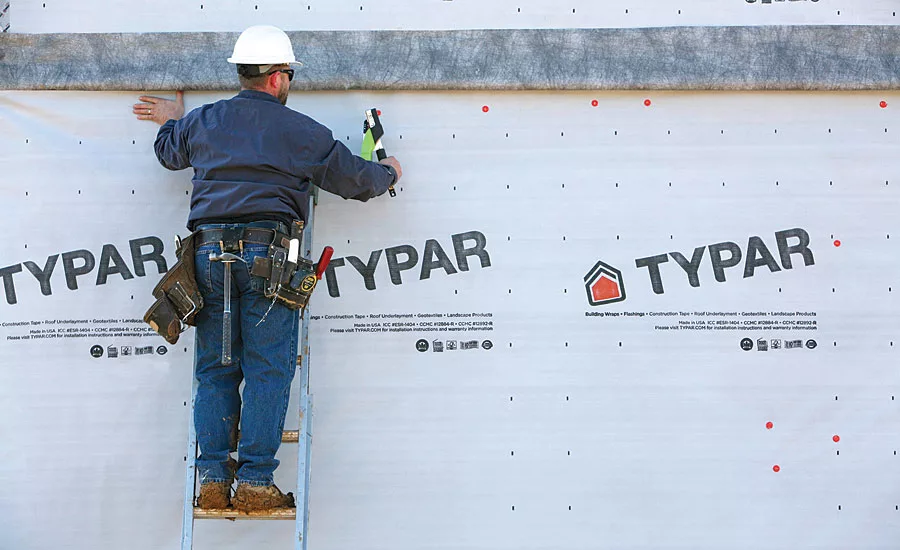
Housewraps do not operate in a vacuum. They are part of a holistic approach to airtight construction, or at least that they should be. As such, they require thorough, comprehensive integration with other elements of the building envelope in order to retain system integrity. Sometimes this integration can be tricky, especially when it comes to building components like flashing, windows, doors, attached decks and band joists. These areas can present a challenge for the successful installation of housewrap. Because of this, some manufacturers provide on-site or classroom education to ensure proper installation. Choose a product that offers this type of added value.
6. Is the Housewrap Part of a Holistic System?
While housewraps are an important element in a whole-house approach to quality construction, well-designed housewraps should also come packaged as their own system. In other words, be sure the housewrap includes compatible tapes for seaming and adhesive flashings for openings as these details vastly improve the air and moisture resistance of the housewrap.
7. Is the Housewrap Environmentally Responsible?
Building and construction is unfortunately among the least sustainable industries, yet trade professionals across the board are making significant gains toward a greener future—housewrap included. As an air barrier, some housewrap systems contribute to the requirements for the Energy Star Qualified New Home program as a component in the air sealing and insulating category. A properly installed housewrap system can also contribute toward U.S. Green Building Council’s LEED certification points in both LEED – New Construction (commercial) and LEED for Homes (residential). When specifying, seek environmentally friendly options that produce minimal VOC emissions and contain post-industrial recycled content.
As we work to create airtight homes and buildings, we are also working to create healthy indoor environments that will last and not rot. High-performance housewrap is a key component to these efforts. Be sure to use the best one for your job.
Looking for a reprint of this article?
From high-res PDFs to custom plaques, order your copy today!





