Hydraulic Lime Vs. Pure Form of Lime
What are the distinctions between a hydraulic vs. pure form of lime?

What are the distinctions between a hydraulic vs. pure form of lime? Read on.
As we considered in our previous article on lime, it is perhaps the most prized and exceedingly versatile building material of the modern world. Today, lime is processed into plasters, stucco coatings, paints, mortars and cements. From a chemical perspective, pure limestone is a carbonate of calcium or calcite having the formula CaCO³. However, there exist several categories of impure limes (dolmitic, magnesium, natural cement, i.e.). So the question arises, what distinguishes a natural hydraulic lime from a purer form of lime?
The Romans of course are famous for their widespread, imposing and durable works of architecture. They were the first to demonstrate a firm technical understanding of lime in general and to make widespread use specifically of hydraulic limes (limes that would set with water) for ports, aqueducts and monumental architecture. Many of these works were accomplished with additions to lime to make them hydraulic. These pozzolanic limes are a subject we will consider in a future article. However, the Romans also exploited limestone deposits in the province of Gaul, the modern day Languedoc and Provence regions of France, which produced limes that were naturally hydraulic without pozzolanic additions.
The Romans brought their lime technology in the conquest of North Africa. The tradition of using Natural Hydraulic Limes continued for water cisterns, stuccoes and objets d’arte. NHL’s continued to be used throughout the medieval period. At the height of the Renaissance, Palladio made specific mention of hydraulic limes in his architectural treatise. By the 18th century, English and French engineers were hard at work identifying quality mineral deposits of NHL’s and exploiting them for public works.
Advances in modern chemistry led to the 1807 discovery that lime was not an element, rather an oxide of calcium. With this scientific knowledge established, French engineer Louis Vicat conducted an exhaustive study and published a landmark, comprehensive paper in 1818 classifying limes based on hydraulic properties such as rapidity of set with water and corresponding compressive strength.
Chemistry & Manufacturing
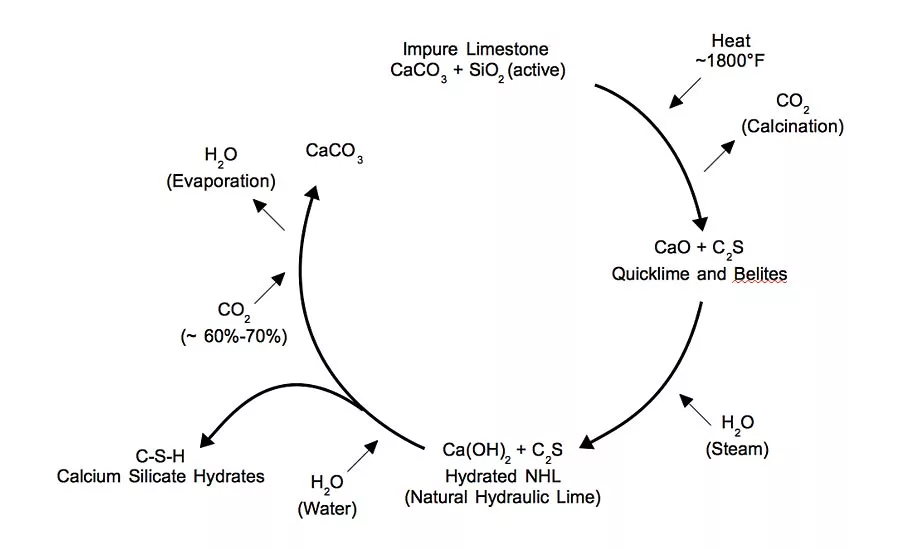
What makes a lime “hydraulic”? As you might guess it has to do with water. Perhaps we can start by first reviewing a non-hydraulic example, pure lime. When water is added to pure lime it forms a putty. As long as the mix is kept covered the lime will stay in a putty state. Pure lime only reacts chemically when exposed to air, slowly reabsorbing carbon dioxide and returning to its original state of calcite, CaCO³.
By contrast, hydraulic materials exhibit a chemical change in the presence of water. Molding plaster and Portland cement are common examples of hydraulic materials. NHLs mixed with water likewise transform from a putty to a hardened state, even underwater.
Limestone is a sedimentary stone that forms primarily though not exclusively from skeletons of marine creatures that have accumulated on the sea floor. With time and pressure these skeletons are pressed together in beds of stone that remain relatively porous. Under certain geologic conditions impurities can leach in, deeply infiltrating the limestone over time. The valued impurity present in the limestones used to produce Natural Hydraulic Lime is silica.
Common silicas like quartz are very prevalent, highly crystalline and non-reactive. Amorphous, chemically active silicas on the other hand don’t tend to last very long in nature because they are very reactive. The most useful limestones for producing NHL’s have a high infiltration of this amorphous silica.
These limestones are fired a little hotter than pure limestone, at approximately 1,800 to 1,900 degrees Fahrenheit, to first drive off the carbon dioxide and then fuse a portion of the available calcium with silica. After firing the lime is given just enough steam to “slake” (or hydrate it) converting the highly reactive calcium oxide into the more stable calcium hydroxide. The resulting dry hydrate lime can be bagged and transported safely. Upon arrival the calcium silica compounds are ready to react by the addition of more water when mixing the mortar, plaster or stucco on the jobsite.
The terms hydrated and hydraulic can be a little confusing as they both relate to water. A hydrated material is chemically bound to water in a dry state whereas a hydraulic material is one that will set with the addition of water. The terms are not mutually exclusive and as it turns out NHLs are made both hydrated and hydraulic during manufacture.
Properties & Specifications
With the advent of Portland cement in the 19th century, NHL production decreased dramatically. The faster set, harder compressive strengths and impermeability of Portland cement were considered superior qualities that allowed buildings to be constructed faster and cheaper. However, with the passage of time and a large inventory of buildings using both materials, advantages of NHL have become clear and production is once again on the increase.
The lower compressive strength and correspondingly high flexural strength of NHLs are now recognized as fantastic properties for mortar and stucco. The flexibility of natural hydraulic lime as a binder in mortar and stucco mixes reduce cracking, allowing wall assemblies often to bend rather than break when subject to typical settling, flexural and shear stresses over time.
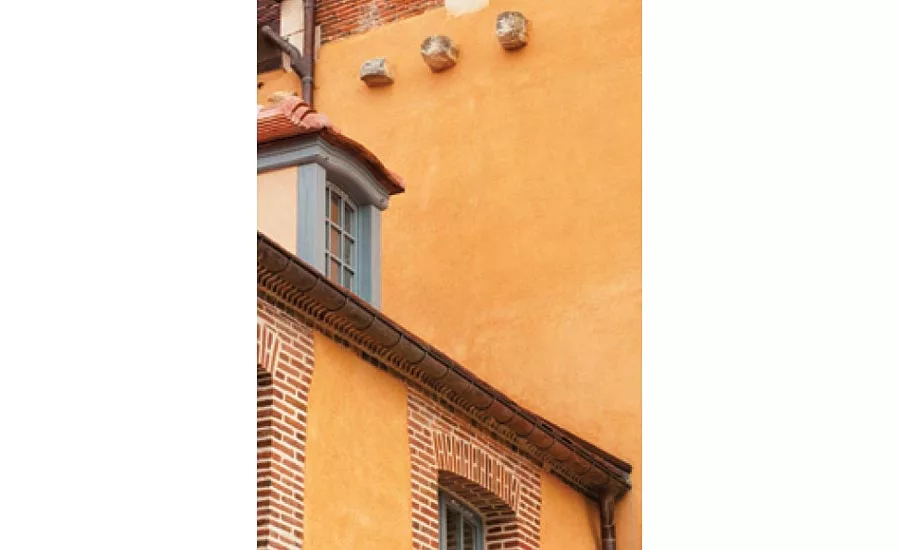
Likewise the increased porosity of NHL stuccoes permits water permeating the coating to readily escape again through the surface. This same porosity is also of great benefit to masonry work permitting soluble salts to slowly deteriorate the sacrificial mortar (which can be re-pointed), protecting the more valuable brick or stone supports. NHL’s thus preserve many of the benefits of pure lime mortars and stuccoes while allowing masonry and stucco work to be conducted at a faster rate and under a greater range of weather conditions with improved long term resistance to erosion of exposed exterior surfaces.
There is much more that could be said about natural hydraulic limes. In our next article we’ll consider both how the standards for classifying limes were developed as well as what the modern standards are, what they mean and how they can guide an appropriate specification.
Looking for a reprint of this article?
From high-res PDFs to custom plaques, order your copy today!





.webp?height=200&t=1625764395&width=200 "WC0721-CLMN-Art-Craft-p1FT-IMG_0699-(2).jpg")
