How Building Product Manufacturers Can Use Offsite Construction Trends
A New Wrinkle to the Supply Chain Puzzle

Interest in alternative construction methods has hit an all-time high as contractors strive to deliver projects faster, safer and cheaper in today’s labor-constrained construction environment.
Offsite construction methods like prefabrication, modularization, preassembly and offsite multi-trade fabrication have been around for decades. However, over the last couple of years, interest in these alternative construction methods has hit an all-time high as contractors strive to deliver projects faster, safer and cheaper in today’s labor-constrained construction environment.
The distribution landscape is already shifting, with improvements in technology and logistics shortening supply chains. In the past, manufacturers were often forced to pick a single distribution lane and stick to it—whether it be one step, two steps, direct to builder, or direct to consumer. In today’s competitive landscape, we see more building product manufacturers (BPMs) willing to experiment and adapt with multiple distribution models. For the truth is, to be successful, a company must deliver products where and how the customer desires. I can’t count the number of conversations I’ve had with product manufacturers discussing how Amazon may affect their business.
Along with this already shifting distribution landscape, comes rapid offsite construction growth. Change creates opportunity for those BPMs observant enough to see it and nimble enough to adapt. But it also creates challenges, as selling direct to prefabrication builders and bypassing traditional distribution can trigger some difficult conversations with your largest distribution customers. However, just as the growth of direct internet sales demands a strategy and response, so does the rapidly growing prefabrication market.
Changing Distribution Models
According to one of FMI’s recent industry studies, two-thirds of engineering and construction firms view the current offsite construction environment as “much different than it was just three years ago”—a shift that’s due mainly to labor shortages and increasing cost and schedule pressures.
And while change is happening in pockets across the country (in different market sectors and across a range of project types and sizes), an underlying transformation is happening and gaining momentum. This transformation is pushing BPMs to rethink their distribution relationships and look more carefully at how they develop, manufacture and deliver products.
Consider the different journeys a product may take:
- For onsite building: from manufacturer to wholesale (two-step) distributor to one-step distributor, then to the site to be assembled/installed.
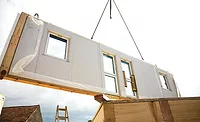
- For prefab construction: from manufacturer direct to factory (should quantities be sufficient), then delivered fully assembled to the site.
The prefabrication product path, in addition to often removing a round of handling and margin, creates opportunities and challenges:
- New prefabrication customers popping up and growing rapidly, these customers must be cultivated and serviced.
- Channel conflict with the traditional distribution customers, some of which will try to extract a toll for prefabrication sales in their territory.
Product Innovation
Manufacturers looking for an edge in the burgeoning prefabrication market should study the factory manufacturing process to see how their products may be altered and improved for ease of installation and greater efficiency. It may be that a simple product tweak can make a product more efficient to install in a factory setting or more robust to withstand the rigors of transportation. Opportunities will exist.
Four Key Trends to Watch
FMI is tracking several trends that support growth in offsite construction. They are:
Geography.
Over the next three to five years, nearly 50 percent of construction is expected to occur in just 20 metropolitan markets, and just five of these metropolitan markets will make up one-fifth of total construction in the U.S. These include New York, Los Angeles, Dallas, Houston and Washington, D.C.
Influx of new entrants into the market.
The industry is starting to see new entrants, new business models and a tremendous amount of venture capital coming into construction—all designed to disrupt an industry that has long been accused of being stale and lacking in innovation. In a market as large as construction, small gains in productivity can translate to massive profits.
Increasing complexity.
According to our latest prefabrication study, chronic productivity issues and new technology advancements are key factors in driving the broader use of prefabrication at a time when lower cost, resource efficiency and sustainable construction are becoming priorities. Ubiquitous digital connectivity, cloud computing and advancements in X-D modeling and 3-D printing are just a few of the evolving drivers presenting opportunities for companies to prefabricate with greater accuracy.
Greater use of data analytics.
With greater access to data and data analytics, industry leaders are incorporating technology tools as a central aspect of their businesses. This helps drive informed decision-making and ultimately leads to better company performance. This analysis is leading some firms to adopt a fixed manufacturing model, both in the product itself and in the process.
Combined, these trends are all indicators of potential and current disruption, and they’re pushing companies to focus on innovation to improve productivity in an industry that’s realized minimal productivity gains over the last 50-plus years.
It’s Not Going Away Anytime Soon
According to the “2018 AGC/FMI E&C Industry Risk Study,” nearly two-thirds of respondents expect more change in how construction is put in place over the next five years than in the last 50 years combined. To leverage this opportunity while also staying relevant and innovative, BPMs will have to adopt a new framework for success. This framework must include programs, systems and standardization—all of which will come together to support a more streamlined approach to the design-manufacture-construct process.
Steps to Success
BPMs that want to take advantage of the offsite construction trend and hone their distribution models in a way that leverages this opportunity should consider these success tips:
Get close to the prefabrication buyers.
Find out who they are, what they’re doing, and what they need. Understand that there are varying degrees of offsite construction but that the channel is growing rapidly.
Be flexible.
Navigating the shifting distribution landscape can be a challenge, but you must meet your customers where they want to be met. We know quite a few manufacturers that are exploring an “all of the above” approach, despite the feathers it may ruffle. The prefabrication and direct-to-consumer markets will only continue to grow, and you’ll want to ride along.
Innovate.
How can you change or alter your products to make the factory-built structure faster and easier to construct? Making those changes will give your company an edge over other products that are out there (remember that logistics can also play a large role in this process).
Constructing buildings in a factory offers many productivity and quality benefits. It is a trend that FMI feels will only accelerate as demand for quicker and more efficient delivery of complex projects grows. With focus, flexibility and innovation, BPMs can ride the offsite building trend and set themselves up for success today and well into the future.
Footnotes:
- “New Day, New Mindset. Rethinking Offsite Construction.” 2018 FMI/CURT/CII Owner Survey. 2018.
- “Prefabrication: The Changing Face of Engineering and Construction. 2017 FMI/BIMForum Prefabrication Survey.” February 2017.
- “Managing Risk in The Digital Age. 2018 AGC/FMI Risk Management Study.” July 2018.
Looking for a reprint of this article?
From high-res PDFs to custom plaques, order your copy today!