Walls & Ceilings logo
search
cart
facebook twitter linkedin youtube youtube Spotify Podcasts Apple Podcasts Spotify Podcasts Apple Podcasts
  • Sign In
  • Create Account
  • Sign Out
  • My Account
Walls & Ceilings logo
  • NEWS
  • TOPICS
    • Drywall
    • Stucco/EIFS
    • Ceilings
    • Steel Framing
    • Fireproofing
    • Interior Plaster
    • Building Envelope
    • Insulation
    • Technology
    • Interior
    • Exterior
    • Women In Construction
  • COLUMNS
    • Up Front
    • All Things Gypsum
    • Art & Craft of Plastering
    • Stucco Stop
    • Steel Deal
    • Industry Voices
  • PRODUCTS
    • Buzz Guide
  • EVENTS
    • Industry Events
    • Webinars
    • BUILD Expo
  • MEDIA
    • Videos
    • Podcasts
    • Photo Galleries
    • BUILD26 Videos
    • Take our Quiz!
    • Infographics
  • EXCLUSIVE
    • Newsletters
    • Top 50 Contractors
    • Contractor of the Year
    • State of the Industry
    • W&C Store
    • Market Research
    • CEUs
    • Sponsor Insights
    • Custom Content & Marketing Services
  • DIRECTORY
  • EMAGAZINE
    • eMagazine
    • Advertise
    • Archive Issues
  • SIGN UP!
FireproofingSteel Framing

How to Handle Fireproofing in Cold Weather

Winter is Coming.

By Tim Vellrath
Winter is Coming
figure 1
figure 2
figure 3
Winter is Coming
figure 1
figure 2
figure 3
September 3, 2019

News flash for those of us in the Northern climates—winter is coming. The cold weather will bring a host of problems: equipment will be strained, men become cold and frustrated, daylight hours will dramatically shorten; but construction schedules will keep on moving along. One trade dramatically affected by cold weather is fireproofing.


The Standard

Sprayed fire resistive materials must be sprayed within an ambient environment of at least 40 degrees Fahrenheit (4.4 degrees Celsius) as a minimum temperature. This includes 24 hours prior to the application, during the application, and 24 hours after the application.

Regardless of the methodology selected, the clear objective is to keep the building at least 40 degrees F prior to, during, and after any application of sprayed fireproofing.

Maintaining temperatures during the application should be obvious as most fire-resistant materials have latex in either the mix or the application, and therefore, are subject to freezing. The 24-hour period prior to the application is required to allow the internal temperatures of the steel structure to become ambient and stabilize within the stated application requirements. The 24-hour period after the application is designed for the chemical reactions to take place including the adhesive and cohesive bonding, as well as the interstitial bonding of water within the SFRM material itself. Without these crucial reactions, the fireproofing will not serve its intended function.


Why?

Most SFRM materials utilize water either in the mix or as an application technique. The obvious part is that water will freeze. It will freeze at 20, 30, 32 degrees one could argue, but not at 33 degrees. Regardless, the standard has been set at 40 degrees Fahrenheit to ensure successful application.

Typically, in the Northeast (Connecticut) we will get nights in the 20’s. The GC would start heating the building at 6 a.m., our crews would get there at 7 a.m., usually ready to spray by 8 a.m. Unfortunately, the internal temperature of the steel will still be in the twenties even though the surface temperatures might read quite a bit higher, even in the 40s.

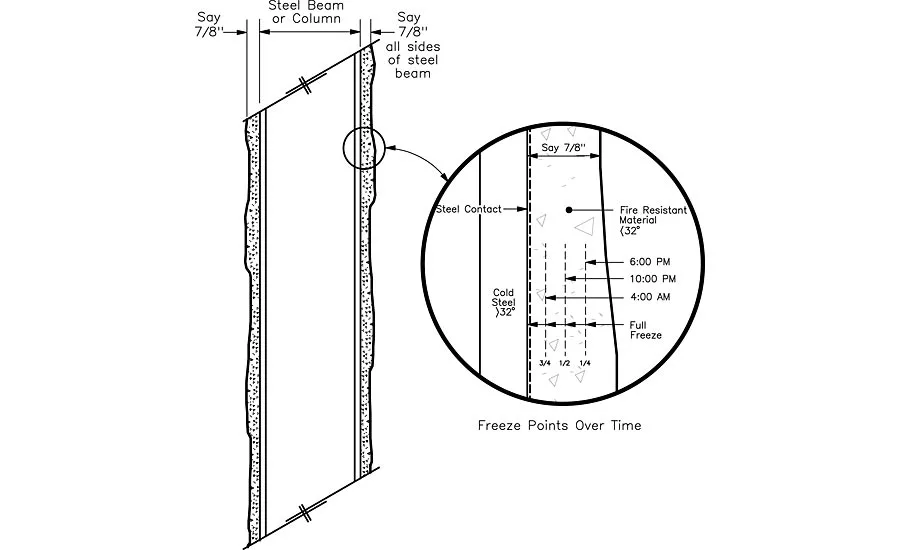
We start spraying and even though the temperature of the mix is above 40 degrees, we know thermodynamically that the heat within the just recently sprayed SFRM mix, will travel toward the internal cold of the steel and will eventually freeze at the point of contact. Failure is almost inevitable and the colder the steel the greater the chance for failure. If a section of compromised fireproofing is removed and the plane of contact between the SFRM and the steel is smooth then it is a pretty good bet freezing has occurred at the point/plane of contact.

Let us now take the other approach: we have been spraying all day and the crew goes home at 3:30. The GC says OK let’s save money and shut down the heat at 5 p.m. and once again the nighttime temperatures go down in to the 20’s. Eventually, some freezing will occur. It might be just at the surface, or it may be halfway through the applied thickness, it might be at the plane of contact, but at some point freezing will occur. Where it occurs will depend on the time the SFRM material is on the steel, how cold it is, the duration of coldness and a bunch of other factors. Obviously, if freezing does occur, failure is looming.

It is important to understand the complex role of water molecules in the physical and thermal performance of SFRM. Most of the cementitious fireproofing depends on having molecules of water interstitially bound up within the SFRM material. This molecular bond is what allows fireproofing to do its work and is crucial to the function of the SFRM. In the case of cementitious fireproofing with water molecularly bound up with the material, this bond is crucial to the thermal performance of the fireproofing. Fibrous fireproofing has similar issues in that the applied water must activate the bonding resins coating the fibers. Within the fibrous fireproofing category, the activation and bonding of the resins is similarly crucial to the thermal performance of the fiber fireproofing, albeit in a different reaction. Cold weather does not just affect adhesion/cohesion, it affects crucial chemical reactions as well.

The chemical formulation of propane is:


Propane = C3H8

The combustion process is as follows:


2 C3H8 + 10 O2 = 6 CO2 + 8 H2O + heat


What can we do about it?

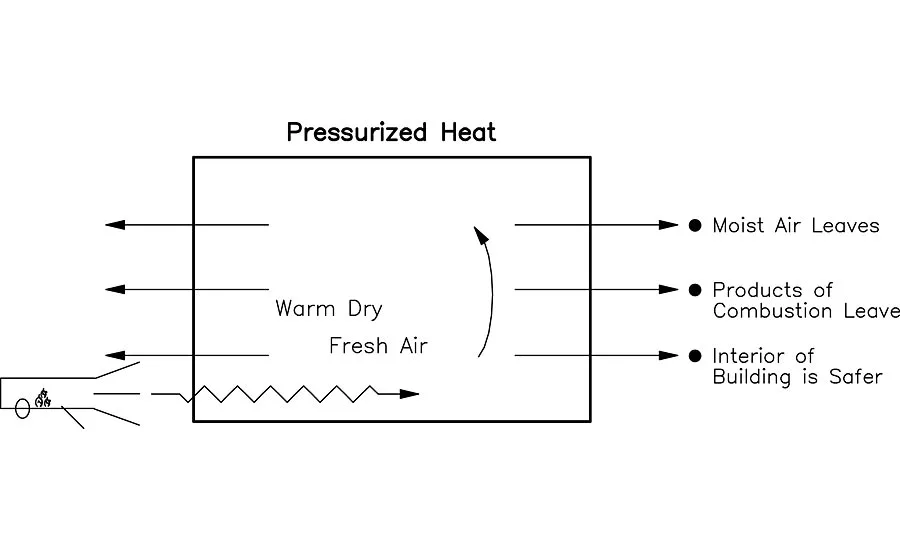
There are two ways to heat the building. One is to use a series of “pot” heaters that burn propane gas — quick to set up and are quite mobile. This is sometimes referred to as “negative pressure” systems. The other heating option is to set up a “positive pressure” system with the combustion taking place outside the tarped-in structure—warm air is blown into the structure, and then distributed throughout or as needed.

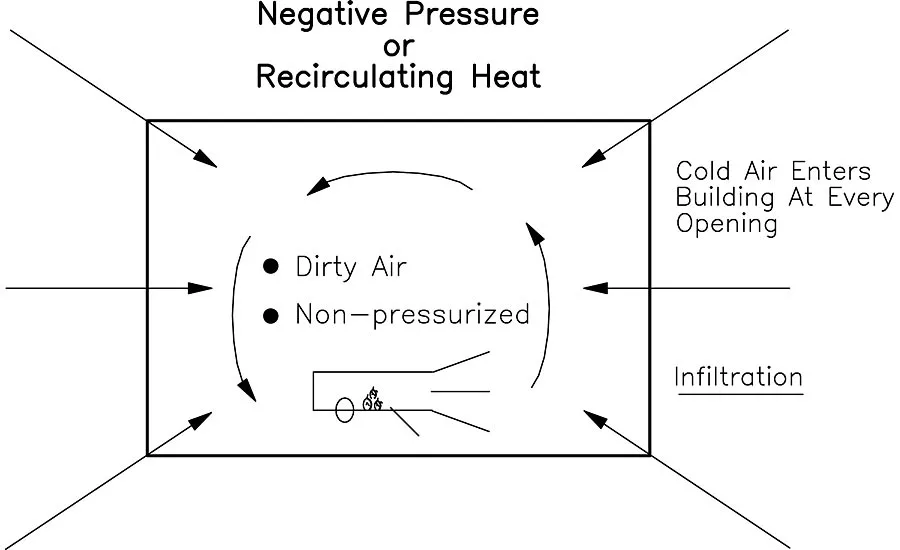
First, let us look at the “pot” heater or negative pressure systems. Anyone can go to the local store or rental facility and purchase this type of heater. Any gas supply house will usually provide cylinders of gas—hook them up and you are ready to go. There are however, some issues. First, gas in cylinders is quite expensive. Second, the combustion process is conducted internally (within the tarped building) which creates a slight negative pressure within the building. Depending on the ventilation, and the tendency is to make the building as tight as possible to conserve heat, off gassing from internal activities gets trapped within the slight negative pressure.

While this might create some physical discomfort to the workers, the amount of water released by the combustion process is significant to the extent that it might: affect the curing and drying process, create a mold condition and negatively affect the physical and thermal performance of the sprayed fireproofing.

The solution to these issues is to install a positive pressure system. Although, the initial set up costs may be higher, the usage costs may in fact be lower or at least about the same. With the combustion processes occurring outside the building we eliminate any off gassing or water build-up conditions. You also create a slight positive pressure which tends to force any air containments out of the building. Obviously, in my own opinion, this is the preferred path of providing temporary heat. Regardless of the methodology selected, the clear objective is to keep the building at least 40 degrees F prior to, during, and after any application of sprayed fireproofing. W&C

KEYWORDS: fire resistance steel

Share This Story

Looking for a reprint of this article?
From high-res PDFs to custom plaques, order your copy today!

Wc0919 ft winter p5 author tim vellrath

Tim Vellrath has managed a fireproofing contracting business for nearly 40 years. He holds several patents and is the author of the “Handbook of Principles and Practices of Spray Applied Fire Resistive Materials” and accompanying workbook.

Recommended Content

JOIN TODAY
To unlock your recommendations.

Already have an account? Sign In

  • Abercrombie & Fitch

    EIFS in 2026: How Specialty Finishes Are Redefining Exterior Wall Systems

    As building codes, owner expectations, and design demands...
    Stucco/EIFS
    By: Regi Mendoza
  • proper air and vapor control

    From Energy Efficiency to Moisture Management: Why Air and Vapor Control Matter

    How proper air and vapor control within building...
    Building Envelope
    By: Benjamin Meyer AIA, LEED AP
  • Linear Metal Ceiling Beam Baffles

    Top 25 Ceiling Contractors of 2026

    Suspended ceilings demand precision, code compliance and...
    Ceilings
    By: John Wyatt and Tanja Kern
You must login or register in order to post a comment.

Report Abusive Comment

Manage My Account
  • eMagazine Subscription
  • Newsletters
  • Online Registration
  • Manage My Preferences
  • Subscription Customer Service

More Videos

Sponsored Content

Sponsored Content is a special paid section where industry companies provide high quality, objective, non-commercial content around topics of interest to the Walls & Ceilings audience. All Sponsored Content is supplied by the advertising company and any opinions expressed in this article are those of the author and not necessarily reflect the views of Walls & Ceilings or its parent company, BNP Media. Interested in participating in our Sponsored Content section? Contact your local rep!

close
  • medical professionals moving a patient on a stretcher through the halls of a medical building
    Sponsored byNational Gypsum Company

    What Does High Performance Mean When It Comes To Gypsum Boards?

Popular Stories

Wichita Biomedical Campus

Wichita Drywall Worker Dies After Scaffolding Fall

Okan Tower in Miami, Florida

OSHA Opens Investigation Into Fatal Okan Tower Column Collapse

Construction workers in safety vests install drywall

Gypsum Sales Hold Amid Market Shifts in the U.S.

data center and logos

USG, Subzero Engineering Form Data Center Alliance

Events

June 24, 2026

The Bright Side & Benefits of Designing with Integrated Lighting

Credits 1 AIA LU/HSW; 0.1 ICC CEU

This course will explore the pivotal role architects and lighting design play in creating safer, more sustainable spaces. Learn how to avoid common lighting mistakes and make informed decisions that create the best visual environment for occupants. 

January 1, 2030

Webinar Sponsorship Information

For webinar sponsorship information, visit www.bnpevents.com/webinars or email webinars@bnpmedia.com.

See our full library of webinars

View All Submit An Event

Products

2026 National Painting Cost Estimator

2026 National Painting Cost Estimator

See More Products

Related Articles

  • Stucco Plastering in Cold Weather

    See More
  • video

    VIDEO: Dear Anna on WC: How to Handle a PR Crisis

    See More
  • COIV-19

    Coronavirus and the Construction Industry: How to Handle an Inevitable Delay

    See More

Related Products

See More Products
  • business.png

    How to Succeed With Your Own Construction Business

  • Accidents Waiting to Happen: Best Practices in Workers' Comp Administration and Protecting Corporate Profitability

See More Products

Related Directories

  • Cold-Formed Steel Engineers Institute

×

Connect with the industry’s leading resource for unparalleled insights and education.

Join thousands of industry professionals today. Shouldn’t you know what they know?

JOIN NOW
  • RESOURCES
    • Advertise
    • Contact Us
    • Directories
    • Store
    • Want More
  • SIGN UP TODAY
    • Create Account
    • eMagazine
    • Newsletters
    • Customer Service
    • Manage Preferences
  • SERVICES
    • Marketing Services
    • Reprints
    • Market Research
    • List Rental
    • Survey/Respondent Access
  • STAY CONNECTED
    • LinkedIn
    • Facebook
    • Instagram
    • YouTube
    • X
  • PRIVACY
    • PRIVACY POLICY
    • TERMS & CONDITIONS
    • DO NOT SELL MY PERSONAL INFORMATION
    • PRIVACY REQUEST
    • ACCESSIBILITY

Copyright ©2026. All Rights Reserved BNP Media, Inc. and BNP Media II, LLC.

Design, CMS, Hosting & Web Development :: ePublishing