Using Building Wraps as an Air Barrier
Understanding How Air Barrier Materials and Systems Are Evaluated Helps Design Professionals Find The Solution For Their Project.
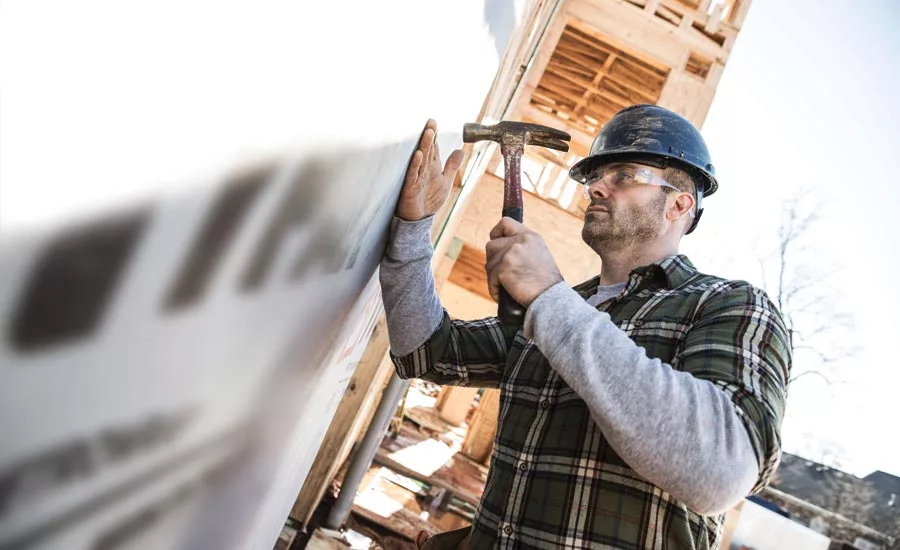
Photo courtesy of TYPAR Construction Products
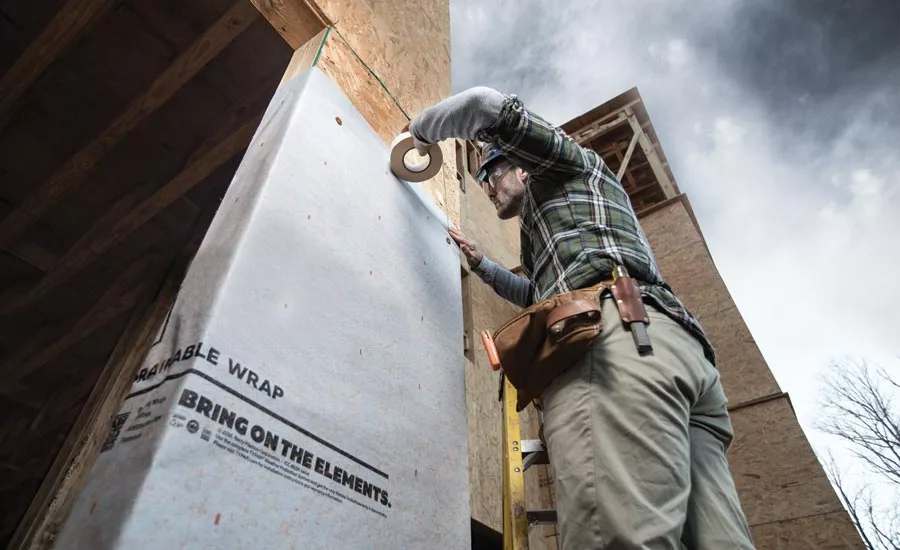
Photo courtesy of TYPAR Construction Products

Photo courtesy of TYPAR Construction Products
It is important to establish a continuous air barrier for several reasons. As an air barrier isolates the indoor environment, it plays a major role in the overall energy efficiency, comfort and indoor air quality of a building. According to the U.S. Department of Energy, up to 40 percent of the energy used to heat and cool a building is consumed due to uncontrolled air leakage. Establishing a continuous air barrier reduces heating and cooling costs, thereby lowering greenhouse gas production.
An air barrier is defined as a material or system of materials designed to control airflow between conditioned and unconditioned spaces. It serves as the primary air enclosure boundary separating indoor and outdoor air. In multi-family construction, the air barrier system also separates the conditioned air from any given unit and adjacent units. Air barriers also typically define the building enclosure’s pressure boundary.
Numerous materials can achieve the ASTM air leakage requirement, but this does not necessarily mean they will perform in the field once installed as part of a system. The question becomes whether the material will be able to hold up to the rigors of the jobsite and installation. After all, an air barrier’s performance is defined by its weakest link—and it only takes one tear or unsealed connection to compromise the entire system’s integrity.
Plastic building wraps are popular options on many jobsites due to their durability and ease of installation. They are typically either woven or nonwoven and provide several performance attributes like air holdout, moisture management and energy efficiency, which make them ideal for today’s high-performance buildings. As an added benefit, some plastic wraps, such as TYPAR’s MetroWrap, also offer up to 12 months of UV protection.
The use of air barriers in commercial construction is growing, driven by advances in building codes and increased awareness of their ability to support sustainable, comfortable buildings. However, not all air barriers are equal in performance or design, and there is not one solution suitable for all climates, regions and project conditions.
Building Codes
The requirements for continuous air barriers were added to the International Energy Conservation Code in 2012 and have been included in subsequent code updates since then. As part of this mandate, the code requires all new construction and additions to be visually inspected, as well as pressure-tested, as standard operating procedure.
To know whether a given material can serve as an effective air barrier, it is first important to understand an air barrier can be defined as either a material or an assembly—each category is subject to a specific set of tests. For an individual building material to be classified as an air barrier, its air permeance (i.e. amount of air migrating through materials rather than holes or gaps) must be equal to or less than 0.02 L/(s-m2) @ 75 Pa (0.0004 cfm/sf @ 1.57 psf) when tested in accordance with ASTM E2178, Standard Test Method for Air Permeance of Building Materials. Gypsum board, liquid-applied membranes, sprayed polyurethane foam insulation, and this article’s focus—polyethylene or polypropylene building wraps—are all examples of air barrier materials.
The requirements for an air-barrier assembly are somewhat less stringent and are measured in terms of air leakage. When tested in accordance with ASTM E2357, Standard Test Method for Determining Air Leakage of Air Barrier Assemblies, the subject must be 0.20 L/(s-m2) @ 75 Pa (0.04 cfm/sf @ 1.57 psf) in both directions (i.e. infiltration and exfiltration), which works out to 10 times greater than a material alone. This method is intended to simulate the performance of various air barrier materials and accessories when combined into an assembly. This “air barrier assembly” is defined as a group of materials assembled and joined together to provide a barrier to air leakage through the building envelope. For example, use of a weather resistive barrier, combined with properly installed flashing and tapes, would be considered an air barrier assembly.
Air barriers can also be defined through whole-building testing in accordance with ASTM E779, Standard Test Method for Determining Air Leakage Rate by Fan Pressurization. This test method is intended for the measurement of the airtightness of building envelopes of single-zone buildings. For the purpose of this test method, many multi-zone buildings can be treated as single-zone by opening interior doors or inducing equal pressures in adjacent zones.
Proper Installation
Equally important as correct material selection, proper installation is critical in order for an air barrier system to work as intended. Even when the primary air barrier material meets ASTM requirements, system continuity can still be compromised by incompatible tapes and flashing or improper installation.
This is just one of several reasons why construction details and pre-installation meetings are so important.
Sealing all laps and penetrations with the proper tape can improve the building wrap’s performance by 20 percent. Horizontal laps are just as important as vertical laps because windblown rain can travel sideways or even up and over an improperly installed lap. Any tears and holes should be sealed with manufacturer-recommended tapes, and all windows and doors should be properly flashed. The goal should be to create a continuous building envelope free from any penetrations through which air could potentially pass.
During installation, it is also important the proper nailing pattern be followed to ensure the material is kept against the wall and not blown off. Galvanized roofing nails or plastic cap nails should be used to attach the air-barrier material to the structural sheathing and framing. Uncapped nails, staples, or screws can contribute to tearing and moisture intrusion—they must not be overlooked.
The simplest way to ensure the entire system works together effectively and meets all code requirements is to specify wrap, tapes, and flashing from a single manufacturer. Doing so provides added assurance each component comes together seamlessly; further, the system will be covered by the manufacturer’s warranty.
Understanding how air-barrier materials and systems are evaluated, and knowing their performance characteristics, helps design professionals find the right solution for their project. Approaching air barriers from a holistic view and evaluating the entire system—rather than just an individual material—results in a tighter and far more durable enclosure that can stand the test of time.
Looking for a reprint of this article?
From high-res PDFs to custom plaques, order your copy today!




