Build for a Healthier Tomorrow, Today
In Today’s Health Crisis, SIP Construction Is A Very Relevant And Safe Building Solution.

Structural insulated panels (SIPs) helped this 4,182 square foot Legacy House in Lewis Center, Ohio, reach almost net-zero energy with a HERS of 17 and air leakage of 0.53 ACH50—below passive house levels. Credit: Courtesy of MM&I Construction Renegade Panels manufactured by Insulspan SIPs by Plasti-Fab

The 6-inch thick SIP walls and 10-inch thick SIP roof enable better indoor air quality (IAQ), while meeting project goals of speedy installation and reduced energy/operating costs. Credit: Courtesy of Premier Building Systems

The 3,410 square foot Bryant Residential Loft was a fourth-level to an existing three-story masonry building, and SIPs were able to help reduce crane time and labor compared with the costs of conventional framing and insulation. Credit: Courtesy of Energy Panel Structures
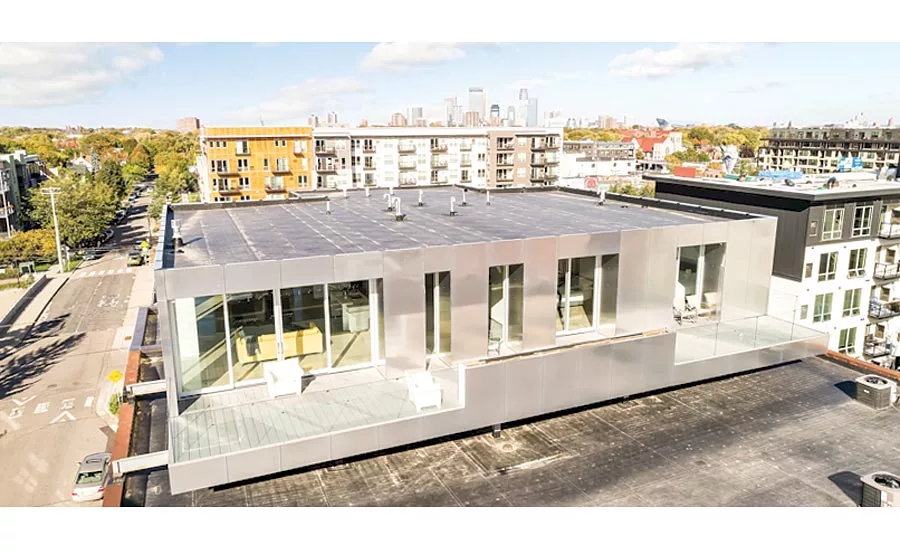
The Bryant Residential Loft scored 0.80 ACH50 on the blower door test, significantly lower than the Climate Zone requirement and key to keeping outdoor pollutants diluted. Credit: Courtesy of Energy Panel Structures
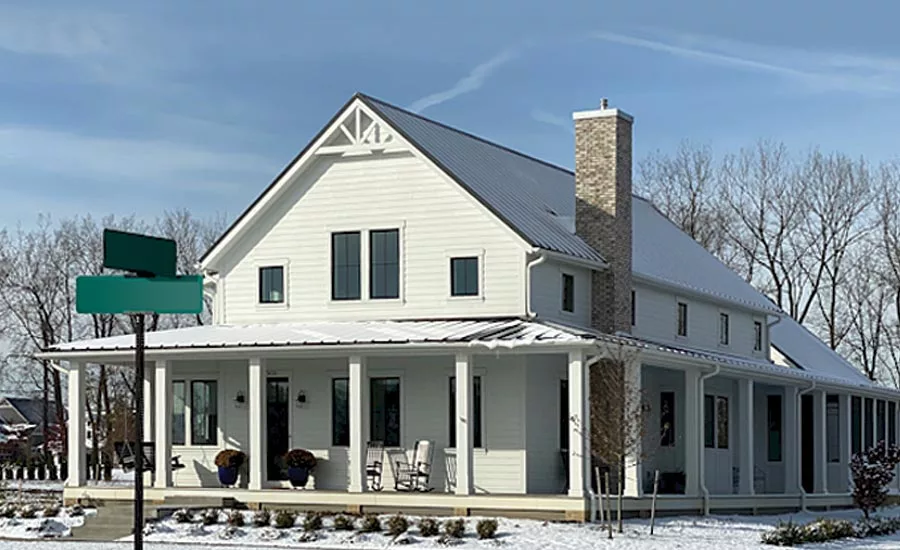
Along with virtually airtight SIPs and mechanical make-up air, the home also had a special foundation radon tubular venting system below the basement to keep radon levels at 0.5 pc/l, contributing to a healthier residence. Credit: Courtesy of MM&I Construction Renegade Panels manufactured by Insulspan SIPs by Plasti-Fab

Builders and designers can also use SIPs for commercial applications, such as the 7,826-square-foot Walk-Ons Sports Bistro in Edinburg, Texas. Credit: Courtesy of Premier Building Systems
As COVID-19 has made its presence known across the nation, the workforce has largely responded by turning to telecommuting. According to a recent Brookings Institution Center on Children and Families’ report, “Numbers suggest that about half of employed adults are currently working from home.”
With many in the building and design industries similarly finding themselves at home during the unprecedented economic climate, professionals are likely looking at the walls, ceilings and interior environments of their own residences with new eyes. This is the moment to consider the materials around us and ask, “How can we build our future homes and businesses better?” And, “How can we ensure the solution chosen can keep occupants safe and healthy?” Now, perhaps more than ever, is the time to embrace a new way forward with structural insulated panels (SIPs).
Have Occupants Breathe Cleaner, Easier with SIPs
Forest Products Laboratory first conceptualized skinned panels for construction in the 1930’s, though it would be 40 years later until SIPs gained traction with renowned architect Frank Lloyd Wright’s Usonian Houses. Today, as the green movement has continued to build momentum, eco-friendly solutions like SIPs—consisting of an insulating foam core sandwiched between two structural facings—are a trusted source for healthier residential and commercial structures.
Minimizing exposure
When architects and builders consider, “Americans, on average, spend approximately 90 percent of their time indoors, where the concentrations of some pollutants are often 2 to 5 times higher than typical outdoor concentrations,”¹ there’s no question that occupant well-being should be at the center of design and construction.
SIPs themselves contribute to a healthier indoor environment, as the construction materials minimize occupants’ exposure to volatile organic compounds. For example, OSB—typically used for the panels’ structural facings—reduces the likelihood of fungus when treated with zinc borate. By minimizing the risk of coming into contact with compounds that adversely affect human health, SIP walls and roofs (the roof and the ceiling are one and the same with SIPs) deliver peace of mind for specifiers, contractors and owners.
Air impermeable
Further adding to this concept of building better for all, SIPs’ physical properties include air impermeability, which leads to improved indoor air quality. Starting at the panel’s core, rigid foams prevent the migration of air so well that specifiers frequently turn to the solution to meet stringent continuous insulation requirements. Moving to the outer OSB, builders have long relied on this material to protect the air inside of buildings.
With rigid foam and OSB working together, SIPs’ very components assist with keeping harmful outdoor pollutants such as radon, smoke, VOCs² and more from contaminating the indoor air supply. IAQ is the bedrock of safer and healthier homes and businesses, and SIPs’ virtual airtightness can ensure a legacy of cleaner, more comfortable interiors designed with the occupant in mind.
Mechanical make-up air
As for addressing contaminant sources within buildings themselves, where most pollutants impacting IAQ come from,³ the total structural insulated panel holds the key. SIP walls and roofs can be manufactured in large sizes (up to 8 feet by 24 feet), resulting in fewer air gaps, reduced thermal bridging from fewer lumber connections (lower framing factor of 5 percent vs. 25 percent in traditional framing) and the elimination of air spaces within the wall cavity. In fact, when the Department of Energy’s Oak Ridge National Laboratory compared a SIP building with a stick framed building side-by-side, the laboratory found the SIP structure was 14 times more airtight.4
Because of this virtually airtight shell, SIPs require residential and commercial applications to have mechanical make-up air. With an often smaller HVAC unit installed inside the conditioned SIP envelope, the system takes expended air, dilutes it and then redistributes for a fresher, cleaner interior atmosphere. This works to dilute the accumulation of dangerous carbon monoxide, insecticides and other substances harmful to human health.5
Mechanical ventilation further provides easier control over airflow for increased air cleaning, diminishing, or even outright eliminating, contaminants in the built environment. And, for the 24.6 million people who suffer from asthma,6 this dehumidification process can crucially lessen triggers such as dust mites, mold and other particulate matter.7 Through the combined efforts of make-up air and SIP walls and roofs, building professionals can take pride knowing their structures allow occupants to breathe easier and lead a healthier life.
Put SIPs to the Test
Blower door test
With IAQ linked to airtightness, a blower door test can confirm SIPs’ minimal air leakage performance in a real-world setting. Pre-drywall, builders or independent third parties use a powerful fan to blow “air into or out of the house to pressurize or depressurize the home. The inside-outside pressure difference will cause air to force its way through any cracks in the building thermal envelope.”8 Ideally, there will be an equal amount of air leakage, and the flow rate is calculated by multiplying the structure’s cubic feet of leakage per minute by 60 and dividing the result by volume (expressed as air changes per hour or ACH50).9
Per the International Energy Conservation Code 2018, building envelopes located in Climate Zones 1 and 2 must have no higher than 5 ACH50, and in Climate Zones 3 through 8, the air leakage rate can’t be higher than 3 ACH50. SIP structures typically achieve less than 2 ACH50 at this stage, but proper design and installation can often achieve values of less than 1 ACH50. What’s more, passive house standards require less than 0.60 ACH50, and builders frequently utilize SIPs to get to this level.
Application
In the Building Excellence Award-winning Bryant Residential Loft project in Minneapolis, Minnesota, the construction company utilized 10-inch SIP panels in the ceiling and 6-1/2 inch SIP wall panels for a fourth-floor addition to a modern masonry building.10 The blower door test yielded 0.80 ACH50, well below Climate Zone 4 and 5 mandates. The results indicate that SIP walls and ceilings help protect occupants living on the roof of another building from urban pollution, such as car exhaust, outside fireplace and chimney emissions and more. Year in and year out, this SIP loft will maintain superior IAQ, helping ensure safety and comfort within.
Look Ahead
While it’s currently unclear how long the global outbreak will last, this pause is a chance to rethink the future of building and design. And as some states begin to lift construction restrictions, the safer, healthier and virtually airtight SIP solution can further assist with social distance building. Not only do SIPs’ large size options provide adequate room for construction crews, but the prefabricated panels also offer framing and insulation in one product, consolidating trades and speeding up overall installation for fewer people and less time on the jobsite.
If you’re new to SIPs, consult technical resources such as “Building with SIPs: Need to Know” and “Designing with SIPs: Design Considerations” to learn more about the smarter solution for residential and light commercial applications.
References
1-3, 5, 7 - See “Indoor Air Quality” at www.epa.gov.
4 - See “Toward Simple, Affordable Zero Energy Houses” at https://web.ornl.gov/sci/buildings/conf-archive/2004%20B9%20papers/117_Christian.pdf.
6 - See “Asthma Facts” at www.epa.gov.
8-9 - See “Air Leakage Guide” at www.energycodes.gov.
10 - See “Building Excellence Awards” at www.sips.org/projects/bryant-residential-loft.
Looking for a reprint of this article?
From high-res PDFs to custom plaques, order your copy today!



.webp?height=200&t=1741113368&width=200 "Sto(4).png")