The Finish Line: Mechanical Fasteners Part 2
Last month I discussed fastener design, thermal bridging and other topics. This month we’ll get into more detail.

WIND FORCES
The purpose of mechanical fasteners is to keep the EIFS on the wall. In a product like EIFS, which is in continuous direct contact with the wall structure, it is not the strength of the EIFS itself but that of the supporting wall that controls the effects of inward-blowing wind forces on the EIFS. When the wind blows, it simply pushes the EIFS into the wall. There is nowhere for the EIFS to go.
The real issue is the EIFS being pulled off the wall. Most people do not realize it but the pull-off forces from winds, as they swirl around a building, are sometimes much greater than the inward force of the same wind. Thus, the attachment of the EIFS to the supporting wall is critical. This is where mechanical fasteners come into play.
The number and pattern of the fasteners, as well as the strength of the screw’s grip on the substrate, affects the overall wind pull-off strength of the EIFS to a great degree. The thickness of the EIFS insulation also affects the pull-off strength. The pull-off strength is typically determined by the EIFS producer when testing 4-feet-by-8-feet mock-up wall panels, including the studs and sheathing. A vacuum force is applied to the entire face of the panel in small increments until something gets pulled off. Usually, the mode of failure is the fastener (the washer and screw) staying attached to the substrate and foam breaking at the fastener, with the result that the entire EIFS, less the fasteners, comes away from the wall in a large slab, along with the EIFS lamina still attached to the foam. Such failures can be dramatic.
For wind force resistance, a safety factor of “3” is mandated by the International Code Council, the publishers of the widely used International Building Code and the International Residential Code. In other words, the actual strength of attachment must be designed to one-third of the ultimate force the wall is capable of withstanding. Depending on the number and pattern of the fasteners, failure loads of up to about 90 pounds per square foot, or more, can be achieved with mechanical fasteners. This is less than that which can be achieved with adhesives. For 90 pounds per square foot failure force, with the safety factor of 3 added-in, this gives a maximum working wind pressure of around 30 pounds per square foot, which equates to about 130 miles per hour of wind speed. This level of wind speed is more than possible in tornado and hurricane areas, and at the tops and corners of tall buildings. Thus, the use of mechanical fasteners must be engineered for the specific building to be sure the walls can resist such forces.
 FASTENER PATTERNS
When the substrate is continuous and “screw-able”-such as plywood sheathing on a house-there is a huge range of possible fastening patterns. For sheathing substrates, this includes such substrates as plywood and OSB but not gypsum-based substrates. The same wide variety of fastener patterns exists for continuous solid substrates, like concrete, masonry and brick. High pull-off values can be obtained with substrates like plywood but since wood-based sheathings are combustible, they can’t be used on most commercial or tall buildings due to the code requirements. Gypsum-based sheathings do meet this requirement and hence can be used on buildings required to be noncombustible. However, the fasteners must then go into the studs, which makes for a limited number of practical patterns.
FASTENER PATTERNS IN DETAIL
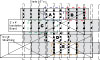
Take a minute to look at the strange-appearing drawing. It shows the layers in an EIFS stud wall, as if you had X-ray eyes and were looking at the wall from outdoors. It shows a number of fastening patterns that can be used when screwing the fastener into the stud. It’s based on studs at the common 16 inch on center spacing, using 4 feet by 8 feet sheathing sheets, and 2 foot by 4 foot EIFS insulation boards.
One of the criteria for proper EIFS installation is that the insulation board joints and the sheathing board joints must not coincide, and that vertical sheathing board joints must occur over a stud. The insulation boards are shown as alternating gray and white rectangles, so you can see the required running board pattern for the EIFS insulation. The patterns shown in the Fastener Patterns illustration on page 70 meet the criteria, thus:
Group A (blue dotted box): 3x3 pattern = 9 fasteners per insulation board. All fasteners within the field of the board.
Group B (red dotted box): 3x4 pattern = 12 fasteners per insulation board. All fasteners within the field of the board.
Group C (green dotted box): 4x2 pattern = 8 fasteners per insulation board. Vertical ends of insulation board shares fasteners with adjacent board.
Group D (black dotted box): 4x3 pattern = 12 fasteners per board. Vertical ends of insulation board shares fasteners with adjacent board.
Group E (orange dotted box): 4x4 pattern = 16 fasteners per board. Vertical ends of insulation board shares fasteners with adjacent board.
There are some interesting things to learn from this drawing, such as:
Note the way the sheathing and insulation boards need to be laid out so that the joints don’t coincide.
Note the limited number of fastener patterns that meet the criteria above.
Note the minimum pattern is Group A, a 3x3 pattern. This works out to 9 fasteners per 2-feet-by-4-feet insulation board (8 square feet) or about .9 fasteners per square foot. The most robust pattern is Group E, a 4x4 patterns with 16 fasteners per board or two fasteners per square foot.
This drawing applies to screws that go into the studs. If the substrate is continuous and screw-able, then you can put in many more fasteners, and get higher wind pull-off values.
SPOTTING THE WASHER
After attaching the EIFS with mechanical fasteners, it’s standard procedure to “spot” the washer with a thin layer of basecoat, without the reinforcing mesh. After the spot is dry, the full basecoat, including the mesh, is applied. Spotting is necessary so the basecoat gets well adhered to the washer and to prevent cracking. Spotting also assures that the washer area is well covered and flat, before applying the basecoat.
BACKWRAPPING
When backwrapping the perimeter of an EIFS wall area, there’s no adhesive into which the reinforcing mesh can be embedded. Thus, on many substrates, the mesh is stapled to the substrate, or a small amount of adhesive is used at the perimeter of the EIFS to hold the mesh to the backside of the insulation. The point is that the basecoat (with mesh) needs to be brought around the edge. This brings up the issue of the fasteners at the end of an EIFS area.
PERIMETER OF THE EIFS
When the EIFS stops-say, at a window opening-the end of the insulation board needs to be attached to the stud at the edge of the opening. The problem is that the fastener washer diameter is too large (if you are using thin insulation) and the washer will hang over the edge of the insulation board. The solution is to use a pair of shears to nip off the protruding edge of the washer.
RASPING
One of the issues with mechanical fasteners that doesn’t occur when using adhesives to attach the insulation is rasping. After the foam is in place, the wall needs to be sanded (“rasped”) prior to applying the basecoat. The hard plastic fastener washers simply don’t rasp. This is especially an issue when fasteners are put at the ends of the insulation board (in the joint), which is the exact place rasping is needed to get the board edges flush. The trick is overdrive the fastener washer just slightly. Then after the wall is rasped and the fastener head spotted, you have a flat wall.
AESTHETIC REVEALS
If the EIFS wall design has aesthetic reveals, be careful to make sure the mechanical fastener does not line up with the reveal. If it does, you’ll have a big problem trying to use a router or hot wire to create the aesthetic reveal. Again, the insulation board pattern and layout needs to work in conjunction with the mechanical fastener layout.
MINIMUM INSULATION THICKNESS
When the insulation board is attached with mechanical fasteners, the minimum thickness for the board is greater than the normal 3/4 inch minimum used for adhesively attached board. The minimum for mechanical fasteners is 1 to 1 1/2 inch, depending on the specific washer used. The additional thickness is needed due to the recessed socket into which the screws are inserted. The additional thickness is needed to keep the outside face of the socket from bottoming out on the substrate.
EIFS WITH DRAINAGE
In the type of EIFS with Drainage that uses a plastic mat as the drainage media, extra care needs to be taken when driving the fastener into position. If overdriven, the fastener may compress the insulation (due to the springiness of the mat), leading to a “quilting effect”-the fastener area is slightly dished-in. This, in turn, creates an insulation surface that is uneven, and thus a basecoat that may not be flat.
THE FINALE LINE
EIFS producers do not manufacture mechanical fasteners but some do have fasteners made for them (in a “private label”). Most manufacturers publish information on which fasteners are approved for use with their systems, as well as their wind force capacity. Fasteners are sold online and via EIFS distributors, and the fastener suppliers know whose EIFS systems their products work with properly. The point here is to make sure to use fasteners that are compatible with the specific EIFS product you are installing. W&C
WIND FORCES
The purpose of mechanical fasteners is to keep the EIFS on the wall. In a product like EIFS, which is in continuous direct contact with the wall structure, it is not the strength of the EIFS itself but that of the supporting wall that controls the effects of inward-blowing wind forces on the EIFS. When the wind blows, it simply pushes the EIFS into the wall. There is nowhere for the EIFS to go.
The real issue is the EIFS being pulled off the wall. Most people do not realize it but the pull-off forces from winds, as they swirl around a building, are sometimes much greater than the inward force of the same wind. Thus, the attachment of the EIFS to the supporting wall is critical. This is where mechanical fasteners come into play.
The number and pattern of the fasteners, as well as the strength of the screw’s grip on the substrate, affects the overall wind pull-off strength of the EIFS to a great degree. The thickness of the EIFS insulation also affects the pull-off strength. The pull-off strength is typically determined by the EIFS producer when testing 4-feet-by-8-feet mock-up wall panels, including the studs and sheathing. A vacuum force is applied to the entire face of the panel in small increments until something gets pulled off. Usually, the mode of failure is the fastener (the washer and screw) staying attached to the substrate and foam breaking at the fastener, with the result that the entire EIFS, less the fasteners, comes away from the wall in a large slab, along with the EIFS lamina still attached to the foam. Such failures can be dramatic.
For wind force resistance, a safety factor of “3” is mandated by the International Code Council, the publishers of the widely used International Building Code and the International Residential Code. In other words, the actual strength of attachment must be designed to one-third of the ultimate force the wall is capable of withstanding. Depending on the number and pattern of the fasteners, failure loads of up to about 90 pounds per square foot, or more, can be achieved with mechanical fasteners. This is less than that which can be achieved with adhesives. For 90 pounds per square foot failure force, with the safety factor of 3 added-in, this gives a maximum working wind pressure of around 30 pounds per square foot, which equates to about 130 miles per hour of wind speed. This level of wind speed is more than possible in tornado and hurricane areas, and at the tops and corners of tall buildings. Thus, the use of mechanical fasteners must be engineered for the specific building to be sure the walls can resist such forces.
When the substrate is continuous and “screw-able”-such as plywood sheathing on a house-there is a huge range of possible fastening patterns. For sheathing substrates, this includes such substrates as plywood and OSB but not gypsum-based substrates. The same wide variety of fastener patterns exists for continuous solid substrates, like concrete, masonry and brick. High pull-off values can be obtained with substrates like plywood but since wood-based sheathings are combustible, they can’t be used on most commercial or tall buildings due to the code requirements. Gypsum-based sheathings do meet this requirement and hence can be used on buildings required to be noncombustible. However, the fasteners must then go into the studs, which makes for a limited number of practical patterns.
FASTENER PATTERNS IN DETAIL
Take a minute to look at the strange-appearing drawing. It shows the layers in an EIFS stud wall, as if you had X-ray eyes and were looking at the wall from outdoors. It shows a number of fastening patterns that can be used when screwing the fastener into the stud. It’s based on studs at the common 16 inch on center spacing, using 4 feet by 8 feet sheathing sheets, and 2 foot by 4 foot EIFS insulation boards.
One of the criteria for proper EIFS installation is that the insulation board joints and the sheathing board joints must not coincide, and that vertical sheathing board joints must occur over a stud. The insulation boards are shown as alternating gray and white rectangles, so you can see the required running board pattern for the EIFS insulation. The patterns shown in the Fastener Patterns illustration on page 70 meet the criteria, thus:
Group A (blue dotted box): 3x3 pattern = 9 fasteners per insulation board. All fasteners within the field of the board.
Group B (red dotted box): 3x4 pattern = 12 fasteners per insulation board. All fasteners within the field of the board.
Group C (green dotted box): 4x2 pattern = 8 fasteners per insulation board. Vertical ends of insulation board shares fasteners with adjacent board.
Group D (black dotted box): 4x3 pattern = 12 fasteners per board. Vertical ends of insulation board shares fasteners with adjacent board.
Group E (orange dotted box): 4x4 pattern = 16 fasteners per board. Vertical ends of insulation board shares fasteners with adjacent board.
There are some interesting things to learn from this drawing, such as:
Note the way the sheathing and insulation boards need to be laid out so that the joints don’t coincide.
Note the limited number of fastener patterns that meet the criteria above.
Note the minimum pattern is Group A, a 3x3 pattern. This works out to 9 fasteners per 2-feet-by-4-feet insulation board (8 square feet) or about .9 fasteners per square foot. The most robust pattern is Group E, a 4x4 patterns with 16 fasteners per board or two fasteners per square foot.
This drawing applies to screws that go into the studs. If the substrate is continuous and screw-able, then you can put in many more fasteners, and get higher wind pull-off values.
SPOTTING THE WASHER
After attaching the EIFS with mechanical fasteners, it’s standard procedure to “spot” the washer with a thin layer of basecoat, without the reinforcing mesh. After the spot is dry, the full basecoat, including the mesh, is applied. Spotting is necessary so the basecoat gets well adhered to the washer and to prevent cracking. Spotting also assures that the washer area is well covered and flat, before applying the basecoat.
BACKWRAPPING
When backwrapping the perimeter of an EIFS wall area, there’s no adhesive into which the reinforcing mesh can be embedded. Thus, on many substrates, the mesh is stapled to the substrate, or a small amount of adhesive is used at the perimeter of the EIFS to hold the mesh to the backside of the insulation. The point is that the basecoat (with mesh) needs to be brought around the edge. This brings up the issue of the fasteners at the end of an EIFS area.
PERIMETER OF THE EIFS
When the EIFS stops-say, at a window opening-the end of the insulation board needs to be attached to the stud at the edge of the opening. The problem is that the fastener washer diameter is too large (if you are using thin insulation) and the washer will hang over the edge of the insulation board. The solution is to use a pair of shears to nip off the protruding edge of the washer.
RASPING
One of the issues with mechanical fasteners that doesn’t occur when using adhesives to attach the insulation is rasping. After the foam is in place, the wall needs to be sanded (“rasped”) prior to applying the basecoat. The hard plastic fastener washers simply don’t rasp. This is especially an issue when fasteners are put at the ends of the insulation board (in the joint), which is the exact place rasping is needed to get the board edges flush. The trick is overdrive the fastener washer just slightly. Then after the wall is rasped and the fastener head spotted, you have a flat wall.
AESTHETIC REVEALS
If the EIFS wall design has aesthetic reveals, be careful to make sure the mechanical fastener does not line up with the reveal. If it does, you’ll have a big problem trying to use a router or hot wire to create the aesthetic reveal. Again, the insulation board pattern and layout needs to work in conjunction with the mechanical fastener layout.
MINIMUM INSULATION THICKNESS
When the insulation board is attached with mechanical fasteners, the minimum thickness for the board is greater than the normal 3/4 inch minimum used for adhesively attached board. The minimum for mechanical fasteners is 1 to 1 1/2 inch, depending on the specific washer used. The additional thickness is needed due to the recessed socket into which the screws are inserted. The additional thickness is needed to keep the outside face of the socket from bottoming out on the substrate.
EIFS WITH DRAINAGE
In the type of EIFS with Drainage that uses a plastic mat as the drainage media, extra care needs to be taken when driving the fastener into position. If overdriven, the fastener may compress the insulation (due to the springiness of the mat), leading to a “quilting effect”-the fastener area is slightly dished-in. This, in turn, creates an insulation surface that is uneven, and thus a basecoat that may not be flat.
THE FINALE LINE
EIFS producers do not manufacture mechanical fasteners but some do have fasteners made for them (in a “private label”). Most manufacturers publish information on which fasteners are approved for use with their systems, as well as their wind force capacity. Fasteners are sold online and via EIFS distributors, and the fastener suppliers know whose EIFS systems their products work with properly. The point here is to make sure to use fasteners that are compatible with the specific EIFS product you are installing. W&C
Looking for a reprint of this article?
From high-res PDFs to custom plaques, order your copy today!