Walls & Ceilings logo
search
cart
facebook twitter linkedin youtube youtube Spotify Podcasts Apple Podcasts Spotify Podcasts Apple Podcasts
  • Sign In
  • Create Account
  • Sign Out
  • My Account
Walls & Ceilings logo
  • NEWS
  • TOPICS
    • Drywall
    • Stucco/EIFS
    • Ceilings
    • Steel Framing
    • Fireproofing
    • Interior Plaster
    • Building Envelope
    • Insulation
    • Technology
    • Interior
    • Exterior
    • Women In Construction
  • COLUMNS
    • Up Front
    • All Things Gypsum
    • Art & Craft of Plastering
    • Stucco Stop
    • Steel Deal
    • Industry Voices
  • PRODUCTS
    • Buzz Guide
  • EVENTS
    • Industry Events
    • Webinars
    • BUILD Expo
  • MEDIA
    • Videos
    • Podcasts
    • Photo Galleries
    • BUILD26 Videos
    • Take our Quiz!
    • Infographics
  • EXCLUSIVE
    • Newsletters
    • Top 50 Contractors
    • Contractor of the Year
    • State of the Industry
    • W&C Store
    • Market Research
    • CEUs
    • Sponsor Insights
    • Custom Content & Marketing Services
  • DIRECTORY
  • EMAGAZINE
    • eMagazine
    • Advertise
    • Archive Issues
  • SIGN UP!

Dress Up a Room With Crown Molding

December 1, 2005
If clients are looking to dress up an ordinary room, suggest installing crown molding. Very few products make a visual impact like this, which gives a subtle yet elegant design element to any space. And with the proper tools and set up, installation can be easy.

While wood is a common choice for crown molding, urethane is also a popular material. For a recent project, we installed Fypon urethane crown molding, which is lightweight, flexible and looks like solid wood. It also comes pre-primed, which simplified the painting process.
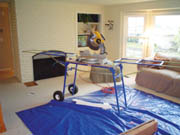
To save time and labor, set up tools and materials in the general area where the molding is being installed. That way cuts and adjustments can be made.

Set up for the Project

As with any project, the ease of completing a crown molding job is determined by the set up of the tools. First, installing crown molding is a two-person job. It helps to have extra hands when placing the molding precisely on the wall. Second, set up the tools and materials in the general area where the molding is being installed. In this project, we were initially faced with setting up shop in a garage, which meant going up and down stairs for each cut and adjustment. We could see that this was going to be time consuming and labor intensive, especially working with 12-foot lengths, so we moved our work area to the upstairs living area. We put down a plastic tarp and brought in the miter saw. Working with urethane molding is less messy than wood, so clean up was simple. We saved several hours by working in the general area of the installation, as we could quickly make cuts and adjustments as needed.

Other tools needed for installing crown molding include:

• Pneumatic nailer

• Corrosion-resistant finishing nails

• Utility knife

• Tape measure

• Caulk gun

• High-quality adhesive

• Pencil

• Wet rags
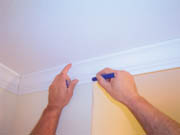
To get the proper lengths of the molding, measure each wall length at ceiling height from corner to corner. The length will be the long points for the molding. For outside corners, the measurement from the wall to the corner will be the short point for the angled cut.

Prepare the Miter Saw

Cutting crown molding is all about measurements and angles. Most cuts are made at 45-degree angles but sometimes the angles need to be adjusted for corners that are not exactly 90 degrees.

Once the angles of the room have been determined, the miter saw can be set up to properly cut the molding.
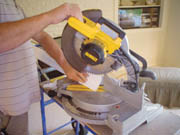
Cut the crown molding in position on the saw, meaning the molding is set on the saw at the same angle it will be installed on the wall and ceiling. Position the molding on the saw upside down and backwards for the best cuts. To help alleviate any confusion with the cuts, make slash marks on the molding indicating the direction of the cut.

Measure the Lengths

To get measurements for the crown molding, measure each wall length at ceiling height from corner to corner. The length will be the long points for the molding when cutting inside corners at a 45-degree angle. If there is an outside corner, the measurement from the wall to the corner will be the short point for the molding on the angle.

Having a pencil and paper handy is another good way to keep track of the cuts that need to be made.
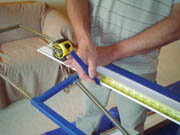
Because crown molding will expand and contract over time, you want to install the molding as tightly as possible. Cut the molding 1/4 inch longer on each 10-foot length to ensure a snug fit and create a small amount of tension when installing the pieces.

Cutting the Molding

When the measurements for the room are made, begin cutting the molding to length. We cut the crown molding in position on the saw, meaning the molding is set on the saw at the same angle it will be installed on the wall and ceiling. Position the molding on the saw upside-down and backwards for the best cuts. To help alleviate any confusion with the cuts, make slash marks on the molding indicating the direction of the cut. It also helps to visualize how the piece will fit when installed, with the saw acting as the ceiling and the fence representing the wall.

As mentioned earlier, it can be difficult to distinguish between left-hand cuts and right-hand cuts, so remember to check twice before cutting. More than once we lost sight of which way the cut was supposed to go. And with nearly 400 feet to install for this project it got confusing more than once. A good rule we followed was if we were cutting an inside corner on the right-hand side, we turned the saw blade to the left. For a left-hand corner, move the blade back to the right.

To minimize the effects of expansion and contraction of the molding over time, install the molding as tightly as possible. Fypon recommends cutting the molding 1/4-inch longer on each 10-foot length to ensure a snug fit and to create a small amount of tension when installing the pieces. For non-corner seams, use straight butt joints or the factory cuts rather than angled cuts.

With crown molding, properly fitting outside corners can be more challenging than inside corners because the angles are reversed and the corners are often the most visible in a room and need to be nearly perfect. There's an easy formula to remember with this process also: To cut outside right-hand corners, turn the saw blade to the right so the long point is the opposite of an inside corner. For outside left-hand corners, make sure the saw blade is turned to the left. If the cuts are made correctly, the outside corners will truly show off the visual design features of crown molding.
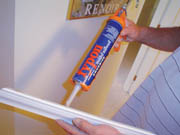
To install, first apply beads of top quality urethane construction adhesive along the entire top and bottom surfaces that will contact the wall and ceiling. Be sure to apply adhesive on all joints, as well.

Installation

When the molding pieces are cut, hold them in position to test for length and fit. Because not every corner will be exactly 90 degrees, you might need to cope the ends of the molding for a better fit. Coping is removing material from the thickness of the molding so that it fits better with the adjoining molding. With urethane, one can use a standard utility knife to shave off the material. Keep removing material until the corners fit as tight as possible.

To install the urethane molding, first apply beads of top quality urethane construction adhesive along the entire top and bottom surfaces that will contact the wall and ceiling. Be sure to apply adhesive on all joints, as well. Start with one corner and press the molding into place. Then swing the other corner into position so the molding is bowed slightly in the middle. After securing the corners, press the rest of the molding into place along the surface and fasten with non-corrosive nails every 16 inches along the top and bottom edges of the molding. Because there is adhesive on the molding, this method also is cleaner and prevents the adhesive from contacting other parts of the wall or ceiling. If adhesive ends up in areas where not wanted or if it seeps out from behind the molding, use a wet rag to immediately wipe it clean. If the adhesive leaks out during the drying process, use a utility knife to score the material and remove it after it has dried.

For best results, wear latex gloves to keep fingerprints off of the white molding and adhesive off the hands.
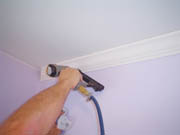
Fasten with non-corrosive nails every 16 inches along the top and bottom edges of the molding for a secure fit.

Finishing Touches

Before installing the molding, we painted it to match the ceiling color. That way we could just touch up nail holes and gaps upon completion of the installation.

For any gaps in the joints and to fill in nail holes, use a good premium spackle. We used Dap Fast & Final, which is light and can fill gaps and holes easily. After the spackle dries, lightly sand the areas and touch up with paint to finish the job.

One more thing: Be sure to take before-and-after pictures to show future clients how crown molding can transform ordinary rooms into exciting spaces.

Thanks to Fypon for participating in this project.

Share This Story

Looking for a reprint of this article?
From high-res PDFs to custom plaques, order your copy today!

Recommended Content

JOIN TODAY
To unlock your recommendations.

Already have an account? Sign In

  • Abercrombie & Fitch

    EIFS in 2026: How Specialty Finishes Are Redefining Exterior Wall Systems

    As building codes, owner expectations, and design demands...
    Stucco/EIFS
    By: Regi Mendoza
  • proper air and vapor control

    From Energy Efficiency to Moisture Management: Why Air and Vapor Control Matter

    How proper air and vapor control within building...
    Building Envelope
    By: Benjamin Meyer AIA, LEED AP
  • Linear Metal Ceiling Beam Baffles

    Top 25 Ceiling Contractors of 2026

    Suspended ceilings demand precision, code compliance and...
    Ceilings
    By: John Wyatt and Tanja Kern
You must login or register in order to post a comment.

Report Abusive Comment

Manage My Account
  • eMagazine Subscription
  • Newsletters
  • Online Registration
  • Manage My Preferences
  • Subscription Customer Service

More Videos

Sponsored Content

Sponsored Content is a special paid section where industry companies provide high quality, objective, non-commercial content around topics of interest to the Walls & Ceilings audience. All Sponsored Content is supplied by the advertising company and any opinions expressed in this article are those of the author and not necessarily reflect the views of Walls & Ceilings or its parent company, BNP Media. Interested in participating in our Sponsored Content section? Contact your local rep!

close
  • medical professionals moving a patient on a stretcher through the halls of a medical building
    Sponsored byNational Gypsum Company

    What Does High Performance Mean When It Comes To Gypsum Boards?

Popular Stories

Linear Metal Ceiling Beam Baffles

Top 25 Ceiling Contractors of 2026

Wichita Biomedical Campus

Wichita Drywall Worker Dies After Scaffolding Fall

QXO Just Changed the Game-Here's What Contractors Are Asking

QXO Just Changed the Game-Here's What Contractors Are Asking

Less compound

Joint Compound Market to Reach $9.7B by 2033

Events

June 24, 2026

The Bright Side & Benefits of Designing with Integrated Lighting

Credits 1 AIA LU/HSW; 0.1 ICC CEU

This course will explore the pivotal role architects and lighting design play in creating safer, more sustainable spaces. Learn how to avoid common lighting mistakes and make informed decisions that create the best visual environment for occupants. 

January 1, 2030

Webinar Sponsorship Information

For webinar sponsorship information, visit www.bnpevents.com/webinars or email webinars@bnpmedia.com.

See our full library of webinars

View All Submit An Event

Products

2026 National Painting Cost Estimator

2026 National Painting Cost Estimator

See More Products

Related Articles

  • Miterless crown molding by Fypon

    See More
  • Crown molding by Trim-Tex

    See More
  • Omega-Lite Panels Dress-up Popular Retail Chain

    See More

Related Products

See More Products
  • business.png

    How to Succeed With Your Own Construction Business

  • building codes illustated.jpg

    Building Codes Illustrated: A Guide to Understanding the 2021 International Building Code, 7th Edition

See More Products
×

Connect with the industry’s leading resource for unparalleled insights and education.

Join thousands of industry professionals today. Shouldn’t you know what they know?

JOIN NOW
  • RESOURCES
    • Advertise
    • Contact Us
    • Directories
    • Store
    • Want More
  • SIGN UP TODAY
    • Create Account
    • eMagazine
    • Newsletters
    • Customer Service
    • Manage Preferences
  • SERVICES
    • Marketing Services
    • Reprints
    • Market Research
    • List Rental
    • Survey/Respondent Access
  • STAY CONNECTED
    • LinkedIn
    • Facebook
    • Instagram
    • YouTube
    • X
  • PRIVACY
    • PRIVACY POLICY
    • TERMS & CONDITIONS
    • DO NOT SELL MY PERSONAL INFORMATION
    • PRIVACY REQUEST
    • ACCESSIBILITY

Copyright ©2026. All Rights Reserved BNP Media, Inc. and BNP Media II, LLC.

Design, CMS, Hosting & Web Development :: ePublishing
