The Green Thumb
Cathedral in the Sky: Sustainability Restores an Architectural Masterpiece Restored
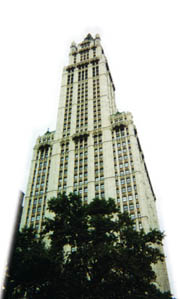
The year 1913, the year of the building's completion, was an auspicious time in history. Scientific knowledge and innovation were growing exponentially, the American century was in its infancy, and it was a time of prosperity and hope for the future. Nestled between two other significant events of the early 20th century: the tragic sinking of the Titanic (1912) and the carnage of what would come to be known as The Great War (1914-1918), 1913 was to be the last full year of the Gilded Age and-in a very real sense-the Woolworth Building itself was to be the last hurrah for that bygone era.
No less a personality than President Wilson would inaugurate the building's opening by turning on the electric lights remotely from his desk in the Oval Office. Further uptown, Grand Central Station and the Apollo Theatre would open their doors to the public for the first time.
To scrape the sky
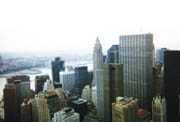
Though the Skyscraper was born in Chicago (in the wake of the great fire of 1871), it grew up on Manhattan Island in the early years of the 20th Century. By 1902, the Flatiron Building-at the intersection of Broadway, 5th Avenue and 23rd St.-had reached the dizzying height of 300 feet. The term "skyscraper" has its origins in the age of sail. Mariners referred to the top-most sail on a fully rigged sailing ship as the skyscraper.The demise of sailing ships in the second half of the 19th Century coincided with the technological advances that made the skyscraper possible: structural steel and Mr. Otis' elevator. Architect Cass Gilbert's two-tiered, 1 million square-foot design for the Woolworth building-topped with a copper-clad pyramid roof, pinnacles, towers and flying buttresses-was to be New York's and the world's first true skyscraper, literally touching the sky at 792 feet (241 meters) for 54 stories above terra firma. Though it took six years to complete (construction began in 1908), the day it opened, it set the standard for the design and construction of corporate office buildings for decades to follow.
The Flemish Gothic façade features elaborate ornamentation in both cast iron, glazed terra cotta and also stone sculpture. Images of gargoyles and animals of all kinds abound along with fine latticework. The "boneyard" (as it is affectionately referred to in one of the buildings sub-basements) attests to the building's new owner The Witkoff Group LLC and Building Manager Roy Suskin's efforts to maintain the building's aesthetics and landmark status.
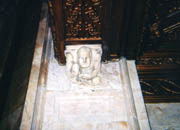
Many of the original castings of the façade's decorative terra cotta and cast iron ornamentation will be found there. Architectural Molded Composites Corp. specializes in duplicating the ornamentation by casting rubber molds of the originals; from the boneyard-if possible, or in-place-from the façade, if necessary. Using composite materials, the ornamentation is duplicated exactly then secured to the building with integral stainless steel anchors.
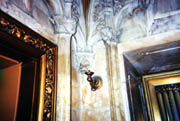
To ensure that the views from his building were left unobstructed, Woolworth purchased the neighboring properties on three sides (north, south and west). The main elevation (east) has beautiful (and recently restored) City Hall Park as its neighbor directly across Broadway. Not to be outdone by the exterior, Woolworth spared no expense to make the lobby one of New York City's finest and a modern tourist attraction. Painted murals of the goddess of commerce and labor adorn the mezzanine level, fine marble full of filigree on the walls, vaulted ceilings with inset mosaic tile and sculpted bas-reliefs in caricature of Woolworth himself (counting out his fortune in nickels and dimes), Architect Cass Gilbert (holding a model of the building) and other key players in the building's creation such as the structural engineer and the estate agent, make the lobby a feast for the eyes.
Born in 1852, Woolworth enjoyed his cathedral for only six years, until his death in 1919. He made the building the headquarters for the retail-empire he founded in 1879. With humble beginnings as a farmer and later a shop assistant, he single handedly revolutionized retailing by creating a chain of stores whereby the customer was allowed to actually see and touch the merchandise (a novel approach at the time)-it set the standard for retailing still in use today. Best yet, he charged them only a nickel or a dime for the merchandise and thus the "five- and 10-cent store" was born. His retailing innovations created a lot of nickels and dimes for his company's coffers with which he paid for the building entirely in cash: $13.5 million. The Woolworth Building has the unique distinction of being the only large-scale commercial building in New York ever built without an underlying mortgage to finance it.
Race for the sky
The Woolworth Building inadvertently started the ego-driven "race for the sky," whereby individuals and corporations sought to build monuments to themselves in the form of tall buildings. For 27 years (from 1913 to 1930), the Woolworth Building was the tallest building in the world. Automobile industry titan Walter Chrysler changed that in 1930 with the celebrated art deco Chrysler Building. But it was not to last for a year later, in 1931, the speculative Empire State Building took and held the title as world's tallest building until the early 1970s. Though these later buildings were significant achievements, they did not come anywhere near the level of ornamentation and craftsmanship lovingly bestowed upon the Woolworth Building by all involved in its creation.Not only in life was Woolworth driven to make his mark upon the world-so too in death. North of the city in the Bronx is the Woolworth family mausoleum-reminiscent of the Woolworth Building's elaborate ornamentation-alongside other prominent personages such as RH Macy, Herman Melville and Duke Ellington, all at eternal rest in Woodlawn Cemetery.
Soon after the building was completed and the race for the sky underway, city officials realized the need to change the zoning laws to allow for light and air to enter the streets below the vertical city New York was fast becoming. With City Hall Park across the street providing an open frontage, the Woolworth Building is inoffensive to the pedestrian in this regard. However, other early skyscrapers of the era-particularly those in the financial district, rise for hundreds of feet just a few feet from the curb, thus blocking out sunlight and air.
To correct the problem, particularly for the development of mid-town, the city incorporated into its zoning laws the Sky Exposure Plane. This requires buildings to rise and "step back" at intervals to allow light and air to enter the streets and avenues below.
The Woolworth Building was in 1913, and for many years thereafter, a city unto itself. Woolworth was benevolent to his employees providing them with access to a pool, sauna and hot tub in the building's basement. Dynamos provided electric power and boilers steam (of which the excess was sold back to the city). Multiple well heads at the base of the building provided fresh water for the boilers and steam-driven turbines, as well as potable water for the occupants (though these well heads are no longer in use).
A sophisticated climate-control system even took into account "stack effect" air pressure inherent in high-rise buildings. This allowed for smooth operation of the world's first high-speed elevators (700 feet per minute)-the original motors are still in use. Though electricity was available and featured in the building's design, in 1913 electricity was considered unreliable. To be safe, all building exit (egress) signs utilized gas lamps to insure a safe exit from the building lest the electricity fail. These fixtures are still in place but no longer used. Electricity has come a long way since then.
Sustainable restoration
The sustainable restoration really began in 1978. That year, Ernest A. Conrad, PE, president of Landmark Facilities Group Inc., of East Norwalk, Conn., was brought in as a consulting building systems engineer. LFG specializes in modernizing historic buildings and has to its credit such notable institutions as Rockefeller Center and the Frick Collection Museum. Ernie immediately began the unenviable task of creating a detailed study of the Woolworth Building's in-place mechanical/electrical/plumbing systems. The end result many years later was 10 volumes of data from the study and an intimate knowledge of the building-literally from top to bottom. For Ernie, it was a labor of love. The New York Historical Society generously provided the original design drawings to the new owner and LFG. They will be duplicated and historically preserved for posterity in a museum collection.Sustainable restoration includes reusing existing MEP systems whenever and wherever possible and/or finding innovative uses for dormant building elements. A good example of the former is the continuing use of the original high-speed elevator motors and ventilating fans. For the latter, unusable mail slots, which run up the entire height of the building, will become risers for future fiber-optic cable installations.
Another feature of the restoration was the replacement of more than 50 types of windows. DeVac Inc. was contracted to furnish and install matching custom-made anodized aluminum windows with insulating glass (double glass) and triple weather seals. The windows are-for the most part-operable (like the originals) and are designed to withstand stack effect wind pressure.
Even by today's standards, the building meets or exceeds New York's tough building code in many respects. Woolworth was concerned about fire in his building and the safety of his employees. He directed his architect to use the highest standards then in use for fireproof construction: side method terra cotta flat arch floor construction. Hollow terra cotta blocks encase the steel beams and wedge shaped and keystone terra cotta blocks interlock as they span the gap between beams thus acting as a "flat arch" to support the applied loads. Atop the flat arch a 3-inch aggregate fill with a 2-inch concrete topping is applied. The floor construction can support 1,500 pounds per square feet and direct attachment to the terra cotta is allowed with appropriate anchors.
The demise of the Woolworth Corp. in the 1990s left the building's future in question for a time. The Witkoff Group's ownership has given the building new life as a mixed-use building. Already, several of the lower, larger floors have been renovated, upgraded and rented to prominent institutions such as New York University, the Securities and Exchange Commission, and a prestigious law firm. The intent is to use the tower portion (higher, smaller floors) as high-end residences with panoramic views of Manhattan Island and the surrounding areas. The location is not bad either: Broadway and Park Place-at the very heart of lower Manhattan. Perhaps that's why Milton Bradley placed a premium on Park Place when he created the board game Monopoly-he probably had in mind the real location of the Woolworth Building and knew a good thing when he saw it.
Building Green is not only about building new; it's also about building anew. The stewardship of the Witkoff Group and the care and concern of professionals like Ernie Conrad bode well for the future of Woolworth's Cathedral of Commerce. The Woolworth Building remains a testament to the creative energy of the human race and a living monument to our American civilization: past, present and future.
Looking for a reprint of this article?
From high-res PDFs to custom plaques, order your copy today!


