High on Safety: Build a Defensible Construction Safety Program
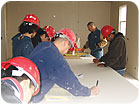
Indoor training session conducted by the Safety Director Charlie Vasconez.
Oftentimes, small contractors become overwhelmed at the thought of developing a safety program but this should not be the case. The goal of this article is to give the small contractor several useful and easy-to-implement tools that should help take the mystery out of developing a genuine safety program to protect your employees, without the benefit of employing a full-time safety professional. A word of caution: Choosing not to have a safety program places your employees and company at great risk.
The first and most fundamental thing you need to do is to demonstrate top management commitment to your entire workforce regarding the concept of job-site safety. You should start by calling a special meeting specifically for communicating this message to your key field supervisors. Be prepared for some complaining but don't be worried as this is a natural reaction to your "cultural evolution." If you do not already have one, consider developing a company mission statement that lists safety as one of your organization's core values.
Once you establish management's commitment to safety, you must work hard to maintain and strengthen that commitment. Try the practice of opening conversations with a safety-related topic with your workforce, your project management/estimating staff, vendors, etc. Periodically, conduct safety inspections and audits. Ride individually with your supervisors, visiting job sites with the purpose of talking in-depth with them about safety. Occasionally attend job-site safety meetings. Celebrate safety milestones by hosting a job-site lunch. The list could go on but you get the idea.
Along with top management commitment to safety, you must also be willing to hold your field supervisors accountable to actively participate in and wholeheartedly support the safety program. Supervisory accountability is also a fundamental cornerstone of a viable program. You will need to decide if you can truly hold your best field supervisors accountable if they do not lend support not only in the short term but in the long term, as well. Letting go of a supervisor who consistently meets deadlines yet fails to uphold safety practices in the field may be a hard choice to make but it can be essential in controlling your firm's exposures to liabilities.
Documentation
Building a defensible safety program requires that you develop essential safety-related documentation. The first part of this is to develop a basic new employee safety orientation program. It is extremely important that you communicate basic company policies/procedures/rules to your new employees, which are specific to your organization, before they set foot on your job sites. You should also communicate applicable regulatory requirements (OSHA, EPA, etc.) to them before they work. Make certain that these employees understand that compliance with your entire new employee orientation is a condition of employment that requires their signature. In other words, if one does not like all those "constraints," then he or she will need to find other employment.Basic items you may want to include in your orientation program are:
- Fundamental company philosophies
- Consequences of falsifying information
- Guidelines for using and inspecting company-specific tools, equipment, machinery, vehicles, etc.
- Using company tools, equipment, etc., for personal use
- Using personal tools on your job sites
- Using other contractors' tools, equipment, etc.
- Allowing other contractors to use your tools, equipment, etc.
- Helping other contractors' employees perform their tasks
- Recognizing and reporting job-site hazards/inspection procedures
- Workplace violence, harassment and discrimination
- Drugs and alcohol
- Lock-out/tag-out procedures
- HAZCOM; health-related exposures; respiratory protection guidelines
- Medical; first aid; emergency; crisis programs/facilities/procedures
- Workplace injury reporting guidelines
- Light duty policy
- Disciplinary guidelines
- Tardiness/absence reporting requirements
- Safety meeting/training guidelines
- Applicable OSHA regulations: personal protective equipment, scaffold, ladder, fall protection, electrical, fire protection, confined spaces, trench safety, heavy equipment safety, etc.
- Machinery/vehicle safety requirements
- Manual lifting, moving and carrying
- Safety and health danger/warning/caution signage
- What to do with damaged, worn-out, unsafe tools, equipment, etc.
- Customer-specific safety requirements
(Note: The recommendation is that a supervisor, not an office administrator, conducts your new employee safety orientations. The supervisor is in the best position to communicate expected safe work practices and to monitor compliance.)
If you do not already have one, it is recommended that you develop an employee safety handbook/manual that elaborates, in writing, on some or all of the items listed above-and others as well. This need not be a complicated or intimidating task. You'll want to address not only job-site safety issues but also how you are going to administer your safety program. If you are not able or willing to tackle this project, check with your insurance broker, insurance carrier or perhaps a nearby college or university. Doing a Google search by typing in "sample safety manual" will reveal numerous potentially helpful Web sites. Some safety program administration guideline recommendations are the following:
- Is management responsible for the safety department, superintendents, foremen and/or employees?
- How will you handle an OSHA inspection?
- How will you handle a job site accident, injury, emergency or crisis?
- How will you pre-plan for new jobs?
- What routine and/or ongoing training will be conducted? For whom?
- What forms will be available? (accident investigation; general liability; incident; vehicle crash; property loss or damage; sign-in sheets; inspection reports and checklists; etc.)
- Subcontractor and vendor safety requirements
- Indemnification agreement
- Written HAZCOM program
- Written respiratory protection program
It is highly recommended that you enforce applicable safety rules consistently by implementing progressive disciplinary techniques, unless the violation is particularly serious (such as not using fall protection), in which case the recommendation is to implement zero tolerance techniques.
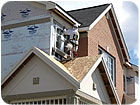
Painter doing the trim wearing a personal fall arrest system.
An example
To further elaborate, let's say an employee is not wearing his/her work boots. The first warning should be verbal but the next violation should result in the issuance of a written warning notice. On the other hand, if you observe an employee working 20 feet high without fall protection, immediately issue a written warning, suspend or terminate that person consistent with your company policy. Either way, these guidelines should be clearly explained to everyone during the new employee safety orientation program so that your employees know what the consequences will be if they commit a violation. It is also recommended that you consistently enforce all applicable rules, policies, regulations, etc.-even those that don't pertain to safety per se, such as unexcused tardiness or absence.Having a documented enforcement program as indicated above serves you two-fold: It will help build an "auto-deterrent" system within your company that will eventually motivate your employees to exhibit desired behaviors without constant supervisory or management involvement.
Should you ever need to "prove" to OSHA that you enforce your rules, policies, procedures, etc., nothing would look better than for you to pull out copies of written warning notices that have been issued over the last several months. If you simply tell OSHA, "Sure we enforce these types of things on our job sites but we've never written anyone up," then you likely will have increased exposure to OSHA citations and penalties. OSHA requires that you designate a competent person for each of your job sites and typically that person is the job site foreman.
On all construction sites, conditions change rapidly throughout the day. For example, a two-story residential home with a basement is nearing completion. The temporary stairway to the basement is slated for removal today to make way for the permanent one. The carpenters successfully removed the temporary stairs but since it was the end of the day, they simply closed the basement door and left the job site with the intent of completing the job the following day. The superintendent called this carpenter foreman at home that night, and informed him that he, along with his crew, would be going to another job the following day, so he would call in a new crew to finish the basement stairs.
When the new crew got there early in the morning, they went right inside, and a young carpenter apprentice opened the basement door. Unfortunately, he had no idea there was no stairway, so he plummeted down below, striking his head on the concrete. He was eventually evacuated by helicopter and was taken to a trauma center.
Two important lessons can be learned here. The first is for you and the supervisors to take the word "prompt" seriously. During each day, when recognized hazards present themselves at your job sites, your competent persons need to take prompt corrective actions to prevent potential injury or death. The second lesson to be learned is that this accident was entirely preventable had the CP of the replacement crew taken the time to communicate job site specific hazards to his employees.
An effective method to routinely communicate job-site specific hazards/information is to require your competent person(s) to conduct a daily huddle at all of your job sites. Attendance at the daily huddle should be mandatory for all employees. The daily huddle is a fun and interactive way for your CP to ensure that his employees become fully aware of the potential hazards they may face each day out on the job site. Typically, a daily huddle should take no more than five minutes, and should involve a discussion of the CP's plan for the day. Employees should be encouraged to provide feedback and to contribute ideas on how to improve not only safety but cost management, productivity and quality as well. If done diligently, the daily huddle will greatly and permanently improve overall job site communication between your workforce and supervision.
Routine training
Another component of an effective safety program is a method of providing routine safety information/training to your employees. Perhaps the easiest way to accomplish this is to implement mandatory weekly toolbox talks/weekly safety meetings. Typically, these safety talks/meetings are conducted by a CP. If you are not familiar with these safety talks/meetings, again there are numerous Web sites for you to hit and perhaps subscribe to an inexpensive service that will provide this information to you.By way of suggestion, listed below are several criteria that will help ensure the competent person has successful delivery of his/her safety talks/meetings:
- Provide the safety talks/meetings well in advance so that the CP can read the material in advance and pre-plan for the actual delivery of the information to the crew.
- Verify attendance and insist on punctuality.
- Start the safety talk/meeting promptly.
- Maintain control of the talk/meeting. Do not allow horseplay or other interference.
- Interact with the crew and ask specific crewmembers by name to explain how they feel about a particular issue.
- Improvise during the talk/meeting. Pay close attention to the crewmembers and pick up on any "vibes" that might prompt the telling of a personal story for example.
- Always provide a job-specific tie-in to the safety talk/meeting.
- At the end, ask for questions/recommendations but only for the topics just discussed. Do not allow "gab sessions" on other topics.
- Either yourself or through your CP, ensure that follow-up occurs for unresolved issues that are raised during these safety talks/meetings.
Before moving on to the last topic, it is recommended that you either substitute or add to an occasional toolbox talk/safety meeting by conducting more "formal" safety training. Again, nothing fancy or complicated here but select a handful of the largest exposures specific to your type of work and provide short classes on the topics throughout the year. For example, if you use a lot of ladders, conduct portable ladder safety training, complete with a demonstration by a competent or qualified person. Or perhaps your employees use rolling scaffolds or personal fall arrest equipment on your job sites. It would also be a good idea then to occasionally conduct rolling scaffold safety training and fall protection safety training for your workforce.
The last component of a basic safety program is to provide a means to formally and routinely inspect your job sites for unsafe employee behaviors and unsafe job site conditions. It is therefore recommended that you routinely perform documented "self-inspections" on your job sites, always making sure to note the corrective actions taken to mitigate the observed hazard, condition, or violation. It is recommended that you develop a customized, simple safety inspection checklist that lists the hazards and exposures that are most likely to be encountered under your particular scope of work. There's no need to have a trench excavation inspection section if you are a wall or ceiling contractor.
In conclusion, the author believes that if you implement the ideas listed in this article, that you will begin to develop a "safety culture" in your organization, a culture where working safely is simply a way of life. What you'll find also is that additional safety activity ideas will be generated by many of your "newly converted" employees and supervisors, which is the first sign that your new safety program is truly becoming self-sustaining. You'll also need to commit to the allocation of sufficient administrative resources to allow your newly developed safety program to survive and flourish. You'll need to make sure someone in the office keeps track of your safety activities and events, as well as your workers' compensation cases, so an experienced administrative assistant will be a huge plus for your organization.
If you read this article, please circle number 340.
Sidebar: Components of a Defensible Construction Safety Program
- Top Management Commitment
- Supervisory Accountability
- Safety Orientation Program
- Safety Manual or Safety Handbook
- Written Disciplinary Program
- Routine Job site Hazard Communication
- Weekly Safety Meetings
- Documented Job site Self-Inspections
Looking for a reprint of this article?
From high-res PDFs to custom plaques, order your copy today!





