All Things Gypsum: It's 18 and We Like It
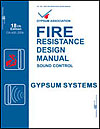
Every three years the Gypsum Association publishes a new edition of its flagship publication, "GA-600, Fire Resistance Design Manual (FRDM)," and this year we are rolling out the 2006 (18th) edition. This publication, first produced in 1938 as "The Fire Resistance of Gypsum Plaster," has evolved from a text-only description of a few fire-resistance-rated designs, which primarily featured gypsum plaster systems, into a fully illustrated, code-referenced document containing 379 different designs, 41 of which are new, and all of which feature at least one gypsum panel product or one plaster system of some type.
Each revision of the FRDM requires a vigorous process of reviewing existing designs and evaluating newly submitted designs. Existing designs are carefully evaluated and systems containing products no longer available are deemed obsolete and are withdrawn. This procedure requires that association staff work closely with member company technical committee members, going essentially page-by-page, paragraph-by-paragraph, and in some cases line-by-line, through several drafts of the manual to ensure that the information contained in the final draft is accurate.
Several editions back, a protocol was established for revising the FRDM every three years. A first review of the current manual by the association's staff and technical committee occurs during the Association's spring meeting the year prior to the publication of the next edition. A second review occurs during the subsequent fall meeting-all new designs must have been submitted to the association staff 30 days prior to the fall meeting to be considered for the next edition. The final review of the new edition by the GA's technical committee occurs during the spring meeting immediately prior to the publication of the manual.
CRITERIA
Each submitted system must meet several criteria in order to be considered for inclusion in the FRDM. A submitted system must contain one or more components that are composed essentially of gypsum. Each system must demonstrate that it has passed a full-scale fire test in accordance with specific fire test criteria, such as ASTM E119, Method for Fire Tests of Building Construction and materials or a code-recognized equivalent, or demonstrate laboratory certified equivalency. If a sound rating (either STC, IIC or FSTC) is included, it must also meet specific sound testing criteria, such as ASTM E90, Method for Laboratory Measurement of Airborne Sound Insulation in Buildings, or a code-recognized equivalent.All submissions are evaluated to determine whether the gypsum-based products contained in the submission are generic or proprietary materials and whether the illustrated system should be designated as generic or proprietary. Generic systems are those in which all components used to build the system are made by at least two producers and are interchangeable without affecting the various test results. Proprietary systems must meet one of several conditions: a U.S. or Canadian patent is in effect concerning one or more of a system's components or its use; no nationally recognized product standard exists that would enable a comparison and substitution of a similar product; or one or more of the principle components has only one producer.
Test reports of submitted systems are reviewed and evaluated by association staff and the member company technical committee members. If the technical committee finds that the submitted test results are inaccurate or insufficient, the sponsor of the submission will be notified of the committee's findings and its reasons for rejecting the submission.
This process has resulted in creating a reference manual that has been recognized by several national, regional, and local building codes over the years. Today the FRDM is a standard tool used regularly by design professionals and code officials, and one that we constantly use ourselves at the association.
COMMON QUESTIONS
Our technical helpline steadily fields calls from design professionals, code officials, and contractors about fire-rated construction, the answers for which are almost invariably found in the FRDM. And though many of those questions focus on the particulars of a specific published design, more often than not such queries are addressed in the explanatory sections found in the front of the manual. Three of the explanatory sections of the FDRM-General Explanatory Notes, Requirements for Fire Protection, and Sound Control-contain a wealth of information useful to almost anyone interested in fire-resistance or sound-rated construction.The questions most frequently posed to our technical support staff are answered in the general explanatory notes. Here is just a sampling of the information requested daily that is found in this section of the FRDM:
"Screws meeting ASTM C 1002 shall be permitted to be substituted for the prescribed nails, one for one, when the length and the head diameter of the screws equal or exceed those of the nails specified in the tested system and the screw spacing does not exceed the spacing specified for the nails in the tested system." [Note 4]
"Unless otherwise specified, the face layers of all systems, except those with predecorated or metal covered surfaces, shall have joints taped (minimum Level 1 as specified in "GA-214, Recommended Levels of Gypsum Board Finish") and fastener heads treated. Base layers in multi-layer systems shall not be required to have joints taped." [Note 6]
"When a fire-resistance rated partition extends above the ceiling, the gypsum board joints occurring above the ceiling need not be taped and fasteners need not be covered when all of the following conditions are met: (a) The ceiling is part of a fire-resistance rated floor-ceiling or roof-ceiling system; (b) All vertical joints occur over framing members; (c) Horizontal joints are either staggered 24 inches o.c. on opposite sides of the partition, or are covered with strips of gypsum board not less than 6 inches wide; or the partition is a two-ply system with joints staggered 16 inches or 24 inches o.c.; and (d) the partition is not part of a smoke or sound control system. Where joint treatment is discontinued at or just above the ceiling line, the vertical joint shall be cross taped at this location to reduce the possibility of joint cracking." [Note 7]
Obviously, this material is a bit stiff and not the kind of information one would expect to find in a slick promotional brochure, but these are three of the 22 notes found in the general explanatory notes section of the FRDM, all of which answer routine questions that arise in the construction of fire-resistance and sound-rated construction. Getting familiar with this manual will go a long way toward understanding the concepts used to create fire-resistant and sound-attenuating gypsum-based building systems.
To further make the information in the FRDM more accessible to its users, we are in the final stages of producing an internet-accessed program that will familiarize viewers with the several sections of the manual, show them how to quickly find the relevant material, and allow them to earn AIA continuing education units.
For more than 75 years, the Gypsum Association has sought to provide the design and code communities with information that enables them to create safer, more comfortable environs, and we're proud that "GA-600, Fire Resistance Design Manual," is one of the main vehicles for imparting that information.
If you read this article, please circle number 371.
Looking for a reprint of this article?
From high-res PDFs to custom plaques, order your copy today!