Finish Line: EPS for EIFS
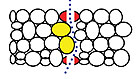
Red beads ARE well-fused, while yellow ones are NOT. The dotted blue line is the 'break' between EPS pieces.
Most EIFS used in North America employ expanded polystyrene foam as the insulation material. Also known as EPS and bead board, EPS is the stuff that white foam coffee cups are made of, as well as lots of other things, such as those white, disposable coolers used for picnics.
In construction, EPS is used as wall and roof insulation, as well as the core in sandwich panels and numerous other uses. The EPS used in EIFS is not the normal EPS you buy at the Big Box home improvement stores. It has some different properties and you may not know that this special form of EPS has it own nationally recognized, written technical specification that you can refer to easily to make sure the EPS you get will work in an EIFS application.
The source of this new specification for EPS in EIFS is from the venerable ASTM. This organization develops standards, such as test methods and specifications, via a consensus process that is open to anyone with an interest. ASTM standards are thoroughly peer-reviewed during their development and are widely accepted by specifiers, designers, producers, contractors and regulatory authorities.
Enhanced specification
You may be aware that ASTM already has a general specification for EPS, called C578. This specification is general for EPS as a material type and covers various forms of EPS. The C578 specification breaks EPS into what it calls "Types," based primarily on density. C578 is not specific as to what the properties should be for a specific end-use of the EPS but rather gives the properties of certain common EPS densities. For instance, Type I EPS, the kind used in EIFS, is the lowest density type. Higher density types have their "Types" in C578 too, and are used to specify EPS for other end-uses, such as where weight bearing and strength are an issue (as on walk-on roofs or structural panels).For EIFS usage, C578 does not go quite far enough in describing all the properties needed, so a new ASTM specification, designated E2430, has been created that when used in conjunction with C578, describes the necessary properties of EPS for use in EIFS. In other words, E2430 could be thought of as an extension of C578.
The reason the new specification was written this way was to allow C578 to remain a generic, non-end-use specification for EPS. This makes modifying the EIFS EPS specification easier in the future and keeps C578 from getting too bulky (by not including all sorts of possible other EPS-use information). The new specification can be downloaded from ASTM's Web site at www.astm.org.
Fear not that this new specification will change the EPS used in EIFS. This new specification has been around for a few years and is, in a nutshell, a standardized version of the specification for EPS that the EIFS industry had been promoting for years on its own. By now, being able to call for the EPS for EIFS by simply referring to a single ASTM standard has made the specifying process easier. You may also recall that this special type of EPS for use in EIFS has also been historically called "Wall Grade EPS" and "EIFS Grade EPS."
What's in E2430?
E2430 takes off where C578 stops-it adds on to C578. There are a number of specific requirements for EPS used in EIFS and E2430 includes them.Density: The E2430 specification calls for using, as a base EPS product, ASTM C578 Type I EPS but goes further. It gives the range of density that works with EIFS. Obviously, the lower the density and the less foam that is in the insulation board, the lower the cost. The range required ensures the foam will not be too light and thus weak.
A word of caution: E2430 is for the nominal 1.0 pcf density used in the vast majority of EIFS. However, this is not to say that some EIFS producers cannot use, for instance, a higher density for their own purposes. An example might be for use in making foam shapes, where higher impact resistance would be afforded by using denser foam. In the case of the higher density EPS, it could be specified by simply saying, "The insulation shall meet ASTM E2430 except that the density shall be whatever pcf."
Dimensional stability: EPS used in EIFS needs to be flat in order for the wall to look good and for the foam to be attached easily to the substrate. This is ensured by requiring that the foam be aged, so that it remains flat after being cut into individual boards. In other words, if you cut a block of EPS into individual boards right after it comes out of the mold, it may not stay flat. So, let the foam rest a while and then cut it.
Cutting tolerances: EPS boards are applied in a running bond pattern and need to fit together closely, so that no gaps occur between the edges of the boards. In order to do so, the board must be cut into sheet sizes that are quite accurate. This includes length, width, squareness and thickness.
Fusion: EPS, when used in EIFS, is stressed by the movement of the lamina, as the surface of the EIFS heats and cools. Thus, the foam must be strong enough internally to resist these forces without splitting. A way to measure this property is to check how well fused-together the small spheres of EPS are bonded to each other (EPS is made by squeezing together small spheres of styrene foam under heat and pressure to form a "fused" block of foam). The way this degree of fusion is determined is by a test, naturally called a "fusion test."
The test is done by snapping a piece of board in half and seeing (counting) what percentage of the EPS beads come loose from each other vs. how many split within themselves. What you are looking for is the majority of the beads to split internally. You've probably seen examples of poorly fused pieces of EPS, where the beads are loose and it takes little force to dislodge. This test is a guard against that poor grade of foam. You can do this test by simply breaking an EPS board and looking at the broken edge. The property of having decent fusion also is an issue in the sense that a well-fused EPS board absorbs less moisture and thus is a better insulator and resists water penetration.
Packaging and Marking: Because EIFS products are code-approved on a specific EIFS product basis, the EPS needs to be packaged in a way that indicates what EIFS product it is to be used with. This is quite different than buying generic pieces of EPS at a lumberyard where the end-use is unknown. This marking includes what company makes the EIFS system, who made the EPS foam, quality control tracking information and so on. This packaging information is often done on the outside of the containers (polybags or cardboard sleeves) that the EPS is shipped in, simply by printing the information on the container or including a leaflet that has the required information.
Along the same line as packaging, EPS for EIFS is required by code to have one piece per package identified with a stamp that gives its source and other information. This is so that when on-site and on the wall, it is possible to identify the foam's source.
When someone tells you that they get the foam for the EIFS they are installing at a lumberyard, ask if it is "EIFS Grade." The specialized type of EPS used in EIFS is usually available only from molders who have arrangements with various EIFS producers to make the EPS in the way described above. If you do try to use generic foam from a DIY store, you may find that it is not flat, doesn't fit together on the wall and simply doesn't work. That's why you pay a bit more for the EIFS Grade EPS.
So when you run into this odd new EPS spec in your dealings with EIFS-ASTM E2430-remember this article and what the spec is about. It's a good thing and part of EIFS's maturation as a product type by standardizing one of the many components of EIFS, such as the all-important foam insulation.
If you read this article, please circle number 177.
Links
Looking for a reprint of this article?
From high-res PDFs to custom plaques, order your copy today!