The Finish Line: Water Resistive Barrier Coatings
The code requirements for the use of EIFS over moisture-sensitive substrates like wood include adding the capability for the EIFS to drain. This added capability results in an EIFS product type that is commonly known as EIFS with Drainage, indicating the drainage capability has been added on to a conventional (barrier) EIFS.
Technically, the EIFS itself does not drain. It does not need to since it is laminated and has no place to store water. So, with EIFS with Drainage, there is a drainage cavity or plane between the EIFS and the substrate. The drainage plane or cavity can be created by making vertical grooves in the foam, or by using some form of space, or even by using a thick layer of EIFS attachment adhesive. The substrate is covered by some form of material that protects both it and the supporting wood stud framing. This protective layer is called the Water Resistive Barrier, or WRB. WRBs can take the form of papers (like building paper), dry films (such as Tyvek) and wet-applied coatings. The coating type of WRB is what this month’s column is about.
With paper and dry film types of WRBs, you can’t use an EIFS attachment adhesive because the WRB is not structural; it’s just hanging there, like a shower curtain. That’s fine and it will serve the WRB’s function, but you can’t bond the EIFS to it because it is nonstructural.
Although it is possible to mechanically fasten the EIFS foam through the WRB coating, this creates holes in the coating, defeating the water penetration resistance to some extent. The big advantage of WRB coatings over papers and dry films is the EIFS can be bonded to the WRB with an EIFS adhesive, thus getting around the issue of putting holes in WRB. It also retains the advantage of using an adhesive in lieu of mechanical fasteners in terms of:
• Stronger attachment of the EIFS to the wall.
• The ability to line up the outer surface of the foam by compressing the adhesive.
• The ability to attach to substrates that cannot hold onto screws (such as gypsum-based boards).
• Eliminating ghosting of the fastener washers.
From a business perspective, the EIFS producer and contractor also get to sell more product and labor, as the WRB coating is usually an add-on to the EIFS scope of work. WRB coating comes in a number of styles: cementitious, noncementitious and with and without internal reinforcement (fibers). Many are quite similar to the base coat adhesives used in the EIFS lamina, and most are applied with a trowel.
Because the WRB may be left exposed to the weather for an extended period prior to the EIFS being installed, the codes also require that the WRB have basic resistance to the elements, such as not being degraded by sunlight, freezing-thawing, and so on.
The structural characteristics of a WRB coating are important too. Obviously, the EIFS attachment adhesive must bond well to the coating, and the coating itself must adhere well to the substrate. The real key, though, is at the joint between the sheathing boards. As the wall moves due to temperature, moisture and structural loading (due to wind, etc.) the substrate sheathing joints move slightly. This movement has the potential for cracking the WRB coating. Therefore, the joints are often reinforced with tape or mesh to preclude the cracking. Cracks in the WRB coating would clearly defeat its purpose, and the ability to resist cracking is tested by racking (exerting force in the plane of the wall) large wall assemblies and then inspecting the WRB for damage. This crack-resisting behavior is one of the differences between WRB coatings and paper and film WRBs, as the paper and dry film types are not continuous layers.
Another difference between paper and film WRBs and WRB coatings is that papers and dry films have overlapping joints that allow moisture to pass through them. WRB coatings are continuous and thus the only path for water vapor through them is by diffusion, also known as water vapor permeability. Thus, determining the water vapor transmission characteristics of coating-type WRBs is necessary to make sure the flow of water vapor through the wall does not adversely affect the wall, i.e., creating a vapor barrier in the wrong part of the wall.
WRB coating-like materials have been used in EIFS for more than a decade, which means their use pre-dates the code requirements for EIFS with Drainage. For example, some designers and contractors have applied EIFS base coats over various sheathings to protect them, and then applied a conventional barrier EIFS over it. Such an EIFS wall assembly, I suppose, could be called EIFS with Some Sort of Drainage, as conventional barrier EIFS, if installed using thick vertical beads, does drain somewhat.
WRB coatings alone do not constitute the entire WRB “system”. The WRB is used in the blank “field” of the wall, and to be effective, the perimeter of the WRB needs to be integrated with openings, flashings, sealing tape and caulking joints. This integration or “marrying” can sometimes get a bit complex in designing the construction details, and it can be fussy to install, but it is essential if the EIFS drainage capability is to be effective. Clearly, whatever peel-and-stick tapes or liquid barriers that marry the WRB to the opening must also be compatible, i.e., adhere to each other well, and work as a system.
WRB coatings are a bit more complicated than papers and films when used with EIFS prefabricated panels and at through-the-wall expansion joints, such as at the floor lines in houses. Unlike papers and films, which come in sheets and are flexible and can bridge the panel joints, WRB coatings can’t do this. The way around this is to use a flexible paper, film or tape, or even a bellows-type flashing, to make a continuous splice in the WRB from one panel to the other.
Although the codes only require EIFS with Drainage on moisture-sensitive supporting substrate systems (basically, wood-frame buildings), there is a trend to use EIFS with Drainage on commercial buildings. Some designers and EIFS producers like this approach as it gives an extra measure of protection and peace of mind, without adding a fortune to the final installed cost.
For the future, more sophisticated WRB coatings are in the works. I have been in contact with academic research people who are trying to develop “smart” WRB coatings. These coatings would sense the presence of moisture and would change their properties regarding water vapor permeability depending on the adjacent moisture level. This would help, for instance, a wall to dry out when it was wet, but the rest of the time the coating would be “more waterproof” – sort of like a coatings version of a “mood ring.” There’s also work going on to make WRBs that are partially permeable. This is somewhat like the Gore-Tex clothing fabric (like the Internet, also not invented by Al Gore), which sheds liquid water but lets water vapor through easily, thus aiding in keeping the wall dry, and avoiding moisture related problems like rot, mold and mildew.
Technically, the EIFS itself does not drain. It does not need to since it is laminated and has no place to store water. So, with EIFS with Drainage, there is a drainage cavity or plane between the EIFS and the substrate. The drainage plane or cavity can be created by making vertical grooves in the foam, or by using some form of space, or even by using a thick layer of EIFS attachment adhesive. The substrate is covered by some form of material that protects both it and the supporting wood stud framing. This protective layer is called the Water Resistive Barrier, or WRB. WRBs can take the form of papers (like building paper), dry films (such as Tyvek) and wet-applied coatings. The coating type of WRB is what this month’s column is about.
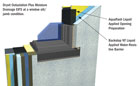
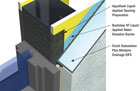
Dryvit Outsulation Plus Moisture Drainage EIFS at a storefront window jamb condition.
COATING OF MANY COLORS
WRB coatings can take the form of spray-, brush-, roller- or trowel-applied materials. EIFS producers make these types of coatings, as do companies that are not EIFS producers. Most of the time, the coating used is one that is made by the EIFS producer. Thus, it is known to be compatible with the rest of the EIFS, and is purchased along with the rest of the EIFS’ components.With paper and dry film types of WRBs, you can’t use an EIFS attachment adhesive because the WRB is not structural; it’s just hanging there, like a shower curtain. That’s fine and it will serve the WRB’s function, but you can’t bond the EIFS to it because it is nonstructural.
Although it is possible to mechanically fasten the EIFS foam through the WRB coating, this creates holes in the coating, defeating the water penetration resistance to some extent. The big advantage of WRB coatings over papers and dry films is the EIFS can be bonded to the WRB with an EIFS adhesive, thus getting around the issue of putting holes in WRB. It also retains the advantage of using an adhesive in lieu of mechanical fasteners in terms of:
• Stronger attachment of the EIFS to the wall.
• The ability to line up the outer surface of the foam by compressing the adhesive.
• The ability to attach to substrates that cannot hold onto screws (such as gypsum-based boards).
• Eliminating ghosting of the fastener washers.
From a business perspective, the EIFS producer and contractor also get to sell more product and labor, as the WRB coating is usually an add-on to the EIFS scope of work. WRB coating comes in a number of styles: cementitious, noncementitious and with and without internal reinforcement (fibers). Many are quite similar to the base coat adhesives used in the EIFS lamina, and most are applied with a trowel.
Dryvit Outsulation Plus Moisture Drainage EIFS at a storefront window jamb condition.
RAIN, RAIN GO AWAY
Clearly the WRB coating must be a water-shedding material; however, it is not subjected to water pressure, such as from driving rain, and therefore water is not being “forced” through the WRB. Thus, water that is running down the WRB, say, from a failed sealant joint up above, merely needs to run down the surface (not get absorbed into the surface or go through it), and then out of the wall via an opening at the bottom of the wall. To qualify as a proper WRB coating, the codes require that this water penetration resistive capability be verified.Because the WRB may be left exposed to the weather for an extended period prior to the EIFS being installed, the codes also require that the WRB have basic resistance to the elements, such as not being degraded by sunlight, freezing-thawing, and so on.
The structural characteristics of a WRB coating are important too. Obviously, the EIFS attachment adhesive must bond well to the coating, and the coating itself must adhere well to the substrate. The real key, though, is at the joint between the sheathing boards. As the wall moves due to temperature, moisture and structural loading (due to wind, etc.) the substrate sheathing joints move slightly. This movement has the potential for cracking the WRB coating. Therefore, the joints are often reinforced with tape or mesh to preclude the cracking. Cracks in the WRB coating would clearly defeat its purpose, and the ability to resist cracking is tested by racking (exerting force in the plane of the wall) large wall assemblies and then inspecting the WRB for damage. This crack-resisting behavior is one of the differences between WRB coatings and paper and film WRBs, as the paper and dry film types are not continuous layers.
Another difference between paper and film WRBs and WRB coatings is that papers and dry films have overlapping joints that allow moisture to pass through them. WRB coatings are continuous and thus the only path for water vapor through them is by diffusion, also known as water vapor permeability. Thus, determining the water vapor transmission characteristics of coating-type WRBs is necessary to make sure the flow of water vapor through the wall does not adversely affect the wall, i.e., creating a vapor barrier in the wrong part of the wall.
WRB coating-like materials have been used in EIFS for more than a decade, which means their use pre-dates the code requirements for EIFS with Drainage. For example, some designers and contractors have applied EIFS base coats over various sheathings to protect them, and then applied a conventional barrier EIFS over it. Such an EIFS wall assembly, I suppose, could be called EIFS with Some Sort of Drainage, as conventional barrier EIFS, if installed using thick vertical beads, does drain somewhat.
WRB coatings alone do not constitute the entire WRB “system”. The WRB is used in the blank “field” of the wall, and to be effective, the perimeter of the WRB needs to be integrated with openings, flashings, sealing tape and caulking joints. This integration or “marrying” can sometimes get a bit complex in designing the construction details, and it can be fussy to install, but it is essential if the EIFS drainage capability is to be effective. Clearly, whatever peel-and-stick tapes or liquid barriers that marry the WRB to the opening must also be compatible, i.e., adhere to each other well, and work as a system.
WRB coatings are a bit more complicated than papers and films when used with EIFS prefabricated panels and at through-the-wall expansion joints, such as at the floor lines in houses. Unlike papers and films, which come in sheets and are flexible and can bridge the panel joints, WRB coatings can’t do this. The way around this is to use a flexible paper, film or tape, or even a bellows-type flashing, to make a continuous splice in the WRB from one panel to the other.
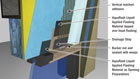
Dryvit Outsulation Plus Moisture Drainage EIFS at a storefront window head condition.
MORE CHANGES ON THE WAY
The development of standards for the properties of WRB coatings, and for the application of them, is under way now at ASTM and should be approved within the year. These standards will then be added to the ICC building codes, and used as the basis for acceptance of WRB coatings. Thus, in the future you will see a pail of WRB coating with a note that says something like “Meets ASTM blah-blah-blah for Water Resistive Barrier coating”.Although the codes only require EIFS with Drainage on moisture-sensitive supporting substrate systems (basically, wood-frame buildings), there is a trend to use EIFS with Drainage on commercial buildings. Some designers and EIFS producers like this approach as it gives an extra measure of protection and peace of mind, without adding a fortune to the final installed cost.
For the future, more sophisticated WRB coatings are in the works. I have been in contact with academic research people who are trying to develop “smart” WRB coatings. These coatings would sense the presence of moisture and would change their properties regarding water vapor permeability depending on the adjacent moisture level. This would help, for instance, a wall to dry out when it was wet, but the rest of the time the coating would be “more waterproof” – sort of like a coatings version of a “mood ring.” There’s also work going on to make WRBs that are partially permeable. This is somewhat like the Gore-Tex clothing fabric (like the Internet, also not invented by Al Gore), which sheds liquid water but lets water vapor through easily, thus aiding in keeping the wall dry, and avoiding moisture related problems like rot, mold and mildew.
Looking for a reprint of this article?
From high-res PDFs to custom plaques, order your copy today!





