Flash in a Dash
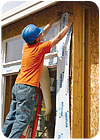
The nation’s leading builders have recognized the need for effective water management in new home construction. As a result, the use of flexible flashing to protect windows, doors and other through-wall penetrations has taken on an increasingly important role in water management strategies.
Flexible flashing products come in two distinct varieties: self-adhesive and mechanically attached. Since both have major advantages, it’s easy to choose to use a flexible flashing. Both types are designed to conform to inside and outside corners, arches and odd shapes, and create a water/weatherproof seal. However, deciding whether to use self-adhesive or mechanically attached flashing is another matter.
Popularity vs. Suitability
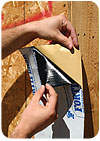
Self-adhesive flashings are a more recent innovation than their mechanically attached counterparts. One might think that since self-adhesive is newer, it is better for every application. The “just peel and stick” idea is very compelling, because it seems that it would be easier to install than a mechanically attached flashing product.Testing evidence shows that both systems work well when properly installed, under the right conditions. Before making a decision to use one or the other, there are a number of factors to consider. Most of these involve climate conditions, the substrate to which the flashing is attached, local code requirements, cost, and the skill level of the installer.
Self Adhesive Sensitivity
The performance of self-adhesive flashing varies with temperature. If the weather at the time of installation falls below 40 degrees F, the product may not stick to the substrate. It can also be sensitive to certain substrates and wet, uneven substrate surfaces can cause adhesion problems. Self-adhesive products must be applied to a clean, dry surface. Self-adhesive products must also be applied over a solid surface, without holes or gaps. While one could argue that all flashing should be installed over solid surfaces, few builders want to caulk and perfect their rough construction.The Cost Factor
Material cost is another factor. The least expensive self-adhesive products cost about 40 percent more than mechanically attached alternatives and the most expensive can cost nearly 10 times as much. Some manufacturers recommend applying a primer over certain substrates (e.g. concrete, masonry, OSB) with their products. So, the installer must apply the primer (to a clean, dry surface) and wait for it to cure. Then the installer must wait to apply the self-adhesive flashing on a dry day, when the temperature is conducive to proper bonding. Some manufacturers recommend using a mechanical roller during installation, rather than hand pressure.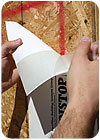
Advantages of Self-Adhesive Flashings
Self-adhesive flashings do have a number of clear advantages:• They provide better integration with the window flange.
• They eliminate the need for an additional bead of sealant on the outside flange.
• They are available in a wider choice of product widths, to better match the application.
• Due to their self-sealing properties, self-adhesive flashing can be a good fit for use on horizontal surfaces, like a recessed window sill.
• Since they require no fasteners, the use of self-adhesive products results in fewer penetrations and thus, (with proper adhesion) a better, more watertight seal.
• They are also designed to self-seal around fasteners that may penetrate the adhesive, to create a true waterproof membrane.
By contrast, mechanically attached flexible flashings are well-suited to vertical surfaces but not recommended for horizontal applications where water could pond.
Advantages of Non-Adhesive Flashings
• Low material cost and ease of installation make mechanically attached flashings a viable contender.• Mechanically attached flashing requires no special preparation of the substrate, which presents advantages in cold, dirty or wet conditions. Instead, non-stick flashings are simply stapled up – overcoming some of the sensitivities of self-adhesive.
• They are proven, familiar, and have a long, successful history of use.
• mechanically attached flashing typically is not susceptible to the same sealant compatibility issues that self-adhesive products can experience.
The fact is that both products work, and even the best products can fail if poorly installed.
Building Codes Offer Little Help
Building codes don’t shed any light on which flashing type a builder should specify.Section R703.8 (Flashing) of the 2003 International Residential Code (IRC) states, “Approved corrosion resistive flashing shall be provided in the exterior wall envelope in such a manner as to prevent entry of water into the wall cavity or penetration of water to the building structural framing components. The flashing shall extend to the surface of the exterior wall finish and shall be installed to prevent water from reentering the exterior wall envelope.”
Since codes offer little advice beyond, “flash in a weatherproof fashion,” some builders might forego flashing and choose to simply apply a bead of sealant in a window installation. Codes offer no advice on sequencing or size of flashing materials, and they don’t specify a minimum width of flashing. Since codes are not specific, most of our information comes from installation standards produced by ASTM and AAMA.
ASTM E-2112, a comprehensive window and door installation standard from the American Society for Testing and Materials, recommends using flexible flashing materials that are a minimum of nine inches wide and meet Test Method D -779 water resistance standards of 24-plus hours for paper-based products and 48-plus hours for polyethylene coated flashings.
The Residential & Light Commercial Window and Door Installation Training and Certification Manual, a program developed by American Architectural Manufacturers Association (AAMA) and transferred to InstallationMasters Institute in 2003, also recommends using flexible flashing material that is at least nine inches wide for new construction window and door installations.
Builders’ regional preferences for materials play a role, and region is also helpful in determining the right choice. Extremely hot or cold climates are less than optimal for self-adhesive flashing installations. In cold or frosty conditions, the adhesive may not stick at all. In addition, most of the adhesives used require some time to cure. The manufacturer’s technical assistance and installation instructions can be of great help here.
Both ASTM and AAMA indicate that adhesive flexible flashing should be used as part of a system, in conjunction with other types of flashing and sealants that are designed to work together. This system approach overcomes adhesion and waterproofing problems that can occur when incompatible materials are used. Both entities also recommend consulting the manufacturers of the flashing and fenestration products used to be advised of any requirements unique to their products.
The Impact of Jobsite Sequencing
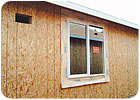
Job sequencing also plays a role in deciding which flashing to use and how it should be applied. In most geographic regions, there are a number of different subtrades involved in exterior wall construction. Thus, flashing needs to be coordinated with weather-resistive barrier, window and exterior cladding installation.Regardless of the preferred order of installation, flashing should always be shingle lapped to shed water. While there is some debate over the matter, the physics of drying within wall systems dictate that building paper and/or WRB must go under the sill flashing. In this case, fully adhesive flashings, applied before the WRB, can create problems when trying to integrate them with the WRB around a window or door. When using a fully adhesive flashing, which has adhesive across the full width of the material, leaving a portion of the release paper attached until after the WRB is installed can make the integration of the sill flashing easier.
Sealant Compatibility
The adhesives used on self-adhesive flashings can be sensitive and/or reactive to other building products with which they may have direct contact. Certain plasticizers, which are found in some sealants on the market, have been found to be incompatible with rubberized asphalt self-adhering flashings. Over time, rubberized asphalt can be softened and these incompatibilities among the various materials can interfere with the proper functioning of all materials and compromise the building envelope. To improve the chance for a successful flashing installation, a systems approach (advocated by both AAMA and ASTM) may be the best answer. Following manufacturer’s recommendations and using flashings, WRB and sealants that are designed to work together in combination with the substrates, will help eliminate potential compatibility problems.Conclusion
The choice between self-adhesive and mechanically attached flashing is not an easy one. It’s complicated by the many variables associated with compatibility of materials, climate, preparation, installation, regional preferences and so on. These factors increase the potential for failure and – since these variables are specific to each region and project – there are no hard and fast rules for product selection that will serve the builder in every situation. The only area of general agreement is that flashing must be part of the overall design and construction of modern wall systems.SIDEBAR: What is flexible flashing?
ASTM 3.2.54Flashing, n – sheet material that bridges and protects the joint (gap) between the window or door frame members and the adjacent construction for the purpose of preventing water penetration by draining water away from the window or door to the exterior.
AAMA 13.3.2
Flexible Flashing is typically a product consisting of two sheets of paper, reinforced with a water resistant material. Flexible flashing materials are typically applied to the fenestration product with sealant or attached to the rough framing/sheathing with staples prior to the fenestration product being sealed to the face of the flashing. Flexible flashing must be at least 9 inches wide when used in conjunction with window and door installations.
1. Paper Flashing typically consists of two sheets of paper laminated with asphalt and reinforced with fiberglass yarns.
2. Polyethylene Coated Flashing is polyethylene coated, laminated and reinforced with fiberglass.
3. Bitumen Flashing has a bitumen-type filler between two sheets of polyethylene and/or polypropylene.
Adhesive Flexible Flashing is typically a product on which one side has a self-adhering surface. It is applied over the window or door flange to seal it. There is no need for stapling or nailing, and most adhesive flashings adhere to wood, vinyl, aluminum, and other substrates.
1. Polyethylene Flashing/Adhesive Strips are polyethylene coated; laminated and reinforced. They have a three-inch adhesive strip to cover the window flange and provide additional sealing between the flashing and the flange/frame.
2. Bitumen Type Flashings typically have a rubberized bitumen base applied to a sheet of polyethylene or foil. Typically, a release sheet is pulled off with the bitumen side used as an adhesive and applied to the flange/frame.
SIDEBAR:case study
A National homebuilder, building 15,000 homes a year, was routinely using self-adhesive flashing for windows, doors and through-wall penetrations. But they were running into problems. Workers would apply flashing, and the next day the material was no longer adhered to the substrate. When the builder called the manufacturer’s technical support, they found that the self-adhesive material was being applied over OSB – the properties of which (resins, smoothness, etc.) vary greatly from manufacturer to manufacturer. An incompatibility of materials created an adhesion problem between the flashing and the OSB.As advised, this builder switched to mechanically attached flashing, and the problem was eliminated. In addition, this simple change saved a lot of money, time and trouble for this builder.
Partially adhesive flashings (which have an adhesive strip of about three inches wide, down one side) make for easy sequencing. Since only three inches of the flashing surface adheres to the substrate, the non-adhesive part remains loose, for simple integration with the WRB. This is true whether the flashing is to be tucked under or lapped over the WRB.
Looking for a reprint of this article?
From high-res PDFs to custom plaques, order your copy today!





