The Green Thumb: Harvesting Underwater Timber

With the coming of the modern Industrial Age, the need to generate vast amounts of electricity called for hydroelectric resources to be exploited wherever and whenever possible. Beginning in the late 19th century worldwide, more than 45,000 dams over 330 feet tall have been built to provide electricity, but not always with positive results for the environment.
When many of these dams were built, particularly those in the early 20th century, old-growth forests were not considered an endangered resource as they are today. Thus, there was no incentive to harvest the vast stands of timber via clear-cutting due to flooding when the dams became operational. At that time, lumber was considered an unlimited resource. Today, old-growth trees are an endangered resource, considering most have been eliminated and it takes about 60 years for a tree to reach maturity. With the cause of global warming due, primarily, to greenhouse gas emissions now acknowledged and accepted by experts, governments and the public at large, the need to preserve trees as a means of carbon sequestration (i.e., trees absorb carbon dioxide and release oxygen) was never more apparent and important.
SUBMERGED IN TIME
Like ancient Pompeii, which was buried under a mountain of volcanic ash when Mount Vesuvius erupted in 79 AD, thus preserving it like a snapshot in time, flooded forests were preserved in a like manner. In their anaerobic (oxygen-deprived) environment, these submerged forests remain in excellent condition because the submerged, waterlogged timber is not exposed to oxygen or wood-decaying fungi as are land-based forests. Submerged timber typically has many superior qualities compared to much of the living timber presently available. Species of old-growth forests include Douglas Fir, Western White Pine, Lodgepole Pine, Hemlock, Cedar and others.An area estimated to be twice the size of the state of New Jersey containing more than 300 million trees–the equivalent of over 100 billion board feet of timber-is available to be harvested worldwide.
Underwater logging is not new and has been going on for quite some time with mixed results. Typically, a diver with a pneumatic chainsaw cuts the tree and then it is brought to the surface. This method is both dangerous and inefficient. Also, about 80 percent of submerged forests are at depths too great for divers to reach. Another common practice is to pull up a tree by its root-ball. This method is inefficient and disturbs the sediment of the reservoir bottom, causing environmental damage/concerns.
Enter Triton Logging Inc., with its “Sawfish” tree-cutting submarine. Based on Vancouver Island in British Columbia, Triton holds long-term timber harvesting licenses in British Columbia, where there is estimated to be about five billion board feet of merchantable, submerged standing timber. This represents about 5 percent of the world’s overall inventory of more than 100 billion board feet.
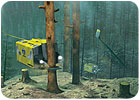
The size of a mini-van, Sawfish is considered to be the world’s only deep-water logging machine capable of reaching depths up to 700 feet. Slightly buoyant, it weighs 7,000 pounds. With eight on-board video cameras as well as sonar, Sawfish is fully remote and is powered by an electric motor tethered to a “mother barge” where a human operator remotely “flies” it.
With the ability to harvest over 100 trees per shift (or one tree every five minutes), it is the most efficient method of harvesting submerged timber in the world. In 2005, Triton harvested 575,000 board feet of timber operating just three Sawfish on two reservoirs in British Columbia. In 2006, even greater productivity was realized.
The machine carries up to 50 reusable, inflatable airbags that are used to float trees to the surface, one bag per tree. Sawfish needs to surface only to replenish its supply of airbags. After the airbag is attached to the target tree and inflated, Sawfish hovers above the reservoir’s floor, grapples the tree trunk with its hydraulic arms and cuts the tree with its 55-inch chainsaw. The tree then floats to the surface where it is recovered and Sawfish then moves on to its next tree.
COST-EFFECTIVE TECHNOLOGY
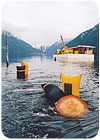
Triton’s Sawfish technology is very cost-effective. In most cases, regulatory agencies are very cooperative and often pay Triton to remove trees posing a hazard to recreational boaters. Unlike land-based logging, underwater harvesting does not require the construction of access roads nor other infrastructure typically required for land-based logging. Slash piles are eliminated and there are no fires or pests to control. Dangers associated with heavy machinery working on steep slopes is eliminated.Triton’s Sawfish system has been certified by the Rainforest Alliance’s Smartwood Rediscovered Wood Program. In 2006, the prestigious GreenSpec Directory named it one of the “Top 10” green building developments of the year–no small achievement. The Canadian Department of Fisheries and Oceans has determined Sawfish to be the most environmentally friendly way of harvesting submerged trees. Triton already uses biodegradable vegetable-based hydraulic fluids for Sawfish and is researching the use of renewable power for its harvesting operation.
Though waterlogged trees take longer to dry than land-based trees; thus having an environmental impact since it requires more time/energy to kiln-dry, Triton is addressing this problem by using the wood waste it generates from its operations in its milling and kiln operations. Even so, waterlogged trees dry evenly and mill very well. They can be dried in the open air as well but, of course, this takes much more time than kiln drying.
Triton’s goal is to create a reliable, abundant supply of recovered wood for use as dimensional lumber, poles, flooring, paneling, furniture and laminated beams, all at prices, grades and a quality level comparable to other recovered wood and/or land-based timber products.
A good example of the use of Triton’s recovered wood can be found at Dockside Green, a prestigious development project on Vancouver Island. As of 2006, Triton was harvesting three reservoirs in Canada and its operations were focused on British Columbia, but the company has plans to expand into the United States and around the world in the near future. Information on Triton and Sawfish technology is at: www.tritonlogging.com.
Looking for a reprint of this article?
From high-res PDFs to custom plaques, order your copy today!


