Straight Green: Alternative VOC Calculation for LEED
It’s the eleventh hour and all the documentation has been gathered and is ready to be submitted to the USGBC for that LEED rating that the entire project team has worked long and hard toward. But what is this? One of the coatings used far exceeds the allowable VOC limit established in the low emitting materials credit for paints and coatings? Panic sets in with the realization that an entire point may be lost due to a simple mistake.
It’s the eleventh hour and all the documentation has been gathered and is ready to be submitted to the USGBC for that LEED rating that the entire project team has worked long and hard toward.
But what is this? One of the coatings used far exceeds the allowable VOC limit established in the low emitting materials credit for paints and coatings? Panic sets in with the realization that an entire point may be lost due to a simple mistake. Panic can quickly turn to hysteria if losing that one point means the difference between getting that highly-sought-after gold rating and lowly silver.
The low-emitting materials credits in the USGBC LEED Indoor Environmental Quality (EQ) section are pursued by most projects, due to their relative ease and simplicity in achievement. These points can be very challenging, however, when products that do not meet the allowable range of performance criteria are required to be used. EQ Credit 4.2 Paints and Coatings requires that interior paints meet the VOC content prescribed in GreenSeal Standard GS11. The standard requires that flat coatings have a maximum VOC content of 50 grams per liter (g/l); non-flat coatings, 150 g/l. Coating systems that comply with the criteria are widely available for many paint and coating systems, but there are exceptions. Specialty coatings–including some primers, epoxies, urethanes, and metallic coatings–often exceed the maximum allowable VOC content. Teams that find themselves faced with this challenge do not necessarily have to abandon the point, however, because the LEED Reference Guide offers an alternative budget calculation path that allows some of the coating systems to be more than the prescribed VOC amounts, if an overall budget calculation shows that the total VOCs for all interior coating systems does not exceed the maximum allowable limit.
• Total square footage of area(s) to be painted.
• VOC content of specified coating systems.
• Coverage rates of coatings specified (from manufacturer’s data sheet).
• Number of coats specified (primer and topcoats).
• Sheen of each coating based on ASTM D523 – Standard Test Method for Specular Gloss.
The sheen of each design case coating system is also required to be entered. The GreenSeal standard requires that the sheen be reported based on a 60-degree geometry for all testing. You will find that product data sheets report sheen both for 60 and 85-degree geometries, based on the type of coating being tested, which is consistent with the ASTM standard requirements. The GreenSeal requirement for sheen seems to be in error. For values reported as 85-degree geometries on product data sheets, it is advisable to use the South Coast Air Quality Management District rules to determine equivalency between values reported using 85-degree geometry versus the GreenSeal required 60 degrees, as follows:
Flat: <15@85° or <5@60°
Non-Flat: >15@85°, or >5@60°
For the baseline VOC content, values are automatically entered depending on the type of sheen selected for the design case. The calculator assigns 150 g/l VOC content for all primers as a default in accordance with a USGBC Errata sheet issued in 2006 that designates all primers, for purposes of this calculation, as non-flat coatings.
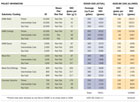
In the example provided (below), coating systems for gypsum board, wood trim, metal trim and railings, and concrete columns are included. The VOC content for the flat coating for the ceilings, the epoxy topcoats, the metallic coating for metal trim and railings, and the primer for the concrete columns exceed the maximum limit imposed by the credit for the prescriptive compliance path. Reasons for using non-compliant coatings are numerous; those I have encountered include such things as owner requirements for particular coating systems or manufacturer’s products, specialty coatings for small portions of the work like epoxy wall coatings in healthcare facilities, urethane coatings for signage, metallic coatings for railings and metal trim items, and unauthorized substitutions for specified products.
As the example shows, because the compliant coatings are well below the allowable VOC limit, the budget calculation method allows the non-compliant coatings to be used without jeopardizing the available point for EQ Credit 4.2.
Performance-based alternative compliance paths in green building rating systems are much needed, and very welcome. Prescriptive requirements have their place, but I have always spoken in strong support of including performance-based requirements alongside prescriptive requirements for maximum flexibility and the greatest potential for success in achieving available points. I am hopeful that green building rating systems developers will continue to provide alternative compliance paths for as many available points as possible. Let them know if you agree! W&C
A final draft of the new GreenSeal standard for paints and coatings is posted and available to the public on the GreenSeal Web site ( www.greenseal.org ). Proposed revisions to the standard include reducing the VOC limit for non-flat coatings from 150 g/l to 100 g/l and requiring that total VOC content include colorants by the year 2010.
It’s the eleventh hour and all the documentation has been gathered and is ready to be submitted to the USGBC for that LEED rating that the entire project team has worked long and hard toward.
But what is this? One of the coatings used far exceeds the allowable VOC limit established in the low emitting materials credit for paints and coatings? Panic sets in with the realization that an entire point may be lost due to a simple mistake. Panic can quickly turn to hysteria if losing that one point means the difference between getting that highly-sought-after gold rating and lowly silver.
Calculate, Don't Panic
What is one to do? With the alternative VOC budget calculation path, there may be no need to panic when high-VOC coating systems are used, inadvertently or otherwise.The low-emitting materials credits in the USGBC LEED Indoor Environmental Quality (EQ) section are pursued by most projects, due to their relative ease and simplicity in achievement. These points can be very challenging, however, when products that do not meet the allowable range of performance criteria are required to be used. EQ Credit 4.2 Paints and Coatings requires that interior paints meet the VOC content prescribed in GreenSeal Standard GS11. The standard requires that flat coatings have a maximum VOC content of 50 grams per liter (g/l); non-flat coatings, 150 g/l. Coating systems that comply with the criteria are widely available for many paint and coating systems, but there are exceptions. Specialty coatings–including some primers, epoxies, urethanes, and metallic coatings–often exceed the maximum allowable VOC content. Teams that find themselves faced with this challenge do not necessarily have to abandon the point, however, because the LEED Reference Guide offers an alternative budget calculation path that allows some of the coating systems to be more than the prescribed VOC amounts, if an overall budget calculation shows that the total VOCs for all interior coating systems does not exceed the maximum allowable limit.
From the LEED NC V2.2 Reference Guide:
“This alternative compliance path allows for specialty applications for which there is no low-VOC product option. It may be used with adhesives and sealants covered in EQ Credit 4.1 and with paints and coatings covered in EQ Credit 4.2. The documentation must demonstrate that the overall low-VOC performance has been attained for paints and adhesives separately, not in combination. The calculation is a comparison between a baseline case and the design case. When the design (or actual) is less than the baseline, the credit requirement is satisfied. The values used in the comparison are the total VOCs contained in the products (i.e., paint) used on the project. The total VOCs is determined by multiplying the volume of the product used by the threshold VOC level for the baseline case and actual product VOC level for the design case.”The VOC Budget Calculator
When taking advantage of this alternative path of compliance, I created a spreadsheet that I use for this purpose. The spreadsheet automatically calculates the total VOCs of the design and base cases, allowing evaluation and comparison for coating systems specified versus what is allowed under the credit requirements. The calculator reports total VOCs in grams, and indicates whether the design case total lies within the base case requirement for total VOCs. In order for the calculation to work, the following information must be entered by the user:• Total square footage of area(s) to be painted.
• VOC content of specified coating systems.
• Coverage rates of coatings specified (from manufacturer’s data sheet).
• Number of coats specified (primer and topcoats).
• Sheen of each coating based on ASTM D523 – Standard Test Method for Specular Gloss.
VOC Content and Sheen
VOC content for coating systems is reported on nearly all manufacturers’ product data sheets. The calculation for VOCs is done in accordance with EPA’s Method 24, which focuses on a particular family of VOCs; those that react with sunlight to create ground level ozone (smog). The current version* of the GreenSeal standard stipulates that the VOC content requirement is for white paint only, and does not include colorants. That will likely change when proposed revisions to the standard take effect, but it is not clear whether or not LEED will adopt the revisions to the standard. In addition to VOC content in product data sheets, coverage rates are also indicated. I use the most conservative coverage rate when a range is given to ensure that the calculation will be accurate, even in the worst case scenario.The sheen of each design case coating system is also required to be entered. The GreenSeal standard requires that the sheen be reported based on a 60-degree geometry for all testing. You will find that product data sheets report sheen both for 60 and 85-degree geometries, based on the type of coating being tested, which is consistent with the ASTM standard requirements. The GreenSeal requirement for sheen seems to be in error. For values reported as 85-degree geometries on product data sheets, it is advisable to use the South Coast Air Quality Management District rules to determine equivalency between values reported using 85-degree geometry versus the GreenSeal required 60 degrees, as follows:
Flat: <15@85° or <5@60°
Non-Flat: >15@85°, or >5@60°
For the baseline VOC content, values are automatically entered depending on the type of sheen selected for the design case. The calculator assigns 150 g/l VOC content for all primers as a default in accordance with a USGBC Errata sheet issued in 2006 that designates all primers, for purposes of this calculation, as non-flat coatings.
How Many Coats?
Determining the number of required coats for each system depends on the type of system, the substrate, and the manufacturer’s recommendation for acceptable performance. Direct-to-metal (DTM) coatings for interior substrates are typically recommended to be applied in two coats. Interior acrylic latex coatings for gypsum board substrates are usually specified as one primer coat and two topcoats. Entering the required number of coats, and the sheen of each coat, is necessary to establish the baseline VOC amount.In the example provided (below), coating systems for gypsum board, wood trim, metal trim and railings, and concrete columns are included. The VOC content for the flat coating for the ceilings, the epoxy topcoats, the metallic coating for metal trim and railings, and the primer for the concrete columns exceed the maximum limit imposed by the credit for the prescriptive compliance path. Reasons for using non-compliant coatings are numerous; those I have encountered include such things as owner requirements for particular coating systems or manufacturer’s products, specialty coatings for small portions of the work like epoxy wall coatings in healthcare facilities, urethane coatings for signage, metallic coatings for railings and metal trim items, and unauthorized substitutions for specified products.
As the example shows, because the compliant coatings are well below the allowable VOC limit, the budget calculation method allows the non-compliant coatings to be used without jeopardizing the available point for EQ Credit 4.2.
Conclusion
The LEED NC V2.2 Reference Guide cautions that the budget calculation method is not meant to be used to bring already applied, out-of-compliance coatings, into compliance with the credit requirements (i.e., painting over high VOC content coatings with low VOC coatings with the number of coatings required to make it look as though, in a budget calculation, the coatings meet the requirement). The goal is not to be additive, but to work within a prescribed number of coatings for an overall VOC compliance. The flip side to this basic tenet of the alternative compliance path should be that reducing the total number of coats for some systems and some substrates increases the allowable budget amount, allowing higher VOC content coatings to be used while still satisfying the credit requirements. A new family of single application, high build gypsum coatings that replace the traditional primer/intermediate/topcoat systems is an example of this. Direct-To-Metal (DTM) coatings are also a good example because a primer is typically not required.Performance-based alternative compliance paths in green building rating systems are much needed, and very welcome. Prescriptive requirements have their place, but I have always spoken in strong support of including performance-based requirements alongside prescriptive requirements for maximum flexibility and the greatest potential for success in achieving available points. I am hopeful that green building rating systems developers will continue to provide alternative compliance paths for as many available points as possible. Let them know if you agree! W&C
A final draft of the new GreenSeal standard for paints and coatings is posted and available to the public on the GreenSeal Web site ( www.greenseal.org ). Proposed revisions to the standard include reducing the VOC limit for non-flat coatings from 150 g/l to 100 g/l and requiring that total VOC content include colorants by the year 2010.
Looking for a reprint of this article?
From high-res PDFs to custom plaques, order your copy today!




